Goliath bird-eating spiders (Theraphosa blondi) live exclusively in the wild rainforests of northern South America. If you are nowhere near Venezuela, northern Brazil, Guyana, French Guiana, Suriname, or eastern Colombia, you are not going to stumble across one in your backyard. That is the short answer, and it matters because a lot of people encounter this spider in content about bird feeders and backyard wildlife and immediately wonder whether they need to worry. The honest answer: almost certainly not, unless you are physically in those countries or you keep one in captivity.
Where Do Goliath Bird-Eating Spiders Live and What They Eat

Maya Bennett
12 Apr 2026
Where goliath bird-eating spiders actually live
Theraphosa blondi is a creature of deep, humid, upland rainforest. Its confirmed native range spans northern South America: Venezuela, northern Brazil, Guyana, French Guiana, Suriname, and pockets of eastern Colombia. These are not fringe sightings. This is the species' established territory, documented by the Smithsonian National Zoo and multiple natural history sources. Outside of this region, the only place you will encounter one is in a zoo or a keeper's collection.
If you are curious how this species compares geographically to other large hunting tarantulas, it helps to look at where bird eating tarantulas live more broadly, since several Theraphosa relatives overlap parts of the same South American rainforest belt but occupy slightly different niches.
The specific habitat inside those countries
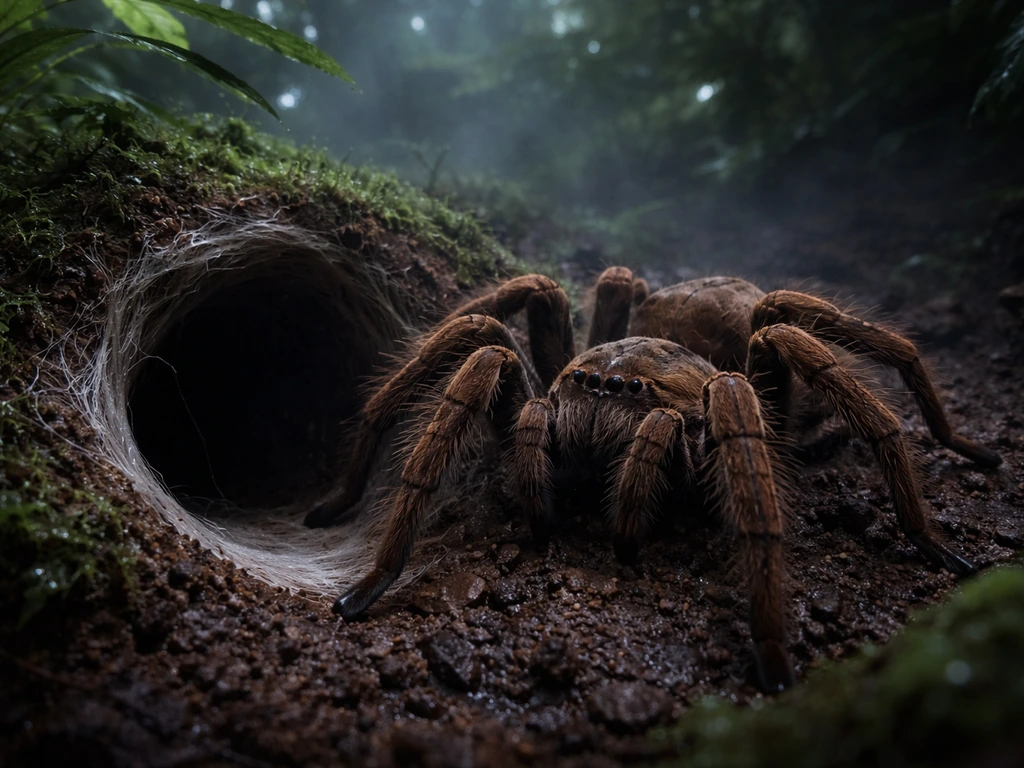
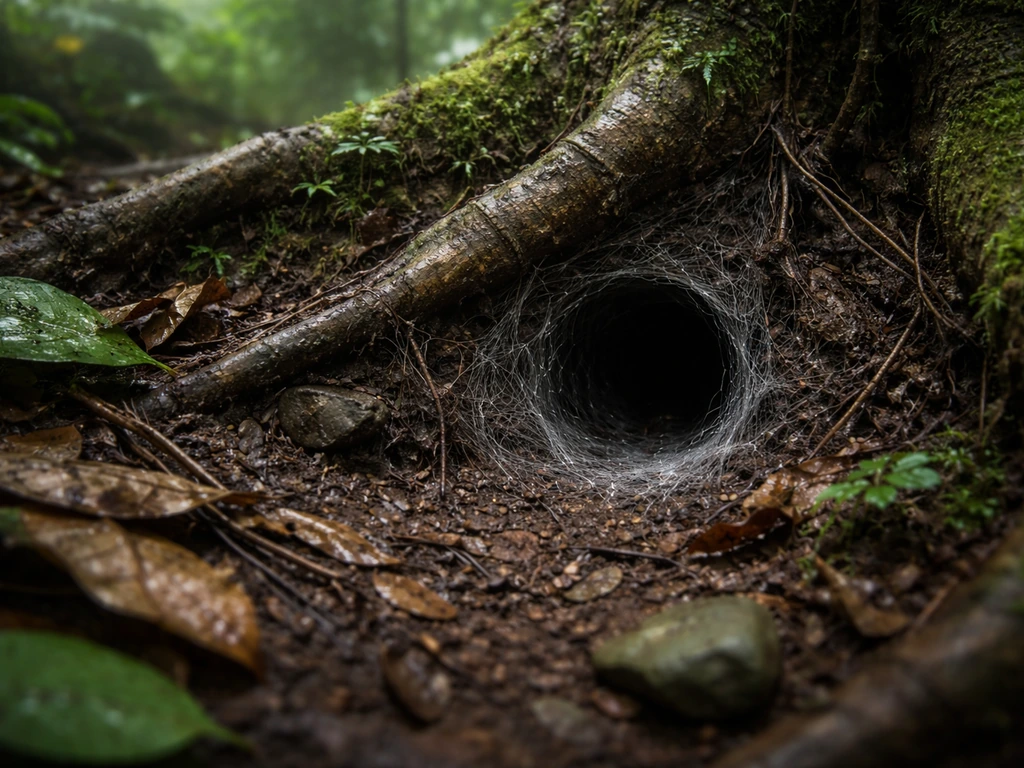
Within its range, this spider is a ground-dweller that lives in silk-lined burrows under roots, rocks, and dense forest-floor cover. It does not spin webs to catch prey. Instead it digs in or takes over existing cavities in damp, shaded soil, lining the entrance with silk as a trip-wire and shelter system. You are looking for moist, heavily vegetated rainforest floor, not open scrub or dry terrain. The burrow entrance is typically concealed beneath root systems or large stones, which is why this spider is rarely spotted despite its massive size.
One close relative worth knowing about is the Brazilian salmon pink bird-eating tarantula. If you are specifically researching South American rainforest species, reading about where Brazilian salmon pink bird-eating tarantulas live can help you distinguish overlapping species and avoid misidentification in the field.
Country and region clues: narrowing it down on a map

If you are traveling in South America and want a realistic sense of where encounters are possible, here is a practical geographic breakdown. The species is most commonly reported from lowland and mid-elevation rainforest in the Guiana Shield countries (Guyana, Suriname, French Guiana) and from Venezuela's southern rainforest states like Bolívar and Amazonas. In Brazil, sightings concentrate in the northern Amazonian states. Eastern Colombia represents the western edge of its range.
| Country/Territory | Likelihood of Encounter | Key Habitat Zone |
|---|---|---|
| Venezuela (southern states) | Moderate | Upland Amazon rainforest |
| Northern Brazil (Amazonian states) | Moderate | Lowland and upland rainforest floor |
| Guyana | Moderate to High | Interior rainforest, Guiana Shield |
| Suriname | Moderate to High | Interior rainforest, Guiana Shield |
| French Guiana | Moderate to High | Interior rainforest, Guiana Shield |
| Eastern Colombia | Lower (range edge) | Amazon basin fringe rainforest |
| Anywhere outside South America | None in the wild | Not applicable |
For backyard birders in North America, Europe, or Australia: this spider has no established wild population outside its native South American range. If you are seeing a very large ground spider near your feeder, it is almost certainly a native wolf spider, fishing spider, or similar species. A good habit is to check whether the spider has a burrow nearby and whether the leg span is genuinely plate-sized before jumping to any Theraphosa conclusion.
How big is a goliath bird-eating spider? Quick ID basics
Size is the most useful field ID cue for this species, and the numbers are genuinely striking. Leg span on large specimens reaches about 28 cm (11 inches), with record-breaking individuals documented at close to 30 cm (11.8 inches) by Guinness World Records. Body weight can hit up to 6 ounces (around 170 grams), making Theraphosa blondi the most massive spider on Earth by weight. To put that in terms you can picture: a large specimen is roughly the size of a dinner plate and heavier than a small apple.
For a more complete breakdown of measurements and how the goliath compares to other large tarantulas, the deep dive on how big a goliath bird-eating tarantula actually gets is worth reading before you try to make a field call. Coloration is dark brown to reddish-brown, with a dense covering of urticating hairs on the abdomen. Juveniles are lighter and sometimes confused with Theraphosa stirmi, a closely related species that shares similar size and coloration and is one of the most common misidentifications in the hobby and in field accounts.
What goliath bird-eating spiders actually eat
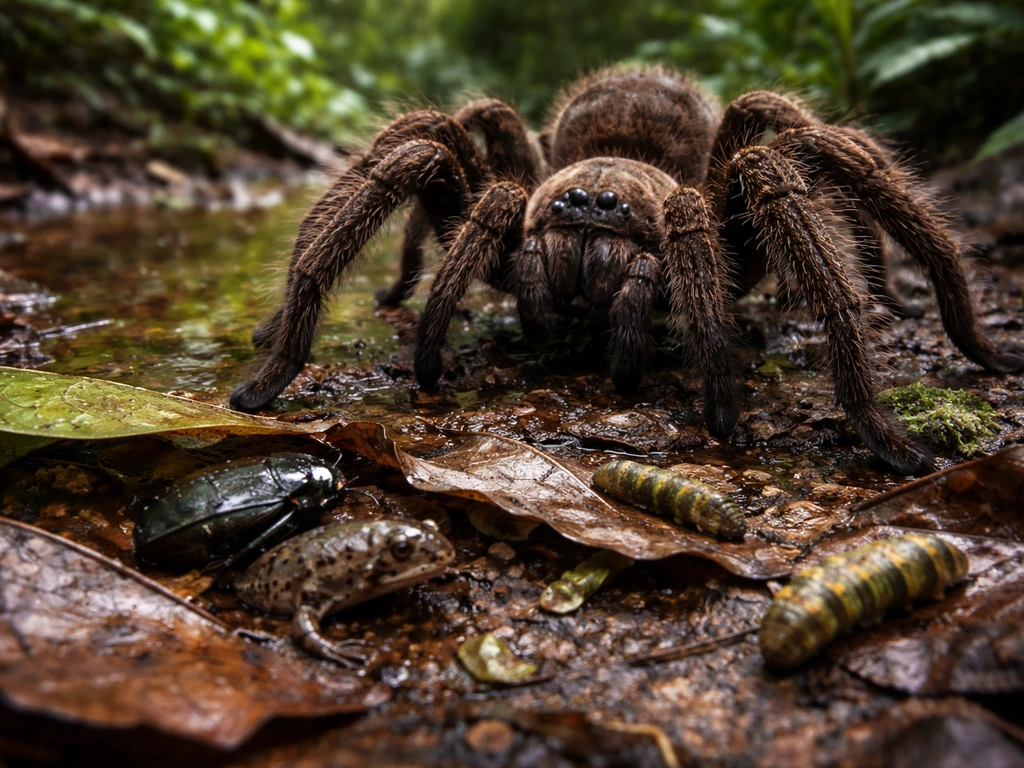
Despite the name, birds are not a regular part of this spider's diet, and that name is something of a historical accident. It traces back to an 18th-century engraving by naturalist Maria Sibylla Merian depicting a different tarantula eating a hummingbird. The name stuck, but it overstates the bird-eating reality considerably. The Smithsonian's own audio description tour explicitly states that birds are not part of the goliath birdeater's regular diet.
The real diet is opportunistic and tied to what is available on the rainforest floor at night, since this spider is nocturnal and hunts by emerging from its burrow after dark. The bulk of the diet is invertebrates: earthworms, beetles, and other large insects make up most meals. It will also take small vertebrates when the opportunity arises, including small rodents, frogs, lizards, bats, and snakes. Bird eggs or nestlings are technically possible but genuinely rare. In captivity at the Smithsonian National Zoo, they are fed cockroaches, which underlines just how unglamorous the everyday diet really is.
If you want a clear breakdown of the bird question specifically, there is a thorough look at whether goliath bird eaters actually eat birds that separates the myth from the documented feeding behavior. The short version: it can, but it usually does not.
What this means for your bird feeder or yard
If you are a backyard birder in the goliath's actual range in South America, the practical takeaway is this: the spider is not hunting birds at your feeder in any meaningful pattern. Its feeding style (nocturnal ambush from a ground burrow) does not put it in competition with or as a significant threat to adult birds visiting a feeder. Nestlings and eggs at ground level are a more realistic scenario, which is the same risk you manage with any large ground-hunting predator. Keep nest boxes elevated and away from dense ground cover where burrows could be present.
What eats goliath bird-eating spiders
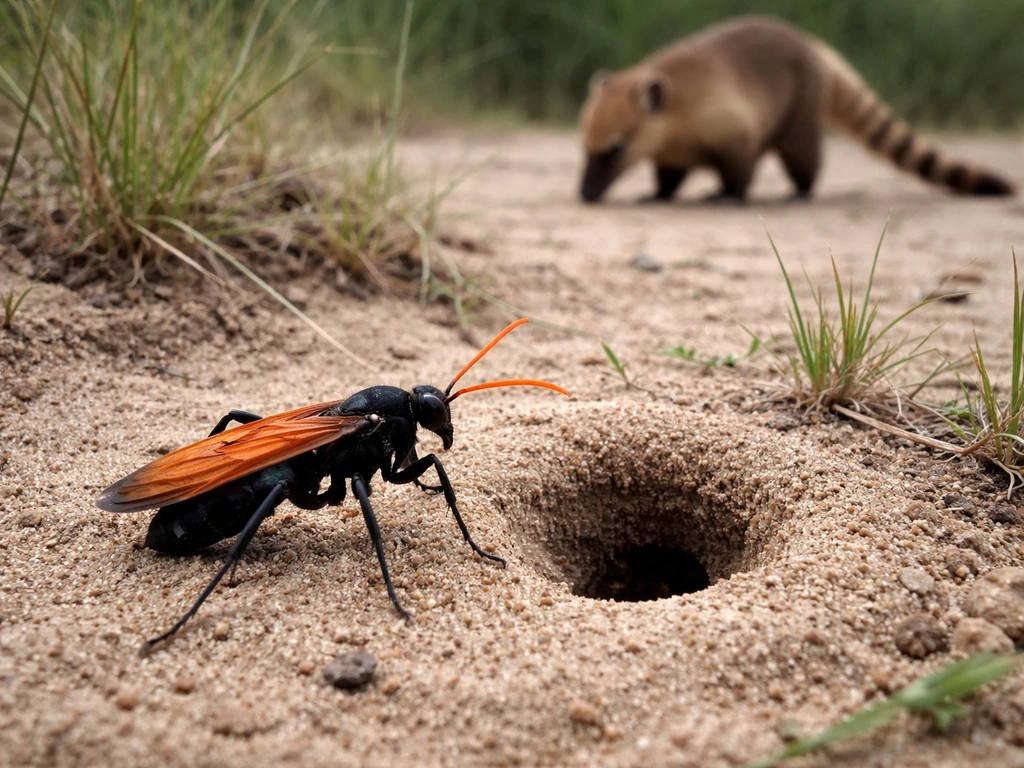
The goliath birdeater is not at the top of its food web. The most specialized and documented predator is the tarantula hawk wasp, a large parasitoid wasp from the family Pompilidae. Pepsis heros, a species with a verified host association with Theraphosa blondi specifically, is one of the most dramatic examples. The female wasp locates the tarantula, paralyzes it with a sting, drags it to a burrow, and lays a single egg on the spider's abdomen. The larva then feeds on the still-living spider from the outside in. The spider remains alive throughout most of this process, which is one of the more unsettling predator-prey dynamics in the invertebrate world.
Beyond tarantula hawks, large coati, peccaries, and some bird species (including ground-foraging birds in its range) will opportunistically take a goliath birdeater if they find one exposed. Humans are also a significant threat in some areas where the spider is collected for the pet trade or eaten as a local food source.
For a different angle on the size-versus-predator question, the piece on goliath bird-eating spider versus mouse gives useful context on how this spider's size stacks up against common prey and potential threats, which is helpful for understanding where it sits in the food web.
Handling risk and practical safety
Whether you are a keeper, a traveler, or someone who has found one in the field: do not handle this spider without serious preparation. The urticating hairs on the abdomen are the primary defense mechanism, and they are effective. When threatened, the spider flicks these barbed hairs toward an attacker. Exposure causes skin irritation, eye inflammation, and respiratory irritation in some people. StatPearls clinical notes confirm that the most common tarantula-related injuries are hair-related, not bite-related, and that treatment is usually supportive.
The bite question comes up constantly. For a direct answer on whether goliath bird eaters bite and what actually happens if they do, that article covers it in detail. The short version: they can and will bite if provoked, and the fangs are large enough to cause a real puncture wound, but venom effects in humans are generally described as mild. The hairs are usually more of a problem than the venom.
On the venom and toxicity question more broadly, it is also worth understanding whether goliath bird-eating spiders are poisonous, since the distinction between venom and urticating hairs matters practically when thinking about risk to pets or children. Standard safety guidance for anyone handling or near one: minimize contact, wash exposed skin immediately, and keep pets away from any enclosure or field encounter.
Quick safety checklist
- Do not handle without thick protective gloves and eye protection
- Wash hands and any exposed skin immediately after any contact with the spider or its enclosure substrate
- Keep pets and small children away from any confirmed or suspected encounter
- If urticating hairs contact eyes, rinse thoroughly with water and seek medical advice
- In the field (within range countries), watch ground-level burrow entrances near forest cover and give them wide clearance at night
- Report captive escapes to local wildlife authorities immediately
Putting it all together: what to do with this information today
If your core question was whether this spider is somewhere near your home: the answer depends entirely on whether you are in northern South America. If you are in the United States, Canada, Europe, or Australia, the answer is no in the wild. If you are in Venezuela, Guyana, Suriname, French Guiana, or northern Brazil, there is a realistic chance of encountering one near forested ground cover, especially at night near damp root systems and rock outcrops. In either case, this spider is not targeting your birds in any meaningful or predictable way, and your feeder setup does not need to account for it specifically.
For identification: if something is smaller than a dinner plate, lives in your North American or European yard, and is not in a burrow in rainforest soil, it is not a goliath birdeater. If you are genuinely within the species' range and find a large ground burrow with silk trip-lines at the entrance in humid forest, treat it with respect and leave it alone. That is honestly the most practical advice there is.
FAQ
How likely am I to see a goliath bird-eating spider near a campsite or lodge in its range?
Encounters are still uncommon because it spends most of its time inside a silk-lined burrow and hunts after dark. The highest odds are usually at night on humid rainforest ground, near roots, rocks, or obvious ground cavities with a concealed entrance. Daytime sightings are rare and are often a result of temporary disturbance around the burrow.
If I find a large ground spider outside South America, could it still be Theraphosa blondi?
In most cases, no. Outside the native range, large ground tarantulas are typically different species (for example, local wolf spiders or other tarantulas) or an escaped pet. A key check is whether there is a rainforest-style burrow with silk near a moist forest-floor microhabitat; dry yards without that habitat make Theraphosa blondi extremely unlikely.
Do goliath bird-eating spiders build webs anywhere near humans?
They generally do not use typical prey-capture webs. Instead, they rely on a ground burrow and silk near the entrance as a trip-wire or shelter barrier. If you see an irregular “web” pattern on the ground or on objects around a home, it is more likely something else than Theraphosa blondi.
What time of day should I look if I’m trying to photograph one in the wild?
Late night is more realistic than morning because it emerges and hunts after dark. Still, the best practice is to observe from a distance and avoid shining lights directly at a burrow entrance, since repeated disturbance can cause it to retreat and can increase the chance of defensive hair flicking if someone approaches too closely.
Are birds at risk if a goliath birdeater is living nearby?
Adult birds at feeders are generally not the main concern because the spider’s hunting strategy is nighttime ground ambush, not feeder stalking. The more plausible risk is to ground-level eggs, nestlings, or birds that spend time near dense cover where burrows can exist, so elevated nest boxes and reduced ground cover close to nesting sites are the practical precautions.
How can I tell the difference between goliath birdeater juveniles and similar Theraphosa species like Theraphosa stirmi?
Color and size overlap a lot in juveniles, so relying on appearance alone can mislead. Look for range and habitat first (deep humid upland rainforest burrow conditions in northern South America). If you are outside known locations, treat the identification as uncertain, since juveniles are one of the most common misidentified stages in collections and field reports.
Is there a safe way to remove or relocate one if it’s in a backyard within the species’ range?
The safest approach is to avoid direct handling and instead contact local wildlife authorities or a licensed wildlife handler. If relocation is attempted, it must be done with the animal left undisturbed and with equipment designed for tarantulas, because the urticating hairs can irritate skin and eyes when the spider feels threatened.
Can pets be harmed by a goliath bird-eating spider without being bitten?
Yes. Even without a bite, urticating hairs can cause skin irritation, eye inflammation, and respiratory irritation in some people and animals. Keeping pets away from any enclosure or any suspected burrow area is important, because a curious pet can trigger defensive hair flicking by approaching the entrance.
Does “bird-eating” mean it will regularly eat birds if it has the chance?
No. Birds are not considered a regular, consistent part of its diet. It tends to take whatever is available on the forest floor at night, with invertebrates making up the bulk, and birds more often represent an opportunistic, uncommon outcome.
How do I recognize its burrow or “home” in humid rainforest conditions?
Look for a concealed ground entrance under roots or large stones, in damp shaded soil, with silk associated with the opening. The silk-lined entrance acts as a barrier or trip-wire, which is why the spider can be present without being visible. If the area is not humid forest-floor habitat, that burrow description becomes less reliable for identification.
What’s the most common injury risk if someone gets too close to one?
The primary risk is usually hair-related irritation rather than venom effects. Defensive flicking can cause skin and eye inflammation, and respiratory irritation can occur in sensitive individuals. If exposure happens, prompt washing and avoiding eye contact are practical first steps before seeking medical or veterinary advice if symptoms persist.