Yes, most birds can eat almonds safely, but the details matter a lot. Plain, unsalted, sweet almonds in the right format for the right species are a nutritious, energy-rich treat. The problems come in specific, avoidable forms: whole nuts given to tiny birds, salted or seasoned products, bitter almonds that carry cyanogenic compounds, moldy nuts, and processed products loaded with additives. Get those variables right and almonds are one of the better nut options you can offer, whether you're filling a backyard feeder or hand-treating a pet parrot.
Can Bird Eat Almonds? Safe Feeding Guide for Birds

Maya Bennett
23 Jul 2026
Quick verdict: can birds eat almonds?
Plain, unsalted sweet almonds are safe and nutritious for most bird species when offered in an appropriate format. They are energy-dense at roughly 575–579 kcal per 100 g, with around 49–50 g of mostly monounsaturated fat, 21 g of protein, 12 g of fiber, and negligible native sodium. That nutritional profile makes them a genuinely useful occasional treat, especially for active or cold-stressed birds. The evidence-based caveats are real but manageable: avoid bitter almonds, skip anything salted or seasoned, always chop or sliver for small species, check for mold before serving, and keep portions small regardless of species. Almonds are not a dietary staple, they are a high-fat supplement in an otherwise balanced diet.
Species-specific guidance at a glance
Different birds interact with almonds in very different ways, so matching the nut format to the species is the most important practical step you can take. Here is how the main groups break down.
Parrots
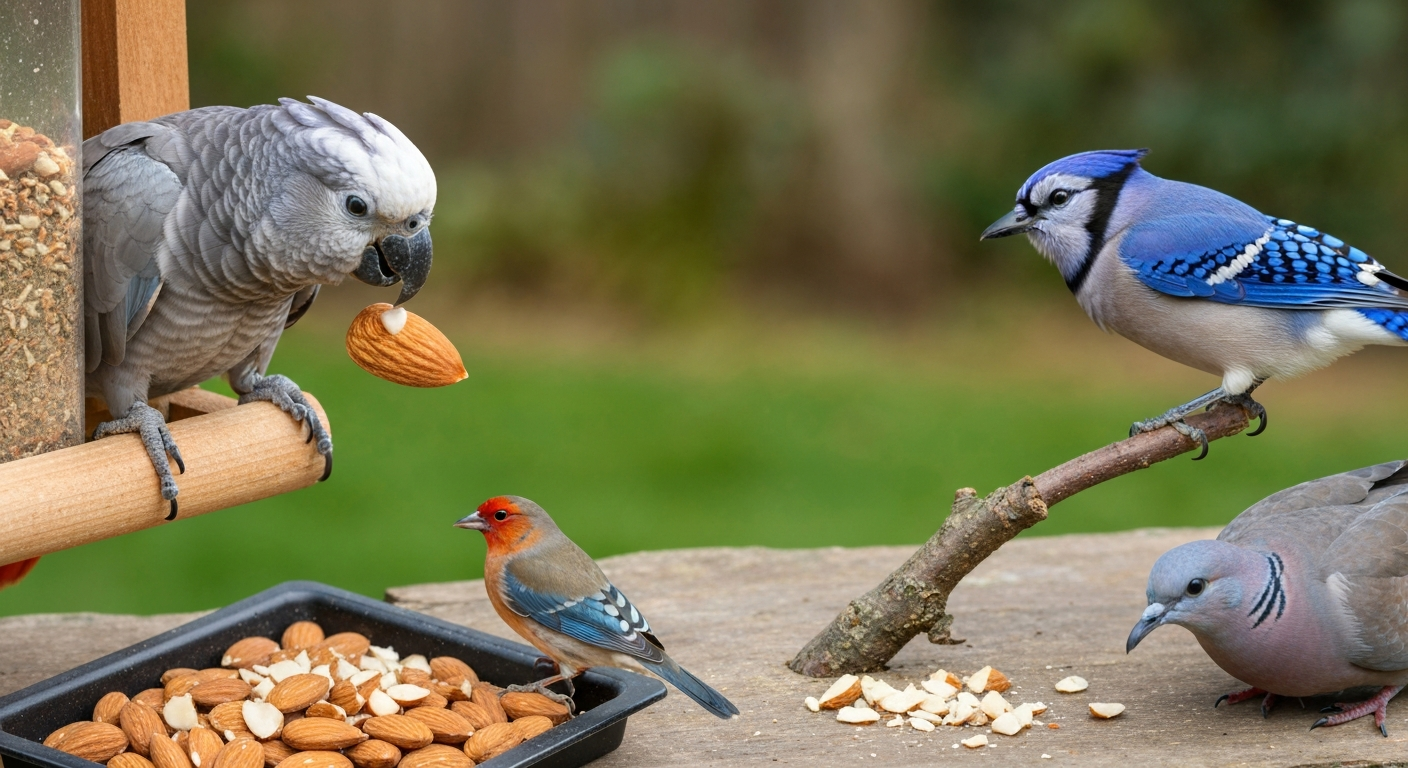
Parrots are the species most commonly given almonds by pet owners, and they handle them well as occasional treats. The Merck Veterinary Manual is clear that formulated pellets should form the diet foundation, with nuts in a treat role. The Merck Veterinary Manual (Management of Pet Birds) recommends formulated/pelleted diets as the foundation for companion parrots and lists nuts, including almonds, as occasional treats rather than dietary staples. A small whole almond works fine for a medium-to-large parrot like an African Grey, cockatoo, or Amazon. For smaller parrots such as conures, cockatiels, and parrotlets, split or slivered almonds are safer and easier to manage. The main risks for pet parrots are over-reliance on nuts at the expense of balanced nutrition and inadvertently offering almond products with added salt or xylitol.
Corvids
Jays, crows, and ravens are natural nut consumers. Almond orchard research documents corvids and other corvid-adjacent species eating and caching whole almonds, and these birds have the bill strength and size to handle whole kernels without issues. If you are feeding corvids at a yard station, whole unsalted almonds are an excellent enrichment food. Blue jays will actively seek them out and often fly off to cache surplus nuts, which is fascinating behavior to watch.
Songbirds
Robins, thrushes, starlings, and similar mid-size backyard passerines can benefit from finely chopped almond pieces mixed into a general feeder blend. Whole almonds are too large for most songbirds to process and carry a choking and impaction risk. Chopped pieces roughly the size of a sunflower seed kernel are a practical benchmark. Keep portions small, the high fat content can skew a small bird's daily energy intake quickly.
Finches
Finches (including house finches, goldfinches, and zebra finches in captivity) have narrow bills optimized for seeds, not large hard nuts. Finely slivered almond pieces or almond meal are the only safe formats for these birds. Whole almonds are genuinely dangerous for finch-sized species. Almond meal mixed into a soft food or scattered sparingly on a tray feeder is how I've had the most success getting finches to actually engage with it.
Doves
Doves are ground-foraging grain eaters. They will pick at small almond fragments on the ground or a low platform feeder, but their gullet size and foraging style mean only very small pieces are appropriate. Finely chopped or meal-format almonds are the right call. Doves are also not strong hullers, so anything larger than a pea-sized fragment is best avoided.
Raptors
Hawks, owls, and falcons are obligate carnivores. They do not naturally seek out nuts or plant foods, and almonds provide no nutritional value in the context of a raptor's diet, which should be whole prey items. If you are working with a captive or rehabilitating raptor, do not offer almonds. Their digestive systems are built around animal protein and fat, not plant fats and fiber. Stick to appropriate prey items under veterinary or rehabilitator guidance. For unrelated topics such as gaming questions, see guides that specifically address whether is bird: falcon fruit good in Blox Fruits.
Portion sizes and feeding frequency by bird size
Because almonds are so calorie-dense, portion control is genuinely important. A backyard bird that fills up on high-fat nuts may skip the more balanced seed and insect foods it needs. The table below gives practical starting points based on body size.
| Bird size/type | Format | Suggested portion | Frequency |
|---|---|---|---|
| Large parrot (cockatoo, Amazon, macaw) | Small whole or halved unsalted almond | 1–2 kernels | 2–3 times per week max |
| Medium parrot (conure, caique, Senegal) | Slivered or quartered | 1–2 slivers | 2–3 times per week |
| Small parrot (cockatiel, parrotlet, budgie) | Fine sliver or tiny piece | 1 small sliver | Occasional treat, 1–2x per week |
| Corvid (jay, crow) | Whole or halved unsalted | 2–4 kernels per visit | Several times per week fine |
| Mid-size songbird (robin, starling) | Finely chopped pieces | Small pinch | 2–3 times per week |
| Small songbird / finch | Almond meal or fine sliver | Tiny pinch only | Once or twice per week |
| Dove | Finely chopped or meal | Small pinch | 2–3 times per week |
| Raptor | Not appropriate | None | Never |
These are guidelines, not rigid rules. The key principle is that almonds should never make up more than roughly 10% of a pet bird's daily food intake, and for wild birds they are a supplement to whatever natural foraging the bird does, not a replacement. On very hot days I reduce or skip nut offerings entirely since birds eat less and high-fat foods sitting in feeders can go rancid quickly.
Safe preparation: raw vs roasted, whole vs chopped, butter, meal, and milk
Raw almonds
Plain, commercially sold raw sweet almonds in North America are actually pasteurized under Almond Board of California regulations using steam or dry heat, which reduces surface microbes and some volatile breakdown products from any trace amygdalin. These are safe to offer as-is to appropriate species. What you want to avoid is raw almonds from unknown sources where sweet versus bitter phenotype is uncertain.
Roasted almonds
Plain, unsalted, dry-roasted almonds are fine. Roasting reduces some heat-sensitive volatiles associated with amygdalin breakdown. The critical word is 'unsalted', commercially roasted almonds are almost always salted, so check the label carefully. Oil-roasted almonds add extra fat, which is unnecessary given how fat-dense almonds already are.
Whole vs slivered vs chopped
This is the most practically important preparation decision. Whole almonds are appropriate only for corvids and large parrots. Halved almonds work for medium parrots and larger songbirds. Slivered and chopped almonds are the format for small parrots, finches, doves, and small passerines. Almond meal (finely ground) is the safest format for the smallest species and can be mixed into soft foods, sprinkled on a tray, or incorporated into bird-safe treat recipes.
Almond butter
Natural almond butter with no additives (just ground almonds) is technically safe in tiny amounts, but it is genuinely hard to find. Most commercial almond butters contain added salt, sugar, and sometimes xylitol in 'reduced sugar' products. Xylitol is acutely fatal in birds: a published case report documented 29 Cape sugarbird deaths after ingestion of a xylitol-containing nectar solution. Always read the full ingredients list before considering almond butter. Honestly, given the label-reading effort involved, I find it easier to just use chopped almonds instead.
Almond meal
Plain almond meal (no added salt, sweeteners, or preservatives) is a genuinely useful format for small birds. A light dusting over soft food or a tray feeder gives tiny species access to almond's nutritional benefits without the choking risk of larger pieces. Confirm the product is simply ground almonds before using it.
Almond milk
Do not offer almond milk to birds. It is nutritionally dilute (very low protein, very low fat compared to whole almonds), and commercial versions almost always contain stabilizers, sweeteners, and sometimes xylitol. It adds nothing a bird needs and introduces real risk. Fresh water is always the right choice for drinking.
How to present almonds at the feeder: format and placement tips
How you place almonds matters almost as much as what form you offer. Whole almonds can go in a mesh nut feeder or hopper feeder for corvids and large birds. These feeders let birds work the nut at their own pace and reduce waste on the ground where mold risk increases. For chopped pieces, a flat platform or tray feeder with good drainage works well and lets smaller birds forage naturally. For almond meal mixed into soft food, a shallow dish on a raised platform works better than a tube feeder.
- Use a mesh nut feeder for whole or halved almonds to keep them off the damp ground.
- Offer chopped pieces on a platform tray feeder with drainage holes to prevent moisture buildup.
- Mix almond meal sparingly into egg food, cooked grain, or mashed fruit for small songbirds and finches.
- Place feeder at a height appropriate for target species: corvids and jays prefer elevated positions; doves prefer ground-level or low trays.
- Offer only what birds can consume in one session, especially in warm or wet weather, to prevent spoilage.
- Keep almond pieces separate from seed mixes if you want to monitor how much is being eaten.
- Clean tray and platform feeders after each almond serving to prevent rancid fat and mold accumulation.
One visual tip worth knowing: if you offer whole almonds at a corvid feeder, watch for blue jays selecting specific nut sizes and flying off to cache them. They are remarkably good at gauging nut density by weight. They will often test several before choosing the one they want. This is completely normal behavior and not a sign they are rejecting your offering.
Choking and physical hazards for small birds
This is the hazard I see people underestimate most often. A whole almond kernel is roughly 2–3 cm long and 1–1.5 cm wide. For a bird weighing 10–30 grams, that is an enormous object. The physical risks are choking during attempted swallowing, impaction in the crop or proventriculus, and trauma from a bird trying to hammer a nut it cannot control. Avian vet guidance consistently recommends no larger than a small sliver for small birds, and I'd reinforce that: if you would not confidently swallow the piece yourself without chewing, it is too big for a finch or small songbird.
- Cut or purchase slivered almonds and then chop them again to pea-size or smaller for small songbirds.
- For finches and small doves, use almond meal or crush slivers to a coarse powder.
- Never offer whole almonds in a mixed feeder where small and large birds feed together — smaller birds may attempt to take pieces sized for corvids.
- Watch new birds engaging with almonds for the first time to confirm they are managing the piece size comfortably.
- If a bird appears to be struggling, gagging, or repeatedly shaking its head after picking up a nut piece, remove the offering and go to a finer format.
Why salted, seasoned, and flavored almonds are dangerous
Salt poisoning is a well-documented and serious risk in birds. Poultry research and Merck Veterinary Manual data indicate that dietary sodium chloride above around 2% of feed weight causes neurological signs, edema, respiratory distress, and death in chickens and turkeys. A single salted almond kernel carries far more sodium than a small bird needs in a day. Common commercial almonds are salted at levels that can run 150–200 mg sodium per 28 g serving, and since a small songbird might eat a significant fraction of its body weight in food daily, it takes very little salted nut to reach a dangerous intake.
Seasoned almonds add further problems. Onion and garlic powders, common in savory nut blends, contain compounds (organosulfides) that damage red blood cells in birds. Chili and paprika coatings are irritants. Smoked almonds may contain compounds from smoking processes. Honey-roasted almonds combine excess sugar with the salt problem. The rule here is simple and absolute: only plain, unsalted almonds for birds, always. Check every label.
Bitter almonds and cyanogenic compounds: what you need to know
This is the hazard most people have not heard of, and it is worth taking seriously. Bitter almonds (a phenotype of Prunus dulcis) contain amygdalin at concentrations of roughly 2–5% by weight. Amygdalin is a cyanogenic glycoside that hydrolyzes to hydrogen cyanide (HCN) when chewed or processed. Sweet almonds, the commercially sold variety in North America and Europe, contain only trace amygdalin, but bitter almonds from uncontrolled sources are genuinely dangerous. Historical avian toxicology records document sudden songbird mortalities following green or bitter almond ingestion, with clinical signs of acute cyanide poisoning: rapid ataxia, collapse, and death within minutes.
The practical precautions are straightforward. Always buy almonds from standard commercial food suppliers, not from unknown trees or imported sources where sweet vs bitter phenotype is unverified. Do not forage almonds from ornamental Prunus trees or garden almond trees unless you have confirmed they are a sweet cultivar. Thermal processing (roasting, blanching, commercial steam pasteurization) reduces volatile breakdown products from amygdalin but does not fully eliminate cyanogenic precursors if bitter phenotype material is present, so sourcing is still your first defense. The same logic applies to other Prunus species: cherry, peach, apricot, and plum pits all contain amygdalin and should never be offered to birds. If you have seen guidance on whether birds can safely eat avocado, you already know that some foods require a hard no, this is similar territory when the wrong almond type is involved.
How to tell sweet from bitter almonds
- Sweet almonds from commercial retail sources (supermarkets, bulk stores, reputable online food suppliers) in North America are legally required to be pasteurized and are sweet phenotype — these are safe.
- Bitter almonds have a distinctly sharp, marzipan-like or intensely bitter smell and taste — this bitterness is caused by benzaldehyde released from amygdalin breakdown.
- Any almond with a very strong almond-extract or marzipan smell before cooking should be treated with suspicion and not offered to birds.
- Almonds from ornamental Prunus trees, home-grown trees of unknown cultivar, or loosely sourced international markets should not be used as bird food.
- When in doubt, discard and buy a sealed commercial bag instead.
Mold, aflatoxin, and storage: the hidden risk in nuts
Almonds and other tree nuts are a recognized mycotoxin risk. Aspergillus molds can produce aflatoxins on poorly stored or damp nuts, and birds, especially poultry and small avian species, are highly susceptible to aflatoxicosis. EFSA Scientific Opinion / Risk assessment of aflatoxins in food notes that almonds and other tree‑nuts can be contaminated by Aspergillus-produced aflatoxins and provides guidance on limits and sampling. EFSA and Codex Alimentarius regulatory frameworks set maximum limits for aflatoxins in ready-to-eat tree nuts precisely because this risk is real and well-documented. In birds, aflatoxin exposure causes liver damage, immunosuppression, poor condition, anorexia, and in severe cases mortality. Unlike cyanide toxicity, which is sudden, aflatoxicosis tends to develop subacutely over days to weeks, making it harder to connect to the food source.
The practical defense is good storage and a zero-tolerance rule for any nut that looks or smells off. Store almonds in an airtight container in a cool, dry location, a sealed jar in a cupboard away from heat and humidity, or the refrigerator or freezer for longer-term storage. Discard any nut that is discolored (yellowed, darkened, or shows white, green, or black surface patches), smells musty or sour, or feels soft or moist. Do not pick off a moldy nut and assume the rest of the batch is fine; mold contamination in a stored batch can spread further than visible growth suggests. Never put damp or half-eaten almonds back into the storage container.
Safe almond feeding vs other common bird foods
It helps to put almonds in context with other foods you might be considering. Raisins are a popular treat for robins, thrushes, and some parrots, and in small amounts for appropriate species they are fine, though the sugar load calls for similar portion restraint. Cucumber is safe and hydrating for most species, though nutritionally minimal. Avocado is in a completely different risk category: the compound persin in avocado flesh and skin is toxic to birds and should never be offered. Almonds, when prepared correctly and sourced from sweet commercial stock, sit comfortably in the safe-treat category alongside raisins and well away from avocado.
How to spot food-related illness and when to act
Recognizing the difference between acute toxicosis and slower, diet-related illness can help you respond appropriately. The timeline and signs differ depending on the cause.
| Cause | Onset | Key signs to watch for | Action |
|---|---|---|---|
| Cyanide (bitter almond) | Minutes | Sudden ataxia, collapse, seizures, rapid death | Emergency vet immediately; remove food source |
| Xylitol (in nut butter/products) | Minutes to 1 hour | Acute hypoglycemia, ataxia, collapse | Emergency vet immediately; check all product labels |
| Salt poisoning | Hours | Neurological signs, excessive thirst, edema, respiratory distress | Vet same day; remove all salted food |
| Aflatoxin/mycotoxin | Days to weeks (subacute) | Anorexia, poor condition, weight loss, lethargy, liver signs | Vet consult; discard all potentially moldy food |
| Choking/impaction | Immediate | Gagging, head shaking, respiratory distress, regurgitation | Emergency vet; switch to finer food format |
For pet birds, any sudden change in behavior, posture, droppings, or feeding should prompt a call to an avian vet rather than a wait-and-see approach. Birds mask illness instinctively, so by the time signs are obvious the situation is often urgent. For wild birds at a feeder, an unusual number of sick or dead birds appearing in a short period is a signal to stop feeding immediately, clean all feeders, and report to your local wildlife authority or nature trust.
Quick safe-feeding checklist
- Buy plain, unsalted, commercially sold sweet almonds only — no salted, honey-roasted, smoked, or seasoned varieties.
- Check for mold before every serving: discard any nut that is discolored, soft, musty-smelling, or damp.
- Match format to species: whole for corvids and large parrots, slivered or chopped for medium birds, meal or fine pieces for small songbirds and finches.
- Never offer almond milk — it provides no bird-appropriate nutrition and may contain harmful additives.
- If using almond butter, read every ingredient: reject any product containing salt, added sugar, or xylitol.
- Avoid any almond from an unverified tree or non-commercial source — sweet vs bitter phenotype matters.
- Do not offer Prunus pits (cherry, apricot, peach) alongside almonds or ever — same cyanogenic risk category.
- Store almonds in an airtight container, cool and dry; discard within a reasonable shelf life and never return uneaten feeder portions to your storage supply.
- Keep almond treats to no more than 10% of a pet bird's daily food intake and offer sparingly at wild feeders.
- Contact an avian vet immediately if a pet bird shows sudden neurological signs, collapse, or stops eating after any new food introduction.
FAQ
Can birds eat almonds — concise verdict?
Yes — many bird species can safely eat plain, unsalted sweet almonds as an occasional treat, but they are high in fat/calories and must be prepared and portioned correctly. Bitter almonds, pits/seeds from other Prunus fruits, salted/seasoned nuts, moldy nuts, and nut products with harmful additives should be avoided.
Are almonds safe for pet parrots?
Generally yes as an occasional treat or enrichment for larger parrots (macaws, amazons, cockatoos). Offer whole unsalted sweet almonds or larger pieces, but keep nuts as a small part of the diet and not a staple; pellets and fresh produce should be the foundation. Avoid almond butters or spreads with added salt, sugar, oil or xylitol.
Can corvids (crows, jays) and other large wild birds eat almonds?
Yes. Corvids and many backyard nut‑feeding species readily eat and cache whole almonds. Offer plain, unsalted almonds; these birds can handle whole kernels and benefit from the high energy, especially in cooler seasons.
Are almonds safe for songbirds, finches and other small passerines?
Caution is required. Whole almonds are often too large and present a choking and excess‑calorie risk for small birds. Offer slivered, finely chopped or ground almond meal in small amounts mixed with seed/bird‑food rather than whole kernels.
Can doves and pigeons eat almonds?
Doves and pigeons (medium size) can eat small pieces or slivered unsalted almonds. Avoid whole large kernels for smaller dove species; keep portions modest because of the high fat content.
Are almonds safe for raptors?
No — almonds are not an appropriate food for raptors. Raptors are carnivores that require animal protein; nuts do not meet their nutritional needs and can displace essential protein and calcium.
Next Articles
Is Falcon Fruit Good in Blox Fruits? PvP and PvE Guide
Falcon Fruit in Blox Fruits: verdict for PvP and PvE, best build tips, and when to skip it.
What Bird of Prey Eats Pigeons: Common Raptors & ID Tips
Which raptors eat pigeons: peregrine, Cooper’s, goshawk, merlin, red-tailed, kestrels, owls; ID tips, risks and how to保护

Which Bird Eats Mice? How to Identify Mouse Predators
Identify which birds eat mice using hunting cues, time of day, calls, and perch habits, plus safe yard steps.