The birds of prey most likely to eat pigeons are the peregrine falcon, Cooper's hawk, northern goshawk, merlin, red-tailed hawk, and great horned owl. See our guide on what bird eats pigeons for a quick species checklist and identification tips. Of these, the peregrine falcon is the specialist: urban diet studies from cities like Warsaw and Maribor consistently list the rock pigeon (Columba livia) as its single most common prey item by number and biomass. Cooper's hawks are the species most backyard birders and pigeon keepers are likely to encounter, because they actively hunt around feeders in suburban neighborhoods. The others each fill a specific niche depending on habitat, season, and prey size.
What Bird of Prey Eats Pigeons: Common Raptors & ID Tips

Maya Bennett
15 Jul 2026
Why raptors target pigeons in the first place
Pigeons are an almost ideal prey package for a medium-to-large raptor. An adult feral pigeon weighs roughly 250 to 400 grams, which puts it squarely in the profitable prey range for peregrines, Cooper's hawks, and goshawks: large enough to provide a substantial meal, small enough to be carried or consumed on site. They are also extraordinarily abundant in cities, which means raptors living in urban environments do not have to range far to find food. Add in predictable behavior (pigeons flock, they roost in exposed positions, and they make regular commutes between roost and feeding sites) and you have prey that is both energetically rewarding and relatively easy to locate. Research comparing urban and rural raptor diets consistently shows that where pigeon densities are high, raptors shift their diet toward them, even if those same raptors rarely touch pigeons in rural settings.
Species profiles: which raptors eat pigeons and how often
Peregrine falcon (Falco peregrinus)
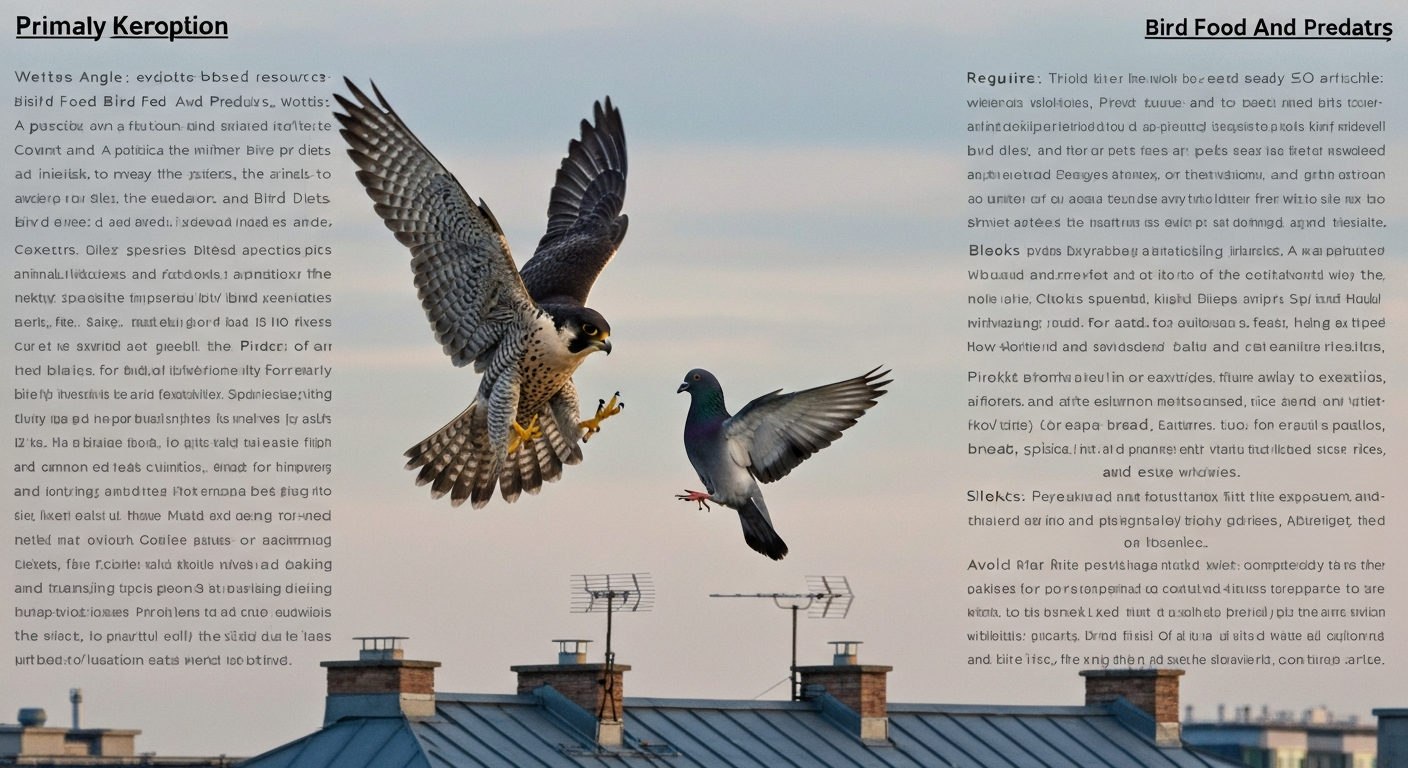
The peregrine is the definitive pigeon predator. Multiple peer-reviewed urban diet studies put rock pigeon at the top of its prey list, often accounting for 40 to 70 percent of prey items by biomass in city populations. Peregrines hunt in open airspace and use a signature high-speed stoop, folding their wings and diving from altitude at speeds that physics-based modelling confirms can exceed 150 mph (240 km/h). That stoop is specifically effective against fast, open-air birds like pigeons, because the sheer closing speed denies the prey time to evade. In most major cities with peregrine populations, the local pigeon flock is the main reason the falcons are thriving.
Cooper's hawk (Accipiter cooperii)
Cooper's hawks are mid-sized accipiters and the raptor most likely to cause problems at a backyard feeder or a domestic pigeon loft. Studies of urban Cooper's hawk nests in the American Southwest found that urban pairs delivered significantly more avian prey biomass to chicks than rural pairs, largely because urban food sources (feeders, pigeons, doves) are so concentrated and reliable. A crow-sized Cooper's hawk can take birds up to pigeon size with relative ease using a perch-and-ambush or short, explosive chase through vegetation. Cornell Lab's All About Birds notes medium-sized birds including pigeons and doves as regular prey items.
Northern goshawk (Accipiter gentilis)
The goshawk is the largest accipiter in the Northern Hemisphere and is capable of taking very large avian prey. Traditionally a forest specialist, goshawks have been documented persisting and even thriving in urban and peri-urban areas where abundant pigeon populations compensate for lost forest prey. A 2021 study published via PMC found that access to urban pigeon populations was a key factor allowing goshawks to successfully exploit urban environments. Goshawks are significantly less common than Cooper's hawks at suburban feeders, but in areas where both species occur, the goshawk is the more formidable and direct threat to larger racing or domestic pigeons.
Merlin (Falco columbarius)
Merlins are small, fast falcons that primarily hunt small birds such as sparrows, finches, and starlings. Taking a full-grown pigeon is at the extreme upper end of what a merlin can manage and it is not a regular occurrence. There are field records of merlins pursuing and occasionally capturing larger birds during migration or when small-bird prey is scarce, but if you see a pigeon being consistently hunted at your location, a merlin is not the most likely culprit. Think of merlins as a real but minor threat to smaller feeder birds, not to pigeons specifically.
Red-tailed hawk (Buteo jamaicensis)
Red-tailed hawks are generalist predators best known for taking small mammals, but a 2023 spatial diet study published in the Journal of Urban Ecology found that rock pigeon featured as a common avian prey item in urban red-tailed hawk territories, particularly near city cores where mammal prey was less available. Red-tails hunt differently from accipiters: they soar or perch at height and drop onto prey rather than chasing it through cover. A pigeon caught in the open on a rooftop or plaza is exactly the kind of target a red-tail will exploit.
American kestrel (Falco sparverius)
Kestrels deserve an honest mention here because they look like small falcons and people often assume they hunt pigeons. They do not, with any regularity. Kestrels weigh only 80 to 165 grams and primarily take large insects, small mammals, and small birds. A full-grown pigeon outweighs a kestrel by a factor of two to four, which makes it essentially off the menu. If you have kestrels near your pigeon loft, you can relax: they are not a meaningful threat to adult birds.
Great horned owl (Bubo virginianus) and barn owl (Tyto alba)
Great horned owls have genuinely broad diets. Pellet analyses document diverse avian prey including medium to large birds, and a great horned owl (weighing up to 1.4 kg with a wingspan around 140 cm) is well capable of taking a roosting pigeon at night. USGS pellet studies confirm varied avian prey, and any pigeon keeper housing birds outdoors is right to take great horned owls seriously as a nocturnal threat. Barn owls are a different story: their pellet analyses consistently show small mammal prey dominating at 80 to 95 percent, with bird prey uncommon except in unusual local conditions. Pellet studies such as Prey Composition of Barn Owl Pellets Collected in Oklahoma (Proceedings of the Oklahoma Academy of Science) report small mammals make up the vast majority of barn owl diets, with birds rarely represented. Barn owls are not a meaningful threat to pigeons.
How and where attacks happen: urban vs rural, stoop vs ambush
The hunting method matters a great deal for understanding where attacks occur and how to protect against them. Peregrines hunt in open airspace above rooftops, bridges, and cliff faces, the urban equivalents of their natural cliff-nesting habitat. They gain altitude first, sometimes circling out of sight, then fold into a stoop. Because they need clear airspace, attacks on pigeons happen most often during flight: a pigeon leaving the loft, crossing open ground between buildings, or making its morning commute to a feeding site is the primary target.
Accipiters (Cooper's hawk and goshawk) work differently. They are built for sudden short chases through complex environments. They will sit motionless in a tree or on a fence post near a feeder or loft, wait for the right moment, then launch an explosive low-level sprint, using buildings, hedges, and trees as cover right up to the point of strike. Telemetry and field video confirm this perch-and-ambush strategy, and it is exactly why feeders surrounded by dense shrubbery can inadvertently give these hawks the concealment they need.
Red-tailed hawks typically hunt from high perches (telephone poles, tall trees, rooftop edges) and drop onto prey on open ground. Their attacks on pigeons tend to happen on roof surfaces, plazas, or parks where the birds are feeding on the ground, and they are more common in urban-edge or suburban environments than in dense city cores. Great horned owls hunt entirely at night, typically landing on prey at a roost site, which is why an outdoor loft with an unsecured roof is the main vulnerability.
Signs of raptor predation: what to look for at the scene
One of the most useful skills for a backyard birder or pigeon keeper is being able to read a kill site. Raptor predation leaves a distinctive signature that differs from mammal predation or cat kills. Field monitoring guides and raptor researchers consistently describe the following diagnostic signs:
- A circular or roughly symmetrical scatter of plucked feathers, often 30 to 60 cm across. Raptors pluck prey before or during eating; mammals tend to scatter feathers more chaotically.
- Feathers with clean quill ends, not bitten through. Raptor beaks pull feathers cleanly; mammal teeth usually leave crushed or frayed quill bases.
- A 'plucking post': a flat surface (wall, fence post, rooftop ledge, tree stump) with a dense feather accumulation where the raptor has returned repeatedly to process kills.
- Decapitation, especially in accipiter kills. Cooper's hawks and goshawks commonly remove the head first.
- Minimal carcass remains (bones, crop, sometimes feet) left in a neat pile if the bird was consumed on site.
- Sudden flock behavior changes: if your feeder pigeons or garden birds suddenly scatter with alarm calls and don't return for 30 to 60 minutes, a raptor pass is the most likely explanation.
Cat kills look different: expect torn feathers, crushed quill ends, saliva-matted plumage, and the remains often partially buried or concealed. Fox kills typically show more signs of dragging and scattered bones over a wider area. If you see a neat pluck pile with clean-ended feathers, think raptor first.
Visual ID guide: identifying the raptor at your feeder or loft
Most encounters with raptors are brief and stressful (for the observer as much as the prey), so having a few solid field marks locked in ahead of time makes identification much more reliable. The table below covers the main pigeon predators you are likely to encounter.
| Species | Size vs pigeon | Key field marks | Flight silhouette | Typical posture |
|---|---|---|---|---|
| Peregrine falcon | Similar or slightly smaller | Dark 'moustache' stripe, slate-blue back, barred white-cream breast, yellow cere and feet | Anchor-shaped: long pointed wings, medium tail | Upright on ledge or antenna; stoops with wings fully tucked |
| Cooper's hawk | Similar (female larger) | Rounded tail with pale tip, blue-grey back, rusty barring on breast, red eye (adult) | Short rounded wings, long rounded tail; flap-flap-glide | Low crouch on branch, head forward, looks 'neckless' in flight |
| Northern goshawk | Larger (female much larger) | Pale eyebrow stripe, grey barring below, fierce red-orange eye, large body | Broad rounded wings, long tail; powerful wingbeats | Heavy, direct flight; perches in dense canopy |
| Merlin | Smaller | Small, compact, streaked brown (female) or blue-grey (male), dark tail bands, no moustache | Small pointed wings, medium tail; fast flicking wingbeats | Very upright on wire or post; bobs tail |
| Red-tailed hawk | Much larger | Classic brick-red tail (adult), creamy belly with dark belly band, broad wings | Very broad wings, short fanned tail; soars in wide circles | High perch: telephone pole, tree top; shoulders hunched |
| Great horned owl | Larger | Large ear tufts, yellow eyes, barred brown plumage, white throat patch | Broad rounded wings; silent, direct flight at night | Barrel-shaped body pressed to branch; nocturnal |
For flight silhouettes, the classic distinction is: falcons have pointed wings (like a swept anchor), accipiters have short rounded wings and long tails (like a flying cross with a long handle), and buteos like the red-tailed hawk have broad, wide wings and a short fanned tail (like a broad paddle). Cornell Lab's All About Birds species pages and the Sibley Guide to Birds of North America are the best quick references for confirming field marks, and both are available free digitally.
Photo callouts: what to photograph and why
If you can safely photograph the predator or the kill site, those images help enormously for later identification and, if needed, reporting. Here is what to focus on:
- Peregrine falcon: photograph the face pattern (the dark moustache stripe is diagnostic), the tail from below during flight (narrow dark bands), and the stoop posture with wings tucked. Suggested illustration: peregrine in full stoop over urban skyline, and a close-up of the facial stripe.
- Cooper's hawk: the rounded tail tip with a pale terminal band is the single most useful mark to capture. Also photograph the eye color (red in adults, yellow in juveniles) and the rounded-wing shape in flight. Suggested illustration: Cooper's hawk at a feeder perch, tail visible, and in-flight silhouette from below.
- Northern goshawk: the white eyebrow stripe and large body size relative to nearby objects are key. Photograph next to a known-size reference if possible. Suggested illustration: adult goshawk perched in open tree, and comparison silhouette against Cooper's hawk.
- Kill site and plucking post: photograph the feather scatter from directly above to show the circular pattern, close-up of quill ends to show clean pulls, and any plucking post surface. These images are valuable for wildlife rehabilitation centers and reporting.
- Red-tailed hawk: photograph the tail from above or behind (the red color is diagnostic for adults), and the belly band from below during a soar. Suggested illustration: red-tail soaring with fanned tail visible.
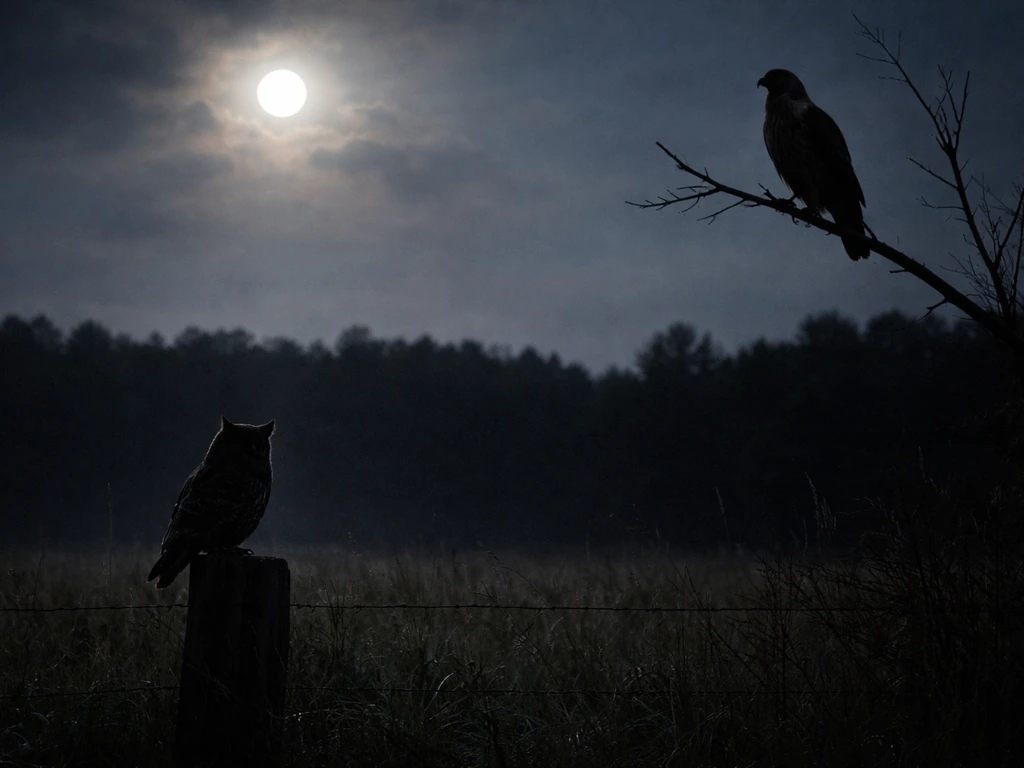
- Great horned owl: photograph ear tufts, eye color (yellow), and body profile. If found at night near a kill site, photograph the scene first before approaching. Suggested illustration: great horned owl on a fence post at dusk near a suburban loft.
Research-grade photos from iNaturalist and the Macaulay Library at Cornell are excellent free references for comparison. For licensed editorial images, Getty Images and Alamy both carry strong raptor portfolios. When photographing live raptors, keep your distance: approaching within 30 meters of a perched bird of prey is enough to flush it and waste the opportunity.
Risks to backyard birds, domestic pigeons, and pets
Bird feeders are predator magnets, and not in a purely dramatic, once-a-year sense. A well-stocked feeder concentrates small birds in a predictable location at predictable times, and Cooper's hawks and sharp-shinned hawks learn this very quickly. Research and urban ecology studies confirm that urban raptor foraging behavior shifts when feeders are present: hawks learn feeder locations and return repeatedly. This is not a reason to stop feeding birds, but it is a reason to set up feeders thoughtfully.
For domestic or racing pigeon keepers, the threat profile is somewhat different. A loft in an area with established peregrine territories faces consistent aerial pressure, especially during the release phase of loft training. Great horned owls are the main nocturnal risk to loft birds roosting near open wire. Cooper's hawks and goshawks may target birds entering or exiting the loft entrance. Cats are a different category of threat: while a domestic or feral cat cannot take a healthy adult pigeon in flight, a pigeon injured by a raptor strike that lands on the ground is extremely vulnerable.
Cats and free-roaming pet birds (including domestic pigeons allowed to roost outside) represent a complicated risk triangle. A raptor pursuing a pigeon near a cat can result in both animals competing for the same injured bird, creating a dangerous situation for anyone trying to intervene. If you see this happening, do not reach between them.
Practical protective measures for feeders and domestic pigeons
Feeder placement and setup
- Place feeders within 1 meter of dense shrubs or a brush pile so small birds can dive for cover instantly. Counter-intuitively, very close proximity to cover is safer than open placement, because the escape distance is shorter than a hawk's attack distance.
- Avoid placing feeders directly under large trees with wide horizontal branches: these are perfect hawk launch platforms.
- Use baffles (cone or cylinder-shaped guards) on feeder poles. These physically prevent a hawk from landing directly on the feeder and reduce the ambush angle.
- Consider feeder cages (cylindrical wire cages around tube feeders with gaps sized for small birds only). They will not stop a determined accipiter from attempting an attack, but they make a clean strike much harder.
- Reduce feeder activity at dusk: this is when Cooper's hawks and sharp-shinned hawks are most active in suburban settings, and clearing ground-fallen seed at the end of the day removes the attraction for ground-feeding birds that are easiest to hit.
Protecting domestic and racing pigeons
- Ensure the loft roof and sides are covered with wire mesh with gaps no larger than 2.5 cm (1 inch) to prevent great horned owls from reaching through at night.
- Install a covered fly pen so birds can exercise in a secured outdoor space without being exposed to aerial attack.
- Train lofts to bring birds in before dusk and release after full daylight: this reduces the nocturnal and low-light owl risk window.
- In areas with known peregrine territories, consider reducing loft training during peak falcon activity (typically early morning) and avoid releasing birds directly into open sky without a gradual, observed return.
- Maintain a clear perimeter around the loft: remove tall perches, dead trees, and fence posts within 20 meters that hawks could use as ambush points.
Seed storage and spoilage prevention
Spoiled or wet seed is not just a pigeon health issue: it is also an indirect predation risk. Seed that goes moldy on the ground or in a feeder causes sick or lethargic birds to linger in exposed positions longer than they normally would, making them easier targets. Store seed in sealed, rodent-proof metal or thick plastic containers away from heat and moisture. Empty and clean feeders at least once a week during wet weather, and immediately remove any seed that appears clumped, discolored, or smells musty. Never use seed that has been wet and dried repeatedly: mycotoxins from mold can cause neurological symptoms in birds, which directly increases predation vulnerability.
What to do if you find an injured or orphaned bird
- Assess from a distance first. A bird sitting still on the ground after a raptor attack may be in shock but not seriously injured. Give it 20 to 30 minutes undisturbed: many recover and fly off. Moving in too quickly causes stress that can be fatal.
- If the bird cannot stand or fly after 30 minutes, contain it gently. Use a cardboard box lined with a clean cloth. Do not use a wire cage: injured birds thrash against wire and cause worse injury. Puncture the lid for ventilation.
- Keep it warm, dark, and quiet. Do not offer food or water unless instructed by a rehabilitator: wrong food can cause aspiration or metabolic problems, and most injured birds need stabilization before feeding.
- Do not handle more than necessary. Wrap in a light cloth for containment if needed, covering the head calms most birds. Avoid squeezing the chest (birds breathe using chest expansion).
- Call a licensed wildlife rehabilitator immediately. In the US, contact the National Wildlife Rehabilitators Association (NWRA) or Wildlife Rehabilitator directory via your state wildlife agency. In the UK, the RSPCA Wildlife Line (0300 1234 999) handles injured wild birds. In Canada, contact your provincial wildlife authority.
- Do not attempt to keep, feed, or rehabilitate the bird yourself beyond the first few hours of stabilization. Most wild birds require specialist care, and holding native birds without a permit is illegal in most jurisdictions.
- If the bird is a raptor (a hawk or owl that was struck or stunned), extra caution applies: talons can puncture skin deeply even in a weakened bird. Use thick gloves or wrap in a heavy towel before handling.
Myth-busting: common backyard feeding questions
Do birds of prey eat scraps from feeders or human food?
No. Raptors do not eat seeds, bread, or feeder scraps. They come to feeders only to hunt the birds eating those scraps. Putting out bread or cooked food will not attract or repel a hawk. The only thing that attracts raptors is the concentration of prey birds that good feeders create.
Does bread or rice harm pigeons and other birds?
Bread is not toxic to birds, but it is nutritionally almost empty, the avian equivalent of feeding candy. Birds that fill up on bread eat less of the nutrient-dense food they need and can suffer poor feather condition, weakened immune response, and slower reaction times, which (again) makes them easier raptor targets. Uncooked rice is safe for pigeons and most birds: the myth that it expands and kills them in the stomach is false and has been thoroughly debunked. Cooked, salted, or flavored rice is a different matter and should be avoided.
Can spiders in seed or feeders harm birds?
Spiders occasionally shelter in seed bags, especially in warm storage areas, and some readers worry this makes the seed dangerous. For birds, it does not: most species will actively eat spiders if they encounter them and spiders found in temperate regions are not harmful to wild birds. The real risk in seed storage is not spiders but rodents, moisture, and mold, so focus your attention there.
Legal and ethical notes: raptors are protected, and that matters
Every native bird of prey in North America is protected under the Migratory Bird Treaty Act (MBTA), and similar protections exist under the Wildlife and Countryside Act 1981 in the UK and equivalent legislation across most of Europe and Australasia. This means you cannot legally trap, shoot, poison, or disturb nesting raptors, even if they are actively predating your domestic pigeons or feeder birds. Violating these protections carries significant fines and in some cases custodial sentences.
If a raptor is causing consistent losses to a registered racing pigeon loft, there are legal routes available: in the UK, Natural England has a licensing process for specific management interventions under exceptional circumstances. In the US, contact your state wildlife agency or the USFWS for guidance. Do not take unilateral action. The ethical position is also worth stating plainly: raptors are eating pigeons because pigeons are abundant, often as a direct result of human activity, and that ecological relationship predates our involvement.
If you observe a raptor nesting on or near your property, keep a respectful distance of at least 50 meters from the nest, especially during incubation and the first three weeks after hatching. Repeated disturbance during this period can cause nest abandonment. Do not share precise nest location data on public social media: egg collectors and some ill-intentioned individuals actively search these posts.
How prey size shapes predator choice: a quick comparison
Pigeons sit in a particular size bracket that determines which predators take them. If you are curious about how this compares to other birds, the pattern is consistent: prey size and habitat together predict predator species more reliably than anything else. Larger, more mobile, or water-associated prey tends to require larger or more specialized hunters. For related information on birds that prey on ducks, see what bird eats ducks. The table below summarizes how the pigeon-predator relationship compares to some related prey types, which are explored in more detail in sibling topics covering birds that eat seagulls, fish, ducks, and mice.
| Prey type | Typical prey weight | Primary avian predators | Key habitat |
|---|---|---|---|
| Pigeons (rock/feral) | 250–400 g | Peregrine falcon, Cooper's hawk, goshawk, red-tailed hawk, great horned owl | Urban, suburban, open farmland |
| Seagulls | 300–1,500 g (species vary) | Great black-backed gull, large eagles, peregrine (juveniles) | Coastal, estuarine, large lakes |
| Fish | Variable | Osprey, kingfisher, herons, cormorant, bald eagle | Rivers, lakes, coastal waters |
| Ducks | 700–1,500 g | Bald eagle, golden eagle, great horned owl, peregrine (ducklings) | Wetlands, rivers, coastal marshes |
| Mice and small mammals | 15–50 g | Barn owl, kestrel, red-tailed hawk, short-eared owl | Grassland, farmland, open country |
Notice how the peregrine appears in multiple columns: it is an adaptable hunter that shifts toward whatever medium-to-large bird is most locally abundant, whether that is a pigeon in a city or a juvenile seagull on a coastal cliff. The barn owl, which almost never takes pigeons, is the primary predator of mice-sized prey, which explains its near-total absence from the pigeon predator list. For more on small-rodent specialists such as the barn owl, see the guide on which bird eats mice. For information on which species prey on penguins, see the related guide what bird eats penguins. For more on fish-eating species, see what bird eats fish.
Practical takeaways for backyard birders, pigeon keepers, and urban stewards
The single most important thing to take from this is that raptor predation on pigeons is natural, legal, and in most urban settings, actually a sign of a functioning ecosystem. The peregrine's recovery in cities is one of conservation's genuine success stories, and it runs on pigeon. That said, there are practical, legal things you can do to reduce predation pressure on feeder birds and domestic pigeons without harming the raptors involved.
- Set up feeders close to dense cover (within 1 meter), use baffles, and clean up fallen seed daily to reduce ground-feeding exposure.
- Secure lofts with fine mesh for nocturnal owl protection and use covered fly pens for daytime exercise.
- Store seed in sealed containers and remove moldy or wet seed immediately: healthy, alert birds are much harder to catch.
- Learn the three silhouette types (pointed wings for falcons, short-round wings and long tail for accipiters, broad wings and short tail for buteos) so you can identify what is visiting in seconds.
- If you find an injured bird, box it gently, keep it warm and dark, and call a licensed wildlife rehabilitator before doing anything else.
- Never attempt to deter, trap, or harm a raptor. Use structural and behavioral measures only, and seek a permit through the appropriate authority if losses to a registered loft are severe.
- Document kill sites and predator sightings with photographs: clean-ended feathers in a circular scatter mean raptor, not cat.
FAQ
What birds of prey commonly eat pigeons (straight answer)?
Title: What bird of prey eats pigeons? Short answer: Peregrine falcons, Cooper’s hawks, Northern (American) goshawks, merlins, red‑tailed hawks, some kestrels where size allows, and large owls (especially great horned owls) commonly take pigeons. Meta description: Which raptors eat pigeons? Peregrines, accipiters, red‑tails and some owls commonly prey on pigeons in cities and countryside. Headline answer: Peregrines and accipiter hawks are the top pigeon predators in many urban areas; red‑tails and large owls take pigeons too, and merlins or kestrels may on occasion. Sources: urban diet and field studies (Peregrine, Cooper’s Hawk, Goshawk, Red‑tailed Hawk, Great Horned Owl).
Why do these species target pigeons (diet profiles)?
Brief species diet profiles: - Peregrine Falcon (Falco peregrinus): Specialized aerial predator of medium‑sized birds; pigeons are a major prey item in many cities because peregrines use stoops to capture fast, open‑air birds. - Cooper’s Hawk (Accipiter cooperii): Medium forest/urban accipiter that targets medium birds at feeders and in cover; pigeons and doves are common where available. - Northern/ American Goshawk (Accipiter gentilis): Forest accipiter that takes larger birds where abundant; will exploit pigeons in suburban/urban edges. - Merlin (Falco columbarius): Small falcon that usually takes small birds but can capture larger prey in chases or surprise attacks. - Red‑tailed Hawk (Buteo jamaicensis): Broad‑spectrum raptor; in cities will add pigeons to diet where suitable. - American Kestrel (Falco sparverius): Mostly insects and very small birds — pigeons are generally too large and are only rarely taken. - Great Horned Owl (Bubo virginianus): Powerful nocturnal predator with broad diet including medium birds (pigeons) where available. Why pigeons: size, abundance (feral/rock pigeons), predictable behavior near roosts/feeders, and urban habitats that concentrate prey.
How and where do these attacks occur (urban vs rural; hunting tactics)?
Where: - Urban: Peregrines, Cooper’s hawks and red‑tails commonly hunt pigeons in city centers, rooftops, bridges, and parks where pigeons congregate. - Suburban/rural: Goshawks, red‑tails, and owls take pigeons in woodlands, farms, or near dovecotes. How (tactics): - Peregrine: high‑altitude approach and steep high‑speed stoop to strike in mid‑air. - Accipiters (Cooper’s, goshawk): perch‑and‑ambush or surprise short chases through vegetation/around structures; fast, maneuverable attacks at feeders. - Merlins: rapid pursuit and surprise sallies. - Red‑tailed: more open perch‑and‑pounce or aerial chase for larger pigeons. - Owls: nocturnal ambush from perches, surprise strikes at roosting pigeons. Evidence: field observations, radar and modeling studies of stoops; urban diet studies show higher pigeon biomass in city raptor diets.
What visible signs indicate raptor predation (what to look for)?
Common signs of raptor predation: - Plucking posts or neat piles of feathers (often with the body missing or decapitated) — diurnal raptors typically remove feathers cleanly. - Circular or semi‑circular feather patterns under perches or low trees. - Small amounts of blood at a perch or on pavement. - Partially eaten carcasses with wings/brain exposed and minimal chewing (vs mammal kills that show tearing and scattered remains). - Observation of the raptor in the act or a rapid dispersal of pigeons followed by one missing. Field manuals and monitoring guides list plucking posts and neat feather removal as diagnostic.
How can backyard observers identify the predator (visual ID aids and field marks)?
Quick visual ID aids: - Peregrine Falcon: slim, long‑pointed wings, fast stoop silhouette, dark ‘moustache’/malar, barred underparts; often seen high above rooftops or perched on tall structures. - Cooper’s Hawk: rounded tail with wide bands, long body, short broad wings, rapid wingbeats then glide, typically stealthy through trees/around feeders. - Goshawk: larger accipiter with bold white supercilium (in some ages), very bulky, long broad tail—seen in woodlands. - Merlin: small, compact falcon with rapid wingbeats, faster than accipiters, sometimes streaked underparts. - Red‑tailed Hawk: broad wings, short wide tail, often a pale belly band, perched on poles or trees; slow wingbeats. - Great Horned Owl: large, ear tufts, stocky silhouette, hunts at night. Field marks and flight silhouettes: use size relative to pigeon, wing shape (pointed = falcon, rounded = hawk), tail length, flight style (stoop vs short chases). Photo callouts: show closeups of malar stripe (peregrine), rounded tail shape (Cooper’s), broad wing and tail of red‑tail, ear tufts of great horned. Recommended ID resources: Cornell Lab All About Birds, Sibley Guide, Peterson/Crossley raptor sections.
How do these attacks look on video or in person (behavioral clues)?
Behavioral clues to note: - Peregrine stoop: sudden fast dive from altitude, collision or strike mid‑air, then both birds fall or peregrine carries prey off. - Accipiter strike: sudden burst from cover, rapid wingbeats through trees, snatch at feeder or flock, quick carry‑off to nearby perch. - Red‑tail approach: slow glide or perch‑drop capturing pigeon on ground or in flight. - Owl attack: nighttime silence then abrupt grapple, often discovered by feather pile in morning. Also watch for flock scattering alarm calls (pigeons and other species emit alarm notes) — a telltale immediate sign of a raptor presence.
Next Article
Which Bird Eats Mice? How to Identify Mouse Predators
Identify which birds eat mice using hunting cues, time of day, calls, and perch habits, plus safe yard steps.