Several bird species eat snakes regularly, and the most likely candidates near you depend heavily on where you live. Some birds also specialize in eating other slow-moving prey like apple snails, and the answer depends on your region. The short answer: raptors are your primary suspects. The most reliable answer to what animal eats a bird is often a raptor like a hawk or an owl, depending on your location.
What Bird Eats Snakes? Top Species and How to Spot Them

Maya Bennett
22 Mar 2026
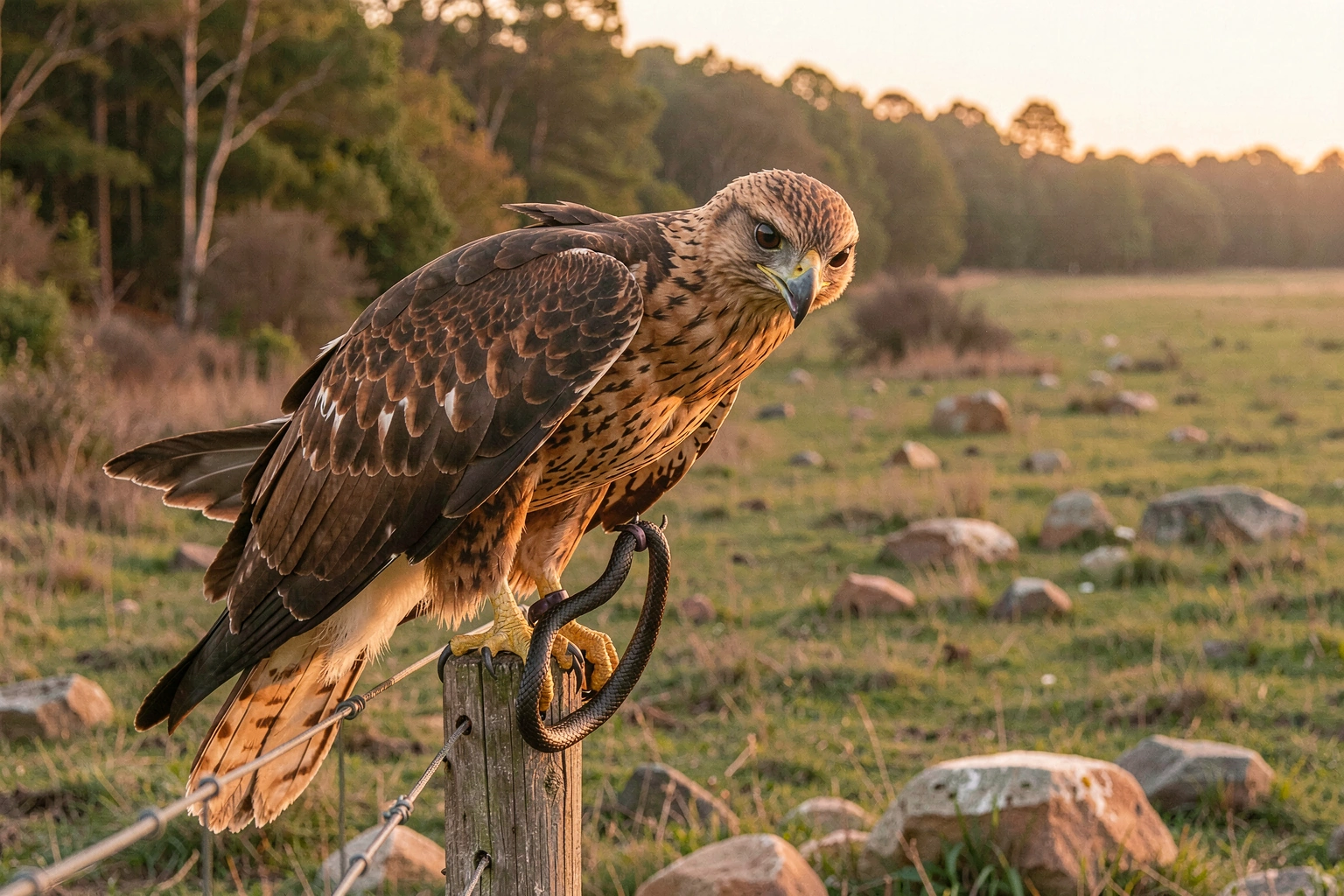
Do snakes eat bird seed? The bigger question is usually whether snakes are drawn to the same areas where birds feed. Hawks, eagles, and certain owls all eat snakes with varying frequency, and a handful of species are [so specialized for snake hunting that it makes up the majority of their diet](https://www. avocetta.
org/articles/vol-epz-feeding-habits-of-the-short-toed-eagle-icircaetus-gallicusi-during-the-breeding-period-in-central-italy/). If you're watching a bird and wondering whether it's actually hunting snakes or just hanging around, there are specific behaviors and physical clues that tell you almost immediately. Here's what you need to know.
The birds that eat snakes (the short list)
Not every raptor eats snakes regularly. Diet varies by season, habitat, and what's available. That said, some species have built their whole lifestyle around snake hunting, and those are the ones worth knowing first.
- Secretary bird (Sagittarius serpentarius): Snakes are their primary food source. They're ground-hunting raptors that stomp and strike snakes just behind the head to neutralize them before eating. Found in African savannas, not North America.
- Short-toed snake eagle (Circaetus gallicus): One of the most snake-specialized raptors on Earth. Studies show reptiles, mainly snakes, make up the bulk of its diet. Found across Europe, the Middle East, and parts of Asia in open plains, arid scrub, and cultivated land.
- Brown snake-eagle: Another African specialist, with heavily scaled legs and tarsi as a physical adaptation against venomous snake bites. Actively seeks out venomous species.
- Black-chested snake eagle: Feeds mostly on snakes, including venomous ones. Hunts by perching at height, hovering, and scanning the ground before diving.
- Crested serpent eagle: Common across South and Southeast Asia. Focuses on snakes and lizards, typically hunting near wet grasslands and forest edges.
- Red-tailed hawk (North America): Opportunistic but regularly takes snakes, especially in open fields and grassland edges. One of the most commonly observed snake-taking raptors in the U.S.
- Red-shouldered hawk (North America): Frequently hunts snakes in wooded areas and near wetlands. More likely to take snakes than red-tails in forested habitat.
- Eastern kingsnake (note: this is a snake, not a bird): Often confused in searches, but kingsnakes eat other snakes. If you're in the Southeast U.S., the predator you're seeing may not be a bird at all.
- Great horned owl: Will take snakes, including large constrictors, especially at night near open ground.
- Roadrunner (North America): A non-raptor that actively hunts and eats snakes, including rattlesnakes, in desert and scrubland habitats of the American Southwest.
Worth noting: in some regions, the animal eating snakes near your property may not be a bird at all. Mongooses, opossums, and even larger reptiles like snapping turtles or monitor lizards can be the true predators. If you're not certain what you're seeing, slow down and observe before drawing conclusions.
Which species are most likely near you
Geography matters a lot here. The secretary bird gets most of the press, but if you're in North America, you're never going to see one outside a zoo. Here's a practical regional breakdown of the most likely snake-eating birds you'd actually encounter.
| Region | Most Likely Snake-Eating Birds | Typical Habitat |
|---|---|---|
| Eastern North America | Red-shouldered hawk, red-tailed hawk, great horned owl | Woodland edges, wetland margins, open fields |
| Western/Southwest North America | Red-tailed hawk, roadrunner, ferruginous hawk | Desert scrub, grassland, open rangeland |
| Sub-Saharan Africa | Secretary bird, brown snake-eagle, black-chested snake eagle | Open savanna, grassland, dry bush |
| Europe / Middle East | Short-toed snake eagle, Montagu's harrier | Open cultivated plains, arid scrub, foothills |
| South / Southeast Asia | Crested serpent eagle, short-toed snake eagle | Wet grasslands, forest edges, rice paddies |
| Australia | Brown goshawk, wedge-tailed eagle (opportunistic) | Open woodland, scrub, agricultural land |
If you're in the continental United States and you're watching a hawk carry or eat a snake, you're almost certainly looking at a red-tailed hawk, red-shouldered hawk, or in the Southwest, possibly a roadrunner. These are by far the most commonly observed snake predators in everyday backyard and field settings.
How to tell if the bird is actually hunting snakes (not just scavenging)
This is where people get tripped up. A bird picking at a dead snake on the road is scavenging, not hunting. It tells you almost nothing reliable about whether that bird regularly preys on snakes. To tell the difference, you need to watch behavior, not just what the bird is eating at that moment.
Signs of active hunting
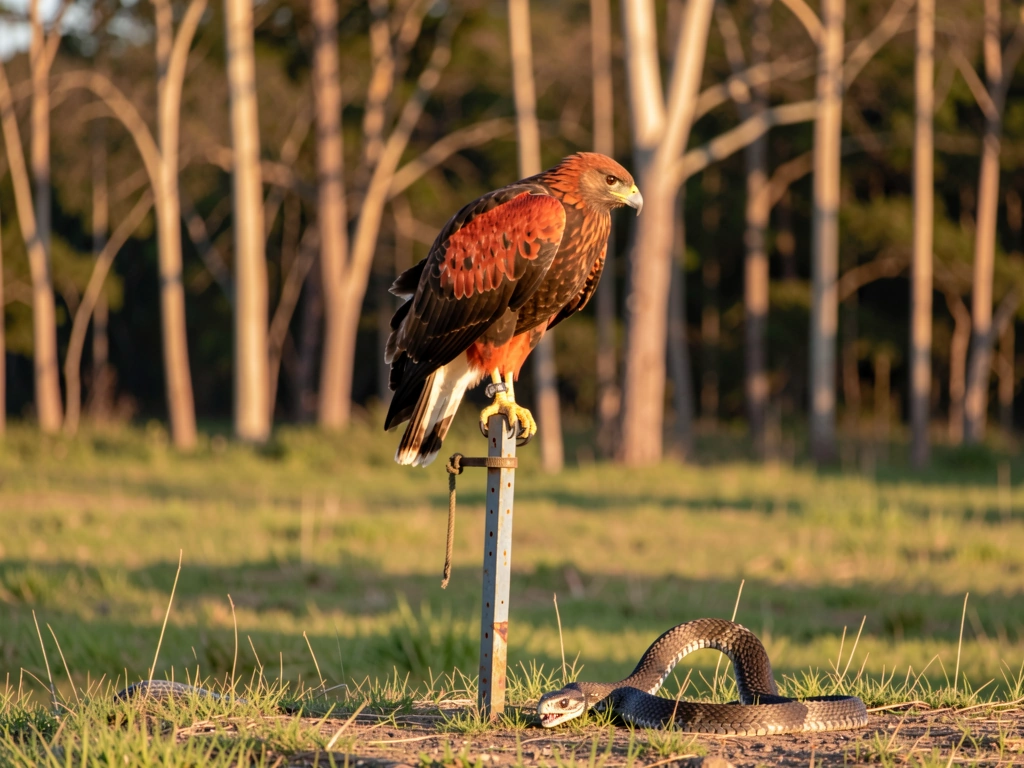
- The bird is hovering or circling low over open ground, grass, or scrubland, then diving suddenly toward a specific target
- It drops from a perch (a fence post, low branch, or utility line) and pins something to the ground with its talons
- It carries a live or freshly killed snake back to a perch or nest and consumes it there
- You observe it repeatedly returning to the same field or patch of ground during peak activity hours (early morning and late afternoon are prime hunting windows)
- The bird is walking on the ground and actively probing or stamping in grass (this is especially characteristic of secretary birds and roadrunners)
Signs it's more likely scavenging
- The snake is clearly already dead when the bird approaches it
- The bird is feeding on a roadside or near a recently disturbed area where snakes might have been killed by vehicles or equipment
- Multiple birds are present and taking turns at the same carcass
- The bird shows no directional searching behavior, it simply lands near an obvious food source
Pellets and prey remains near a roost or nest are also useful evidence, but there's an important caveat: it can be genuinely difficult to determine from remains alone whether a snake was killed by the bird or found dead. Feathers, bones, and scales are clues, not proof. Direct observation of the hunt is the most reliable indicator. Raptor researchers use a combination of pellet analysis, prey remains, and direct observation to get an accurate diet picture, and even then the data has known biases. For everyday field identification, focusing on live hunting behavior is your best bet.
Where to look: habitats that attract snake-eating birds
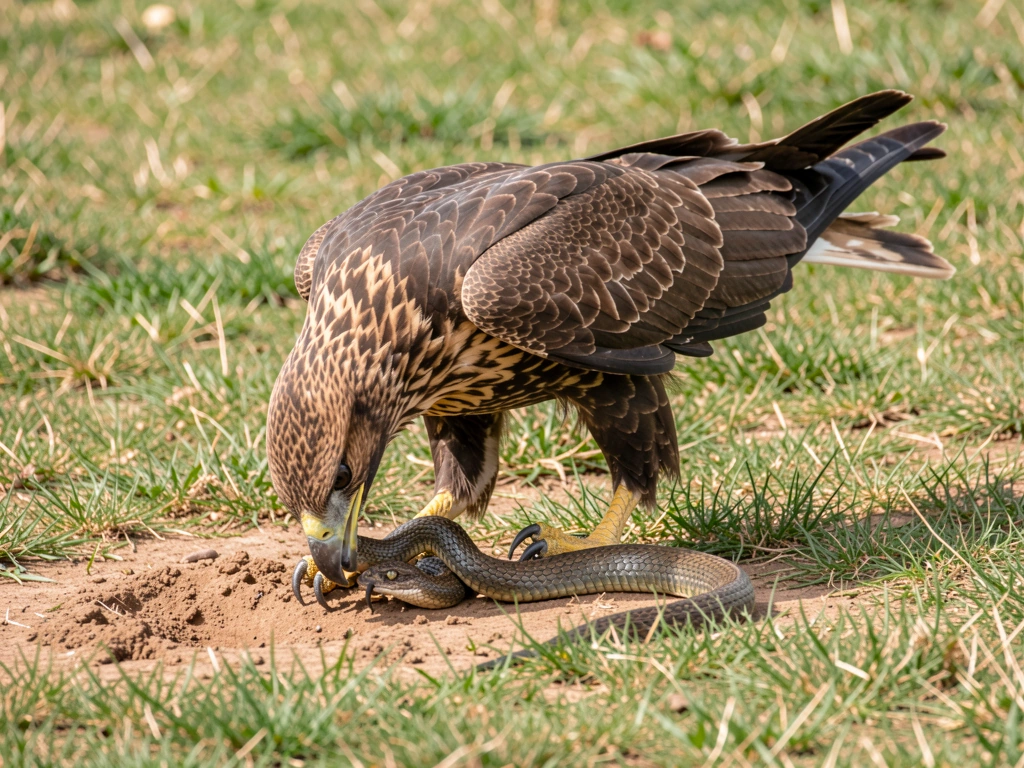
Snake-eating birds show up where snakes are. That sounds obvious, but it has real practical implications for where to look. Snakes are most active at field edges, near water, in tall grass, along rock outcroppings, and at the margins between wooded and open areas. These transition zones, called ecotones, are exactly where hunting raptors concentrate.
- Meadow and field edges bordering woods: Prime red-shouldered and red-tailed hawk territory
- Wetland margins and stream edges: Expect water moccasins and garter snakes, plus the raptors that follow them
- Open grassland and rangeland: Roadrunners in the Southwest, ferruginous hawks and red-tails further north
- Arid scrub and open cultivated plains: Short-toed snake eagles in Europe and the Middle East
- Wet grassland near forest edges: Crested serpent eagle habitat in Asia
- African open savanna: Secretary birds walk up to 30 kilometers a day searching for prey
Time of day matters too. Most active raptor hunting happens near sunrise and sunset when snakes are also more active, thermoregulating or moving between cover. If you're trying to observe a snake-eating bird in action, position yourself with good sightlines over open ground during these windows and use binoculars or a spotting scope. Do not approach nests or roosting areas. Disturbing birds during these critical periods stresses the animals and can cause nest abandonment.
What to do if you have snakes on your property right now
If snakes are the actual concern here and you were hoping birds might solve the problem naturally, here's the honest answer: they can help over time, but you can't rely on birds as a snake control method. Some people also wonder will a squirrel eat a bird, but most backyard bird threats are still tied to predators like raptors and other carnivorous animals. What you can do is make your property more attractive to natural predators and less attractive to snakes.
- Identify the snake first, from a safe distance, before doing anything else. Most snake bites happen when people try to handle or kill snakes they could have simply walked away from.
- Remove habitat that shelters snakes: woodpiles, brush piles, tall grass near the house, and gaps under sheds or outbuildings.
- Eliminate food sources that attract snakes in the first place, specifically rodents. Snakes follow mice and rats. If you have a rodent problem, you'll have a snake problem. Note that bird feeders can attract rodents, which in turn attract snakes (a connection worth thinking about separately).
- Install raptor perches (T-posts or wooden perch poles) in open areas near fields or garden edges. These give raptors a hunting platform and encourage them to work your land. This is a legitimate, low-cost strategy used by farms and vineyards.
- Leave brush edges and meadow strips intact around your property perimeter if you can. These provide hunting habitat for the birds that naturally suppress snake populations.
- If a snake is inside your home or in a situation that feels genuinely unsafe, contact a local wildlife removal professional or your state's wildlife agency. Do not attempt to handle venomous snakes yourself.
Encouraging snake-eating raptors is a long game. It takes consistent habitat and patience. But properties with good raptor hunting habitat and low human disturbance do see better natural predator-prey balance over time.
Safety first: what not to do around snake-eating birds
This section matters because the instinct when you see something interesting is to get closer. With raptors, that instinct will get you into trouble. Here are the firm rules.
- Do not approach nests, roosting spots, or hunting birds. Use binoculars or a zoom lens and stay well back. Animals change their behavior when people get too close, and disturbing a nesting raptor can cause it to abandon eggs or chicks.
- Do not pick up feathers, bones, or prey remains you find on the ground. Many raptors are protected under the Migratory Bird Treaty Act, and possessing feathers, bones, or other parts of protected birds is illegal in the United States, even if you found them by accident.
- Do not attempt to rescue or rehabilitate an injured raptor yourself. Raptors have powerful talons and can cause serious injury. Contact a licensed wildlife rehabilitator or your state wildlife agency immediately.
- Keep pets on leashes near areas where raptors are hunting. A large red-tailed hawk or great horned owl can target small dogs and cats, and they're more vulnerable near open hunting grounds.
- Do not try to kill or trap snakes yourself unless you are trained and certain the species is non-venomous. Even 'harmless' snakes can bite and cause infection.
When to call a professional instead of handling it yourself
Call a licensed wildlife professional or your state wildlife agency if any of these apply:
- You have a venomous snake inside or immediately adjacent to your home
- You've found an injured raptor on the ground and it cannot fly or is visibly wounded
- You're seeing snake activity at a scale that suggests an infestation rather than occasional transient individuals
- You're not certain whether the snake you're seeing is venomous
- A raptor has been roosting in an area that's creating conflict (near a chicken coop, for example) and you need guidance on legal deterrent options
Wildlife rehabilitators, your state's wildlife resources commission, and organizations like local raptor centers are the right first call. It's illegal to keep a wild animal, including raptors, without appropriate federal and state permits, so the answer is almost always to call rather than handle. These organizations can also point you toward legal, humane options for managing snake activity on your property without putting yourself or the animals at risk.
The bottom line: if you're watching a hawk, eagle, or roadrunner near your property and wondering whether it's working on your snake problem, it very well might be. The U.S. National Park Service notes that the Greater Roadrunner (Geococcyx californianus) includes snakes, including rattlesnakes, in its diet. Give it space, give it good hunting habitat, and let it do what it does. That's the most effective and practical thing you can do today.
FAQ
How can I tell if a hawk or owl is hunting live snakes versus eating a snake it found dead?
Watch for hunting behavior cues, not just the food item. Live-snatching hunters typically make directed searches from perches, pause to scan, then launch in a controlled stalk or stoop. Scavengers are more likely to approach opportunistically, linger near roadkill, and show less targeted movement over edges and cover.
Do roadrunners really count as “birds that eat snakes,” and what does their behavior look like?
Yes, roadrunners eat snakes and are known for active ground hunting. If you see quick pursuit, repeated head-level scanning, and a sequence of controlled chases in open scrub or field edges, that pattern is more consistent with hunting than casual feeding.
What time of day is best for spotting snake-hunting birds, and does it differ by season?
Early morning and late afternoon around sunrise and sunset are usually best because both predators and snakes are more active then. In hotter months, birds may concentrate activity closer to dawn and dusk, while in cooler seasons you may see longer mid-day foraging when temperatures keep snakes moving.
If I find feathers or snake scales near a nest, does that confirm the bird killed the snake?
Not necessarily. Remains can come from multiple sources, including the bird consuming prey near the site, scavenging, or bringing prey parts from elsewhere. Direct observation of the capture is the strongest proof, and even experienced researchers treat remains as evidence rather than certainty.
Could I be dealing with a non-bird predator, even if I keep seeing raptor-like activity?
Yes. Other animals that hunt snakes include opossums, mongooses, and larger reptiles such as snapping turtles and monitor lizards (region dependent). If the “hunter” is low to the ground, moves between cover quickly, or leaves tracks and signs that do not match typical bird perching or flight, widen your search beyond birds.
Are there times when snake-eating birds stop hunting them, even if snakes are around?
Yes. If an easy alternative prey becomes abundant, during severe weather, or when breeding demands increase time spent on nest provisioning, snake focus can drop. Also, if human activity repeatedly interrupts hunting or roosting areas, birds may shift routes and avoid your immediate space.
What signs would suggest a bird is regularly hunting snakes on or near my property?
Look for repeated patterns over days, such as consistent hunting trips along the same ecotones, repeated visits to the same perches overlooking field edges, and pellet or prey-remains accumulation under predictable roosting spots. One-off sightings are common, but regular return to the same hunting routes is the stronger clue.
Is it safe or legal to try to relocate snakes by using birds as “natural control” on my property?
Do not approach wildlife nests or attempt to handle raptors. Even if birds are helping, you should treat bird activity as uncontrolled and indirect. For managing snake issues on your property, focus on habitat adjustments that reduce snake attraction and, when needed, consult a licensed wildlife professional for legal, humane options.
How can I encourage snake-hunting birds without making things worse for them?
Create hunting-friendly habitat by maintaining tall grasses or natural cover at field edges and preserving perching spots, like dead snags, while avoiding frequent disturbance near roosts and nests. Keep pets indoors near these areas, because increased predation risk and harassment can cause birds to abandon hunting locations.
If I suspect a raptor is near my property, how far should I stay back from nests or roosts?
Use distance and restraint. If you cannot observe without drawing attention, you are too close, and nest disturbance can trigger abandonment. A safe approach is to watch from farther vantage points with binoculars or a spotting scope, and when uncertain, contact a local raptor center or wildlife agency for site-specific guidance.