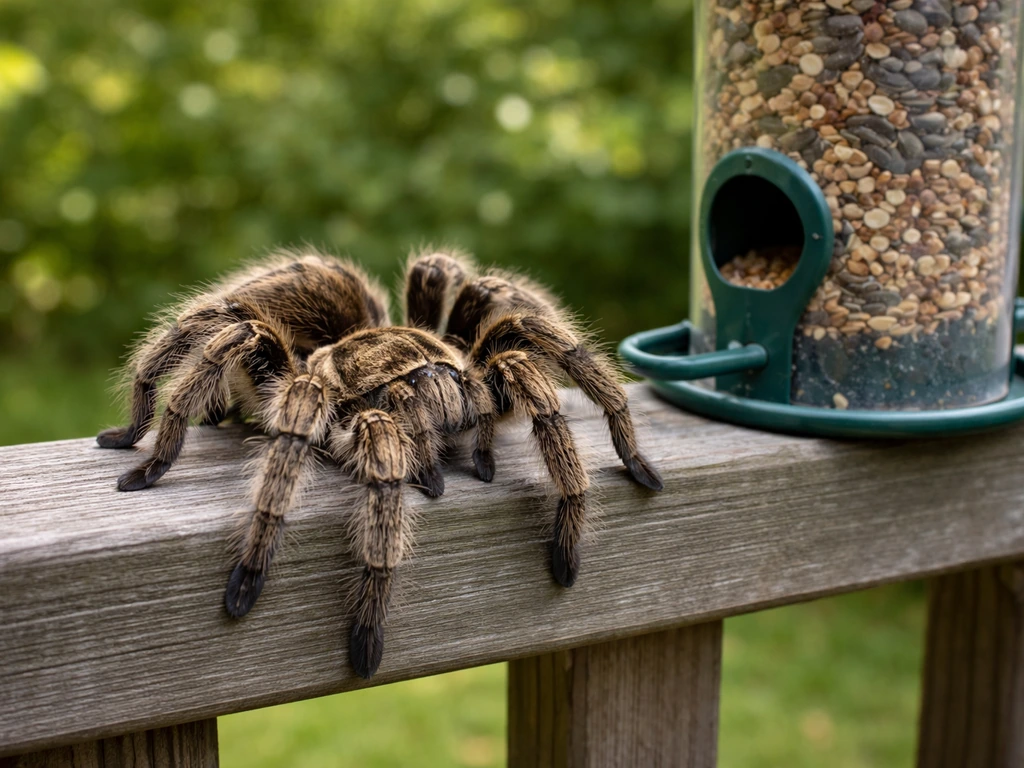
Yes, Australia does have spiders that fall under the broad 'bird-eating spider' label, but the realistic risk to your backyard birds is extremely low. Australia is home to several native tarantula species (family Theraphosidae), the group most commonly called 'bird-eating spiders' in popular media. However, no peer-reviewed study or verified museum record has ever documented an Australian wild spider conclusively killing and consuming an adult wild backyard bird. The spiders exist here; the bird-eating part is largely theoretical for Australian conditions.
Are bird-eating spiders in Australia? Evidence, risks & tips

Maya Bennett
11 Aug 2026
What exactly is a 'bird-eating spider'?
The term 'bird-eating spider' is a colloquial label, not a formal scientific category. Its widespread use in English traces back to an 18th-century engraving by naturalist Maria Sibylla Merian, which depicted a large spider eating a hummingbird. That image stuck in the popular imagination and the nickname has followed large theraphosid spiders ever since. In scientific literature, 'bird-eating' describes an occasional, exceptional behavior, not a defining diet trait. Any large spider that has been recorded consuming a bird, even once, can technically earn the label.
For practical purposes, the term is most accurately applied to theraphosids (tarantulas), particularly the Goliath birdeater (Theraphosa blondi) from South America, which is the largest spider in the world by mass. But orb-weavers, jumping spiders, and other large spiders have also appeared in verified bird-predation records. The 'birdeater' label is therefore more about size and public perception than a reliable indicator of what a spider actually eats day to day.
Bird-eating spiders around the world: what the evidence actually shows
Globally, documented cases of spiders consuming birds come from a surprisingly broad range of families, but they share one feature: the prey is almost always small, lightweight, and vulnerable (hatchlings, nestlings, fledglings, or tiny passerines caught in a web). Here is what peer-reviewed literature confirms.
- Theraphosids (tarantulas): Isolated Neotropical records, primarily from the Brazilian Amazon, show large tarantulas occasionally subduing small birds. These are sporadic events, not regular feeding behavior.
- Nephilid/orb-web spiders: A 2007 study documented Nephilengys cruentata consuming a small tyrannid passerine in Brazil. Large orb-weavers in the Nephilinae group produce some of the strongest silk of any spider.
- Jumping spiders (Salticidae): Journal of Arachnology records include jumping spiders consuming gecko hatchlings and bird hatchlings, demonstrating vertebrate prey capture in a family not typically associated with it.
- Large orb-weavers and entanglement deaths: A comprehensive global review found that web entanglement can kill birds weighing up to around 80 g (a laughing dove is documented in one record), though many of these deaths are accidental entanglement rather than active predation.
- Invasive Trichonephila species (jorō spider): A 2022 note in MDPI Insects documented a northern cardinal (~42 to 48 g) briefly perching on a jorō spider web, demonstrating that some modern orb webs are structurally capable of supporting a songbird's weight.
The overall picture from the literature is consistent: spider predation on birds is taxonomically broad but globally rare. Most records involve exceptional circumstances, small or injured prey, and species that happen to build unusually strong structures or live in microhabitats where small birds are vulnerable.
The Australian evidence: what records and museums actually show
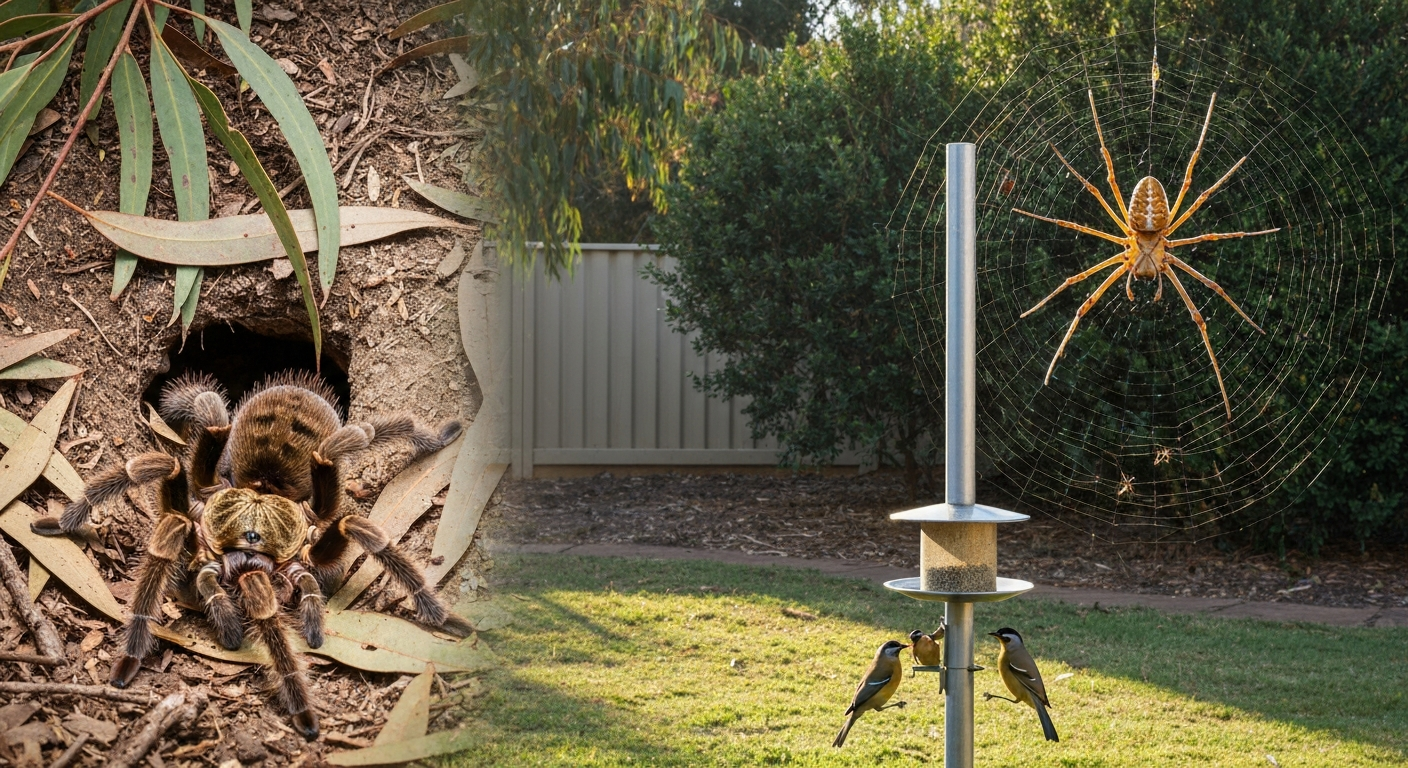
Australia has its own endemic tarantula fauna, assigned to four recognized genera: Selenocosmia/Phlogius, Coremiocnemis, Selenotholus, and Selenotypus. Current taxonomy recognizes roughly 6 to 10 named species for the continent, though molecular work by Briggs et al. (2023) indicates significant cryptic diversity that formal names haven't caught up with yet. Phlogius crassipes (formerly Selenocosmia crassipes), found in tropical Queensland, is the largest and best-documented Australian species, with verified specimen and observation records through the Atlas of Living Australia.
I've gone through the peer-reviewed literature, the Australian Museum's factsheets, ALA specimen records, GBIF, and the World Spider Catalog. The consistent picture is this: Australian tarantulas are documented predators of large insects, cockroaches, crickets, small frogs, and small lizards. The Australian Museum describes bird predation for this group as unlikely and exceptional, not characteristic. As of August 2026, no peer-reviewed study and no verified museum collection record documents an Australian wild spider killing and consuming an adult wild backyard bird. The spiders have the physical capability; the verified events simply do not appear in the Australian record.
Australia also has large orb-weavers, including Nephila and Trichonephila species, that build the kind of strong webs associated with accidental bird entanglement overseas. Golden orb-weavers (Trichonephila edulis) are widespread across northern and eastern Australia and build webs strong enough to catch bats and large insects, but verified cases of them catching birds in Australia remain anecdotal rather than documented in the scientific record.
How likely is it that a spider will take a bird from your feeder?
For backyard birders in Australia, the realistic risk is very low. Here is why. Adult passerines at a feeder are aware, mobile, and too large for any Australian spider to reliably subdue. Australian tarantulas are ground-dwelling, burrow-living animals that hunt at night, using vibration to detect prey that walks into their ambush zone, so feeder activity and tarantula activity almost never overlap. Large orb-weavers could theoretically entangle a very small bird in a poorly placed web, but this is an accidental event rather than targeted predation, and it is extremely uncommon.
The higher realistic concern for feeder birds in Australia is not spiders but other predators: cats, raptors, currawongs, and butcherbirds are all well-documented threats. Spiders, while fascinating, do not feature meaningfully in the risk profile of a typical Australian backyard bird feeding setup.
Where feeder management does intersect with spiders is indirect: an unmaintained feeder with accumulated seed hulls, spilled grain, and insect activity can attract large invertebrates and the spiders that prey on them. A clean, well-maintained feeder reduces this chain of attraction. More on that below.
Large Australian spiders often confused with 'bird-eating' species
Several large Australian spiders get called 'bird-eating spiders' by the public simply because of their size. It is worth knowing who's who, both for accurate identification and to understand what each species actually does.
Phlogius crassipes (Queensland whistling tarantula / barking spider)
This is Australia's largest spider by leg span, reaching up to 22 cm across. It lives in deep silk-lined burrows in tropical Queensland forests and scrublands, and hunts at night. It has distinctive feathery (plumose) hairs on its legs and can produce a hissing sound by stridulation (rubbing leg hairs against its body). Diet: large insects, frogs, small lizards. Theraphosid venom, generally low medical concern (more on this below).
Selenotypus plumipes
Another Queensland theraphosid with museum voucher specimens in the World Spider Catalog and GBIF. See Selenotypus plumipes, World Spider Catalog (species page) for taxonomic details and links to GBIF specimen records blank" rel="noopener noreferrer">Selenotypus plumipes — World Spider Catalog (species page). Slightly smaller than Phlogius crassipes with similar burrowing habits. The species name 'plumipes' refers to its feathered legs, a shared character with other Australian theraphosids. Georeferenced iNaturalist photographs are available via Wikimedia Commons for comparison.
Trichonephila edulis (golden silk orb-weaver)
Widespread across northern and eastern Australia. Builds large, strong golden-silk webs up to 1.5 m in diameter between trees and shrubs, often across pathways. Females reach about 4 cm body length with leg span up to 15 cm. This species is occasionally mistaken for a 'bird-eating spider' but is not a tarantula and does not actively hunt vertebrates. Its web can entangle large insects and occasionally bats, but there are no verified Australian records of it consuming birds.
Sydney funnel-web (Atrax robustus) and relatives
Large, dark, and dramatic-looking, funnel-webs are sometimes called 'bird-eating' by the public. They are not bird-eating spiders in any sense of the term. Their diet is dominated by insects and small invertebrates. They are, however, the most medically significant spiders in Australia and should not be confused with the much more docile tarantulas.
Visual ID: comparing Australia's large spiders
The table below pulls together the key identification features recommended by the Australian Museum and major field guides. These are the characters to check if you encounter a large spider in or near your garden.
| Species | Common name | Max body length | Leg span | Typical habitat | Diagnostic features | Diet / vertebrate prey? | Bite risk to humans |
|---|---|---|---|---|---|---|---|
| Phlogius crassipes | Queensland whistling tarantula / barking spider | ~9 cm (female) | Up to ~22 cm | Deep burrows, tropical Qld forests | Plumose (feathery) leg hairs, stridulation hiss, long spinnerets | Insects, frogs, lizards; bird predation exceptional/unverified in Aus | Low; localized pain, not life-threatening |
| Selenotypus plumipes | Feather-legged tarantula | ~6 cm (female) | Up to ~15 cm | Burrows, inland/central-north Qld | Plumose tibial hairs (name reference), burrowing lifestyle | Insects, small invertebrates; vertebrate predation not documented in Aus | Low; similar to Phlogius |
| Coremiocnemis tropix | Rainforest tarantula | ~5 to 7 cm | Up to ~14 cm | Qld rainforest burrows/logs | Brown, hairy, slower movement; stridulation possible | Insects, small vertebrates occasionally | Low |
| Trichonephila edulis | Golden silk orb-weaver | ~4 cm (female) | Up to ~15 cm | Shrubs/trees N & E Australia, large golden web | Bright yellow abdomen, golden silk, web always present | Insects, occasional bats (in web); no verified bird prey in Aus | Very low; mild local reaction |
| Atrax robustus | Sydney funnel-web | ~3.5 cm | Up to ~7 cm | Moist sheltered burrows, SE Aus | Shiny black/brown, aggressive rearing posture, funnel web entrance | Insects, small invertebrates; NOT a bird predator | High; seek immediate medical attention |
For photo identification, the Atlas of Living Australia (ALA) and iNaturalist both host georeferenced, date-stamped photographs of all the theraphosid species above. When in doubt, the combination of burrow lifestyle plus plumose leg hairs plus large size and Queensland location strongly points to an Australian tarantula rather than a funnel-web or orb-weaver.
Global records of spiders eating birds: context and what they mean for Australia
The global evidence base for spider-on-bird predation is real but needs careful framing. Peer-reviewed records from the Neotropics (primarily Brazil) show tarantulas of the Theraphosa and Avicularia groups occasionally taking small birds, usually nestlings or fledglings. These events make it into the literature precisely because they are rare enough to be noteworthy. A 2007 Brazilian study documented a Nephilengys orb-weaver consuming a small tyrannid flycatcher, and the PMC global review of bat-eating spiders confirmed that web entanglement deaths of small vertebrates occur across many continents.
The largest bird entangled in a spider web in the published literature weighed roughly 80 g (a laughing dove), but the majority of records involve birds under 15 g. Context matters enormously here: these records come from tropical rainforest environments, particularly South and Central America and Southeast Asia, where spider size, web density, and prey-bird size distributions differ meaningfully from an Australian backyard. Australia's native tarantulas are large and capable animals, but they live in a different ecological context, and no equivalent events have been verified in Australian wild populations.
The limitation of all these records, including the global ones, is that they represent opportunistic observations, not systematic surveys. This means the true frequency of spider-bird interactions is almost certainly underestimated globally, but it also means we cannot confidently extrapolate Neotropical event rates to Australian conditions. The honest answer is: it is physically possible but not documented here.
Are Australian 'bird-eating spiders' dangerous to humans and pets?
This is where the risk profile shifts slightly, because the venom question affects both your safety and the safety of pets that might encounter a large spider near a feeder or garden. Australian tarantulas (Phlogius, Selenotypus, and relatives) are not considered medically significant for healthy adult humans. Bites are painful and can cause localized swelling and redness, and some Old World theraphosids elsewhere in the world have been associated with muscle cramps, but Australian species are not in the high-risk category. There are no recorded fatalities attributable to Australian tarantula bites.
The spiders you genuinely need to worry about in Australia are funnel-webs (Atrax and Hadronyche species) and redbacks (Latrodectus hasselti). For details on medically significant spider venoms and clinical effects, see the review Pain‑related toxins in scorpion and spider venoms: interactions with ion channels (PMC) Pain‑related toxins in scorpion and spider venoms: interactions with ion channels (review, PMC). These are the spiders that require immediate medical attention if they bite. It is worth noting that funnel-webs and tarantulas can look superficially similar to the untrained eye, which is one reason accurate identification matters.
For pets, particularly cats and small dogs that may encounter a large tarantula near a feeder area, the risk of a medically serious bite from Australian tarantulas is low, but it is not zero. A vet consultation is always appropriate if your pet has been bitten by any unidentified large spider, particularly if the animal shows distress, muscle twitching, drooling, or vomiting. Funnel-web envenomation in dogs can be fatal and requires emergency veterinary treatment.
How feeder management affects spider activity near your birds
Spilled seed, accumulated hulls, and insect activity around a feeder create a food chain that can eventually attract larger invertebrates, including large spiders. This is not a reason to panic, but it is a reason to keep your feeder area tidy. A few practical steps reduce the chance of large spiders setting up close to where your birds feed.
- Clean up spilled seed under feeders at least twice a week. Decomposing seed attracts insects, which attract spiders.
- Store seed in sealed, airtight containers away from the ground to prevent insect infestation that would extend the food chain toward larger predators.
- Mount feeders on smooth metal poles with baffles rather than hanging them from trees or shrubs where large orb-weavers are likely to build webs.
- Check for large webs (especially golden orb-weaver webs) in approach corridors to your feeder during late summer and autumn, when Trichonephila females are at peak size. Remove webs that are strung directly across bird flight paths.
- Keep ground cover short under and around feeders. Australian tarantulas are ground-dwellers and prefer areas with loose soil, leaf litter, and good cover for their burrows.
- At night, avoid leaving food scraps or fruit on the ground near the feeder area, as these attract large insects that in turn attract hunting tarantulas.
- If you find a large spider near your feeder, do not handle it. Photograph it for identification (use the ALA or iNaturalist apps), then contact a local wildlife handler or your state's pest management line if relocation is needed.
First aid and when to call for help
If a person or pet is bitten by a large spider near your garden, follow these steps while you identify whether the spider was a tarantula or a funnel-web.
- Stay calm and move away from the spider. Do not attempt to catch or kill it, but try to photograph it for identification.
- For a suspected tarantula bite on a human: wash the bite site with soap and water, apply a cold pack, and monitor for symptoms. Seek medical attention if pain is severe, if there is significant swelling, or if the person feels unwell.
- For a suspected funnel-web bite (shiny black spider, aggressive rearing posture): apply a pressure-immobilization bandage immediately, keep the patient still, and call 000 (Australia) or get to an emergency department immediately. Do not apply a tourniquet.
- For a pet bitten by any large unidentified spider: call your vet or an emergency animal clinic straight away. Describe the spider as accurately as possible and note the time of the bite.
- If a small bird appears entangled in a large web and is still alive, cut the web threads carefully with scissors to free the bird. Do not pull the bird as web silk can cut fragile skin and feathers. Contact a licensed wildlife carer if the bird is injured.
Myth-busting: common questions answered directly
Do bird-eating spiders actually eat birds? Occasionally and rarely, in the Neotropics mostly. In Australia, it is not documented in verified records. The diet is dominated by large insects and occasionally small frogs or lizards. Whether these spiders regularly eat birds in Australia is a question worth exploring further, and it connects directly to questions about spider toxicity and bite risk that are detailed in related topics on this site.
Are they poisonous? All spiders produce venom, but 'poisonous' is not the right word (poisonous means harmful if eaten; venomous means harmful via bite or sting). Australian tarantulas are venomous but not considered medically dangerous to healthy adult humans. They are not in the same risk category as funnel-webs or redbacks. Whether their venom poses a risk to you or your pets is covered more fully in the related topic about whether bird-eating spiders are poisonous.
Do they bite humans? Yes, they can and do bite if handled or cornered. But they are not aggressive and bites are relatively uncommon. The bite is painful, comparable to a wasp sting for most people. More detail on bite frequency, symptoms, and first aid is available in the related topic about whether bird-eating spiders bite humans.
Which birds eat spiders? This is the flip side of the question, and the answer for Australia is quite a few. Kookaburras, robins, fantails, thornbills, and wrens all eat spiders as part of their normal diet. This predator-prey relationship runs mostly in the bird's favor, which is part of why spider predation on birds is so rare to begin with. The related topic on which birds eat spiders goes into much more detail on this.
Practical prevention checklist for backyard birders
- Keep feeder areas clear of spilled seed and decomposing organic matter.
- Use smooth-pole feeder mounts with baffles to prevent spiders climbing to the feeder.
- Inspect large web-building orb-weavers near bird flight corridors each autumn and relocate webs if they pose an entanglement risk.
- Know the difference between an Australian tarantula (harmless, burrowing) and a funnel-web (medically dangerous, aggressive): use ALA or iNaturalist for photo ID help.
- Never handle any large unidentified spider bare-handed.
- Keep seed in sealed containers off the ground to break the insect-spider attraction chain.
- If you find a tarantula burrow near a feeder, monitor but do not disturb. These animals are part of the local ecosystem and are not targeting your birds.
- If a bird is caught in a web, free it carefully with scissors and contact a wildlife carer if it is injured.
- Call 000 (humans) or an emergency vet (pets) for any suspected funnel-web bite immediately.
FAQ
Quick answer: Are “bird‑eating spiders” present in Australia and are they a risk to backyard birds, pets or humans?
Short answer: Large Australian spiders (theraphosids/tarantulas and some large orb‑weavers) exist, but verified cases of spiders in Australia routinely killing and eating adult wild backyard birds are effectively absent from the peer‑reviewed record. Globally, a few spider species have occasionally eaten small birds, but these events are rare, exceptional and usually involve either large orb webs that accidentally entangle birds or isolated theraphosid predation reports in other regions. Realistic backyard risk to healthy adult wild birds, pets or humans in Australia is very low. Sources: Briggs et al. 2023, Australian Museum tarantula factsheets, global case reviews (see Evidence Summary).
What does the term “bird‑eating spider” actually mean?
Definition: “Bird‑eating spider” (or “birdeater”) is a colloquial label historically used for large spiders—especially some theraphosids (tarantulas). In scientific literature it’s a descriptive phrase for rare, documented predation events rather than a taxonomic or behavioural category. Most so‑called birdeaters primarily consume large arthropods and small vertebrates; bird predation is occasional and exceptional. (See Merian homage and synthesis: Springer article and reviews.)
What Australian large spiders are most likely to be confused with “bird‑eating spiders”?
Common large Australian spiders to know: - Selenotypus (e.g., Selenotypus plumipes) — large fossorial theraphosid; robust body, long legs with dense setae (hairy), burrow‑dwelling. - Phlogius / Selenocosmia (e.g., Phlogius crassipes) — medium/large theraphosids with flattened carapace, burrows or under logs. - Coremiocnemis spp. — tropical/woodland theraphosids. - Large orb‑weavers (e.g., Nephila/Trichonephila relatives, though the classic jorō/Nephila examples are non‑native/invasive in some regions) — large circular webs, long legs, silk webs built in open spaces. Identification features to compare: body length and leg‑span, habitat (burrow vs arboreal web), leg hair (plumosity), spinneret shape, web type. Museum portals (ALA/GBIF/WSC) provide voucher photos and locality records for verification.
Evidence summary: Are there verified records of Australian spiders eating birds?
Evidence summary: - Global literature documents verified spider predation on small birds (e.g., orb‑weaver Nephilengys in Brazil; isolated theraphosid records in the Neotropics). - Australian literature, faunal surveys and museum records document large theraphosids present in Australia (Selenotypus, Phlogius, Selenocosmia, Coremiocnemis) with specimen and image records (ALA, WSC, GBIF). - Comprehensive searches of peer‑reviewed literature and Australian faunal resources (Australian Museum; Briggs et al. 2023) found no verifiable, published cases of Australian spiders conclusively killing and consuming adult wild backyard birds. - Conclusion: Australian large spiders are present, but documented bird‑eating events in Australia are effectively undocumented or absent; worldwide bird predation by spiders is taxonomically broad but rare and usually exceptional. (References: Briggs 2023, Australian Museum tarantula overview, Peloso & de Sousa 2007, global reviews — PLoS ONE and other syntheses.)
How realistic is it that a spider will kill or eat a small feeder bird (e.g., finch, sparrow) in my backyard?
Realistic likelihood: Very low. Most small passerines visit feeders briefly and are not entangled in webs. Exceptions reported elsewhere are rare and usually involve birds colliding with large orb webs at night or nestlings being taken in vegetation‑near nests. Australian circumstances: no peer‑reviewed verified cases of wild Australian spiders routinely taking feeder birds. Orb web entanglement or opportunistic predation on nestlings is theoretically possible but uncommon; theraphosid ambush predation on adult birds is exceptional and not supported by Australian records.
Visual ID aids (what to look for) and where to find photos/vouchers
Visual ID aids (practical guide): - Theraphosids (tarantulas): stocky body, heavy legs often with dense hairs, visible burrow or under‑log retreat, walking gait is slow/grounded; no aerial web. Example images and specimen records: Atlas of Living Australia (Phlogius crassipes) and World Spider Catalog (Selenotypus plumipes). - Large orb‑weavers (Nephila/Trichonephila relatives/non‑native jorō): very large circular webs, long spiny legs extended at web hub, often in open garden gaps between trees. Example: MDPI Insects 2022 jorō/web observations. Useful image sources: Atlas of Living Australia, iNaturalist/Wikimedia Commons (CC‑BY photos), GBIF specimen pages. Use diagnostic fields: body & leg‑span estimates, habitat (burrow vs web), presence/absence of a silk web, and behaviour (lurking vs web‑sitting).
Next Article
Do Bird-Eating Spiders Bite Humans? What to Expect
Learn if bird-eating spiders bite humans, what bites feel like, risks, and what to do and prevent after exposure.