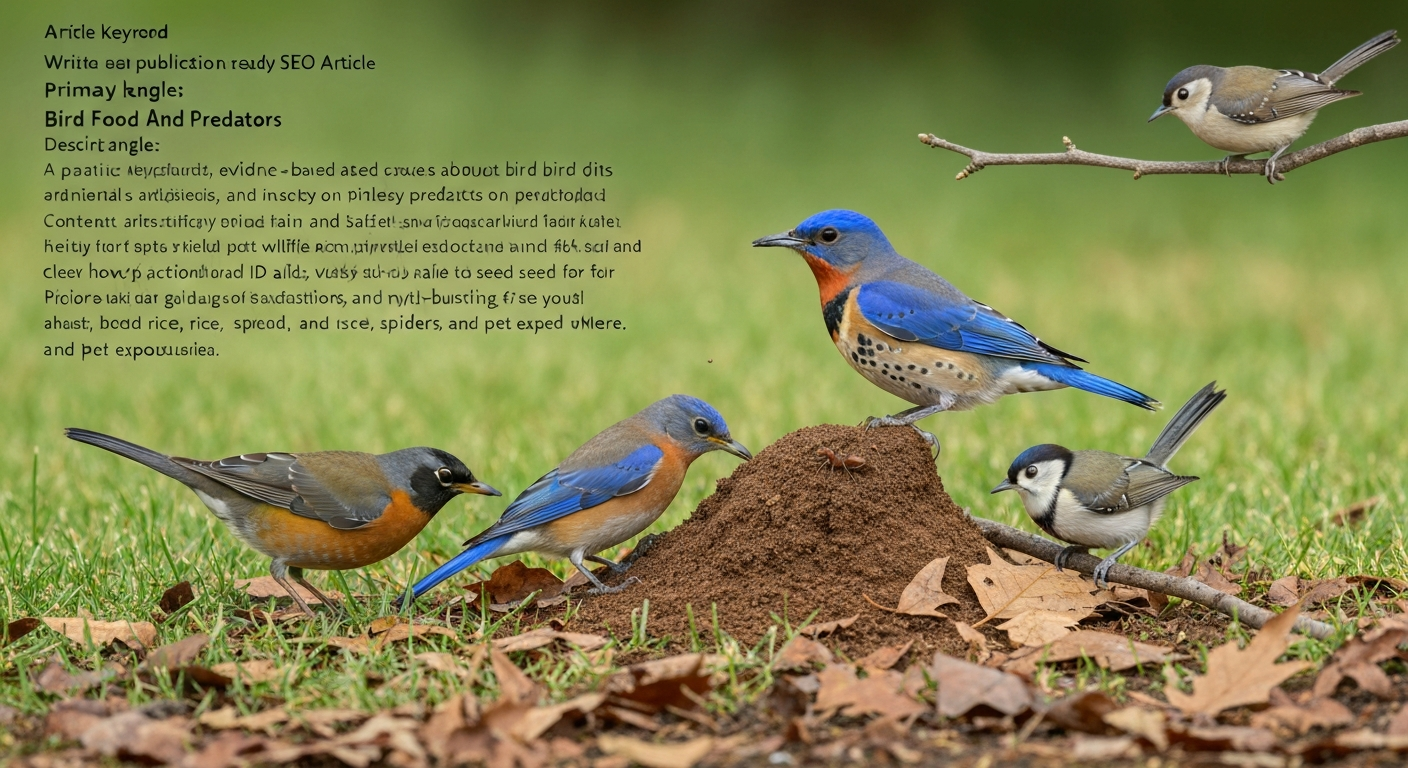
Yes, birds eat ants, and more species do it than most backyard birders realize. Robins, bluebirds, woodpeckers, starlings, wrens, and dozens of other common birds regularly pick up ants from the ground, bark, and leaf litter. Some birds even specialize on them. Beyond just eating them, many birds rub ants through their feathers in a behavior called 'anting,' which has been recorded in over 200 passerine species. So ants are not just an occasional snack for birds; they are a consistent, nutritionally meaningful part of many species' diets.
Does Bird Eat Ants? Why Birds Eat Ants and Safe Feeding Tips

Maya Bennett
28 Jul 2026
Why this matters for backyard birders, pet owners, and educators
If you run a backyard feeder station, keep pet birds, or teach nature programs, ant-and-bird interactions come up in ways that are more practical than they might first seem. Ants invade feeders, contaminate seed, and can carry residues from pesticide baits. If birds are foraging on your lawn, they may be picking up ants that have walked through bait stations. Pet owners sometimes wonder whether their bird can safely eat live ants, or what to do when ants get into a cage food dish. And for educators, anting behavior is one of the more visually dramatic and genuinely puzzling things a backyard bird will ever do. Getting the facts straight matters in all three cases.
Do wild birds really eat ants? What the evidence shows
The evidence is solid and comes from multiple directions. Camera-trap studies at nest boxes have documented Eastern Bluebirds provisioning nestlings with ants, with Formicidae specifically counted as a separate dietary category. Behavioral ecology research confirms that ant-following, where birds track ant swarms to pick off flushed arthropods, is a well-documented foraging syndrome in Neotropical forests. Field experiments that suppressed invasive fire ants near bluebird territories showed measurable changes in how often and how far parents foraged for food, demonstrating that ant abundance directly shapes bird feeding decisions. Across all these lines of evidence, ants emerge as a genuine, recurring food source and not just an incidental one.
In temperate North America and Europe, ant-eating tends to be most intense in spring and early summer when ant colonies swarm and alates (winged reproductive ants) are available in large numbers. Ground-nesting ant colonies disturbed by rain or soil disturbance also become easy targets. Birds that primarily eat earthworms or berries will still take ants opportunistically when they are abundant at the surface. This kind of dietary flexibility is a core survival strategy for most insectivorous birds.
Why birds bother with ants: nutrition, timing, and opportunity
Ants are nutritionally worthwhile. Aggregated analyses of ant species show roughly 40 to 45 percent crude protein and 15 to 20 percent fat on a dry-matter basis, with the values varying by species, caste (workers vs. queens), and life stage. That puts ants in the same general tier as other feeder insects. For comparison, dried mealworms run around 40 to 50 percent crude protein but carry more fat at 25 to 35 percent, which is why mealworms are often considered a richer supplemental food for birds like bluebirds. Ants are leaner but still protein-dense, and when they are swarming in the thousands, the caloric payoff per foraging trip can be very high.
Seasonality is a big driver. Ant activity peaks in warm months, which overlaps almost perfectly with nestling season. That is not a coincidence from a bird's perspective: high-protein insect prey when chicks need the most protein makes biological sense. Ants are also available with very little pursuit effort when they are swarming or disturbed, making them an energetically efficient food source compared to prey that has to be chased or extracted from bark.
Common backyard birds that eat ants
- American Robin: frequently seen probing lawns and pulling up ants alongside earthworms
- Eastern Bluebird: documented feeding ants to nestlings in camera-trap studies
- Northern Flicker: one of the most dedicated ant-eaters among North American woodpeckers; probes soil with its long tongue
- Downy and Hairy Woodpecker: bark-flake and probe for ant galleries in dead wood
- European Starling: an opportunistic ground feeder that readily takes ants during lawn foraging
- House Wren: gleans ants from low vegetation, bark, and leaf litter
- Northern Mockingbird: includes ants in its broad opportunistic insect diet
- Blue Jay: observed anting and will take ants directly from the ground
- Common Grackle: documented performing anting behavior with lime fruit; also eats ants directly
- Dark-eyed Junco: ground-forages and picks up ants from bare soil and litter
- White-breasted Nuthatch: probes bark crevices and will take ants found on trunk surfaces
- Tufted Titmouse: gleans insects including ants from bark and foliage
Ant specialists: antbirds, woodcreepers, and North American pros
In Neotropical forests, a distinct guild of birds has evolved specifically around army ant swarms. These are the 'ant-followers,' and the system has been studied in depth. Phylogenetic analyses show that ant-following evolved independently and repeatedly across Neotropical bird families, which tells you the behavior is strongly adaptive. Around 20 to 25 species are considered obligate army-ant followers, meaning they depend on ant swarms for most of their prey capture. The classic examples come from the family Thamnophilidae, the true antbirds. Species like the Ocellated Antbird (Phaenostictus mcleannani) and the Bicolored Antbird (Gymnopithys bicolor) spend most of their foraging lives tracking Eciton army ant columns and snatching arthropods, small lizards, and other invertebrates that flee the advancing swarm. They are not eating the ants themselves so much as using the ants as a flushing mechanism.
Woodcreepers in the family Dendrocolaptidae, along with some members of Furnariidae, Cuculidae (ground-cuckoos), and certain tanager lineages, also show ant-following behavior across a continuum from occasional participation to near-obligate attendance. In North America, the Northern Flicker stands out as the most specialized ant-feeder on the continent. It uses its long, sticky tongue to probe ant mounds directly, and ants can make up a majority of its diet during peak season. Flickers are genuinely built for this: they forage mostly on the ground, unlike most other woodpeckers, specifically to access ant colonies.
Backyard visitor vs. true specialist: a side-by-side comparison
| Species | Diet type | Typical ant prey | Foraging style | Feeder visitor? |
|---|---|---|---|---|
| American Robin | Omnivore (invertebrates, fruit) | Ground-nesting workers, alates | Ground-probing, lawn foraging | Occasionally (fruit feeders) |
| Eastern Bluebird | Insectivore / omnivore | Ground workers fed to nestlings | Aerial sally to ground, gleaning | Yes (mealworm feeders) |
| Northern Flicker | Ant specialist among woodpeckers | Carpenter ants, pavement ants, colony workers | Ground probing, mound excavation | Rarely (suet occasionally) |
| Downy Woodpecker | Insectivore (wood-boring insects) | Ant galleries in dead wood | Bark-flaking, bark-probing | Yes (suet, seed feeders) |
| European Starling | Omnivore | Pavement ants, lawn ants | Aggressive ground foraging | Yes (suet, fruit, mixed seed) |
| House Wren | Insectivore | Small workers, pupae | Low-level gleaning, leaf-litter probing | Occasionally (mealworm feeders) |
| Ocellated Antbird (Neotropical) | Obligate ant-follower | Arthropods flushed by army ants | Swarm attendance, flush-and-catch | No |
| Bicolored Antbird (Neotropical) | Obligate ant-follower | Arthropods flushed by army ants | Swarm attendance, ground-gleaning | No |
| Northern Mockingbird | Omnivore | Various ground ants | Ground and low-foliage gleaning | Occasionally (fruit feeders) |
| White-breasted Nuthatch | Insectivore / seed-eater | Bark-surface ants | Trunk-probing, head-down foraging | Yes (sunflower, suet) |
Species diet profiles
American Robin
Robins are iconic earthworm hunters, but their diet is broadly insectivorous and ants are a regular part of it, especially when earthworm activity is low in dry or cold conditions. For more on species that specialize in worm-foraging and which birds grab and hold worms, see our guide on what bird grabs and holds worms. For a brief discussion framing predator–prey roles (for example, when a bird eats a worm, who is the predator?) see the related note on the topic when a bird eats a worm—who is the predator?. For more on species known for hunting earthworms, see our piece on what bird eats worms, which highlights robins and other common earthworm-foraging birds. They forage by running short distances, stopping to tilt their heads, and then probing the soil. Ants encountered at the soil surface or near disturbed colonies are taken readily. If you see robins working a recently mowed or rained-on lawn, ant collection is very likely part of what is happening. Robins do not visit seed feeders, but a fruit or mealworm station can attract them.
Eastern Bluebird
Bluebirds hunt primarily by perch-and-sally: they sit on a low branch or fence post, spot prey on the ground below, and drop down to grab it. Camera studies at nest boxes confirm ants are delivered to nestlings alongside the caterpillars, beetles, and grasshoppers that typically dominate nestling diets. An important field study found that when invasive fire ants were suppressed near bluebird territories using hydramethylnon bait, parents changed their foraging distances and provisioning rates, showing how tightly ant availability is linked to bluebird breeding behavior. Bluebirds are reliable mealworm feeder visitors and are one of the most rewarding species to attract to a well-managed backyard setup.
House Wren
Wrens are low-to-the-ground hunters that work through brush piles, dense vegetation, and leaf litter with almost mechanical efficiency. They take a wide variety of small invertebrates and ants are well within that range. House Wrens are cavity nesters that will use nest boxes, and bringing a mealworm feeder close to a nest box setup often attracts them quickly.
Northern Mockingbird
Mockingbirds are dietary opportunists. They eat fruit, berries, and a very broad range of insects depending on season. Ants taken from the ground or low vegetation fit easily into their foraging profile. They are bold feeders and will work close to structures, gardens, and driveways where ant activity is high.
European Starling
Starlings are probably the most efficient ground-foraging insectivores at most North American feeders. They use a technique called 'open-bill probing' or 'star-gazing,' in which they insert the closed bill into soil or turf and then force it open, exposing hidden invertebrates including ant galleries. They are competitive at feeders and can dominate suet blocks if not managed.
Woodpeckers
All North American woodpeckers eat some ants, but the Northern Flicker is in a class of its own as a committed ground-forager of ant mounds. Downy and Hairy Woodpeckers also find ant galleries in dead wood when they are excavating for wood-boring beetle larvae. Pileated Woodpeckers, which carve characteristic rectangular excavations in large logs, frequently target carpenter ant colonies specifically.
Nuthatches and Titmice
White-breasted and Red-breasted Nuthatches creep down tree trunks head-first, probing crevices that other birds miss. Ants moving along bark or sheltering under loose bark are fair game. Tufted Titmice and Black-capped Chickadees also glean ants from bark and foliage during the warmer months. All of these species are reliable seed and suet feeder visitors.
Antbirds (Thamnophilidae)
True antbirds are Neotropical forest specialists with no North American backyard representatives, but they are worth understanding for educators and anyone interested in how far ant-related foraging can go. Obligate ant-following antbirds maintain territories that overlap with predictable army ant column routes and will follow a single swarm for hours. They compete intensely with each other at the ant front, with dominant species holding the best flush-and-catch positions closest to the column edge. They are not eating the ants themselves; they are exploiting the ants' predatory behavior to do their insect-flushing work for them.
How birds find and handle ants
Foraging techniques vary by species and ant type. Ground-gleaning is the most common method: the bird walks or hops across soil, turf, or leaf litter and picks up ants visually. Bark-flaking and probing, used by woodpeckers and nuthatches, exposes ant galleries inside dead wood. Flush-and-catch, used by ant-following birds, relies on army ant swarms to push prey into the open. Some species, like the flicker, probe directly into mounds or soil galleries using a long, sticky tongue.
When feeding nestlings, birds typically carry ants in the bill alongside other insects. Studies show parents often crush or squeeze prey before delivering it to chicks, though smaller soft-bodied ants may be delivered intact. Larger or more chemically defended ants may be wiped against a substrate before being swallowed or delivered, which is a behavior observed in several species.
Anting is different from eating. In active anting, a bird picks up one or more ants and rubs them vigorously through the undersides of its wing and tail feathers. In passive anting, the bird spreads its wings and lets ants swarm through the plumage. Both forms have been recorded in over 200 passerine species across roughly 40 families. The leading hypothesis is that formic acid and other defensive chemicals produced by ants (particularly Formicinae ants) transfer to the feathers and help suppress feather lice, mites, or other ectoparasites. Experimental results are mixed: some studies show measurable ectoparasite reductions, others do not, and the behavior may serve multiple functions including feather conditioning or simply being a response to chemical stimulation. The evidence is real but the exact function is still being worked out.
Ant defenses and what they mean for birds
Ants are not passive food. Different subfamilies have different defensive arsenals. Formicinae ants (including carpenter ants and pavement ants) spray or secrete formic acid, which is the chemical central to the anting hypothesis. Myrmicinae ants include fire ants (Solenopsis invicta), which both bite and sting, injecting venom. Ponerinae include some of the most chemically potent and physically aggressive species.
Birds handle these defenses in several ways. They may avoid particularly aggressive species, select ants that are disrupted or confused (making them less defensive), crush prey before swallowing, or wipe ants against a surface to discharge acid before eating. The Northern Flicker's ground-probing style works partly because it can withdraw quickly and uses its long, sticky tongue to extract ants without placing the entire bill deep into an active colony. For most birds, the risk from ant defenses appears manageable, but it does mean birds make choices about which ant species and situations are worth pursuing.
Invasive fire ants create a specific problem that goes beyond individual bird-ant encounters. Research in the southeastern United States has documented that dense fire ant populations near nests can directly harass or kill nestlings, and that fire ant presence near bluebird nest boxes is associated with reduced nest success. In Hawaii, invasive ant species have been linked to reduced chick weight and survival in colonial-nesting seabirds. Detrimental effects of invasive ants on weight and survival of colonial‑nesting seabirds (Hawaii) (study) documents reduced chick weight and lower survival associated with invasive ant infestations in Hawaiian seabird colonies. This is a case where ants shift from prey to threat, and it is an important distinction for backyard birders managing nest boxes.
When ants get into feeders: specific hazards and real risks
Ants in feeders are annoying, but the actual risk picture is more nuanced than 'ants equals bad.' The bigger concern is what the ants might be carrying or what they signal about feeder conditions.
- Pesticide-poisoned ants: If nearby lawns, gardens, or bait stations have been treated with systemic insecticides, ants foraging in those areas can carry sublethal residues. Neonicotinoids (imidacloprid and related compounds) are a documented concern: field incident reviews in France documented repeated bird mortality events associated with imidacloprid-treated seeds, and the mechanism, birds ingesting treated prey, is the same pathway ants could create. Organophosphates, fipronil, and some carbamates carry similar risk profiles at high exposure.
- Ant bait products (hydramethylnon, such as Amdro): Studies classify these as low to slightly toxic to birds at realistic field exposure levels, but 'low toxicity' still means some risk, and the key variable is how many poisoned ants a bird ingests and how often. A bird that forages heavily at a treated lawn and eats large numbers of affected ants over days could accumulate meaningful exposure.
- Contaminated and spoiled seed: Ants entering a feeder are almost always a sign that seed has gotten wet, sticky, or otherwise degraded. Wet seed is a growth medium for mold, including Aspergillus species that produce aflatoxins harmful to birds. Ants do not cause the mold, but their presence is a reliable early indicator that your seed needs attention.
- Sugar-water feeders: Hummingbird and oriole feeders with sugar solution are extremely attractive to ants. Beyond contaminating the solution, ants can drown in the ports and introduce bacteria. Ant moats are not optional equipment on sugar-water feeders; they are genuinely necessary.
Safe feeder setup: a step-by-step checklist
- Mount feeders on a smooth metal pole at least 5 feet high. Ants have difficulty climbing smooth metal, especially with a baffle or ant guard installed.
- Install an ant moat directly above any sugar-water feeder. Fill it with plain water and check it every 2 to 3 days. An empty moat provides zero protection.
- Use a wraparound baffle or dome above seed feeders on poles. Position it at least 18 inches below the feeder to prevent ants from bridging across.
- Trim back any branches, fences, or walls within 10 feet that ants or squirrels could use to reach the feeder from above.
- Use seed trays with drainage holes to prevent seed from sitting in moisture. Wet clumped seed is the primary ant attractant.
- Store seed in sealed hard-sided containers (metal or thick plastic) away from exterior walls. Do not store bags of seed in garages where temperature swings cause condensation.
- Never apply ant spray directly to feeder poles, feeder surfaces, or near food. Chemical residues on surfaces transfer to birds directly.
- Clean feeders every 1 to 2 weeks in warm weather: disassemble, scrub with a 9:1 water-to-bleach solution, rinse thoroughly, and allow to fully dry before refilling.
- Inspect for and discard any seed that is clumped, discolored, or smells musty. Do not simply add fresh seed on top of spoiled seed.
Troubleshooting an ant invasion at your feeders
- Step 1: Empty the feeder immediately and inspect the seed for moisture or spoilage. Discard any compromised seed.
- Step 2: Trace the ant trail back to its source to understand the entry point: pole, hanging wire, nearby branch, or wall.
- Step 3: If the feeder is pole-mounted, check whether the baffle is correctly positioned and that no vegetation is bridging to the feeder. Reposition if needed.
- Step 4: If the feeder is hanging, check whether the ant moat is filled and functional. Refill it with water.
- Step 5: For a temporary fix while you reposition equipment, coat a section of the hanging wire with petroleum jelly (Vaseline) wrapped around a small piece of plastic wrap so it does not contact the wire directly. This is a short-term solution only; it must be checked regularly and is not safe near food surfaces.
- Step 6: Clean and fully dry the feeder before refilling. Residual sugar, fat, or moisture is what keeps ants returning.
- Step 7: Consider moving the feeder to a different location if the ant pressure is severe. Even shifting 6 to 10 feet can break an established foraging trail temporarily.
- Step 8: Do not use pesticide sprays around the feeder base. If ground ant pressure is severe, consult a licensed pest control professional about targeted gel baits placed away from bird foraging areas.
Pet birds and ants: what is actually safe
The safety of ants as food for pet birds depends almost entirely on where the ants came from. A small number of ants from a pesticide-free garden, foraged fresh and eaten occasionally, is unlikely to harm a healthy pet bird. In the wild, insectivorous birds eat ants routinely without harm. The risk with pet birds is not the ants themselves but the possibility that those ants have walked through or fed on treated surfaces, toxic baits, or contaminated areas.
Do not let pet birds eat ants found in kitchens, near foundations that have been treated with sprays or bait stations, or in any area where pesticides have been applied within the previous several months. Field incident reviews (e.g., Field evidence of bird poisonings by imidacloprid‑treated seeds: incidents reported by the French SAGIR network (1995–2014) (review, PLOS ONE / PMC)) document repeated wild bird mortality linked to imidacloprid‑treated seeds and contaminated prey. If ants get into your pet's food dish, discard the food, clean the dish thoroughly, and find the entry point. Ants in pet food dishes are a sanitation issue regardless of the bird-safety question.
Call your vet if your pet bird has eaten a significant number of ants and shows any of the following in the hours after: lethargy, loss of coordination, open-mouth breathing, tremors, or refusal to eat. These are not guaranteed signs of ant toxicity but they are signs something is wrong. If you know ants in your home have been exposed to insecticides, treat any pet ingestion of those ants as a potential poisoning event and contact an avian veterinarian or poison control line promptly.
Common myths about birds and ants, sorted out
Myth: 'Birds anting means they are sick or distressed.' Not true. Anting is normal behavior observed in hundreds of healthy species. It can look strange, with the bird drooping its wings, spreading its tail, and appearing almost stupefied. This is a normal postural response to chemical stimulation from the ants. Unless the bird is visibly injured, anting birds should be left alone.
Myth: 'All ants are dangerous for birds to eat.' Also not true. Most ant species available to backyard birds are perfectly safe food. The risks are specific: fire ant venom at high exposure, formic acid in quantity (which birds manage through handling technique), and pesticide contamination from treated environments. The baseline ant is a useful, protein-rich food item.
Myth: 'If birds eat ants at my feeder station, I should put ants out as food.' There is no good reason to deliberately add ants to a feeder. Live ants will simply escape or recruit their colony to your feeder. Birds that want ants will find them in the yard naturally. Mealworms are a far more practical and nutritionally predictable live-insect food for species like bluebirds and wrens.
Myth: 'Anting proves birds eat ants.' Not necessarily. Many birds that use ants for anting (rubbing ants through feathers) belong to species that also eat ants, but the two behaviors are separate. A bird can use ants as a chemical tool without eating them. Conversely, many birds eat ants without ever anting. The behaviors overlap but are not the same thing.
Suggested images and figures for this article
- Photo: Northern Flicker probing a lawn or ant mound at close range, showing bill position and ground-foraging posture
- Photo: Eastern Bluebird perched on a fence post with visible insect (or ant) in bill, ideally with nest box in background
- Illustration: Common backyard ant species side by side (pavement ant, carpenter ant, fire ant, Argentine ant) with size scale bars for species-ID reference
- Photo or illustration: Active anting behavior in a Common Grackle or Blue Jay, showing wing-drooping posture and ant in bill
- Photo: Ant moat correctly installed above a hummingbird feeder, with and without water, for comparison
- Diagram: Feeder pole setup showing correct baffle placement height, clearance from vegetation, and ant-entry prevention zones
- Photo: Moldy or clumped seed in a feeder tube showing early signs of spoilage (to illustrate ant-attracting conditions)
- Photo: Obligate ant-following antbird at an army ant swarm column edge (educational/comparative use for specialist section)
- Infographic: Ant-nutritional-value comparison chart (protein and fat percentages for ants vs. mealworms vs. crickets on a dry-matter basis)
Quick-reference checklists
Feeder setup checklist
- Smooth metal pole installed, minimum 5 feet tall
- Wraparound baffle or dome installed 18+ inches below feeder
- Ant moat installed and filled on all nectar feeders
- No vegetation within 10 feet at feeder height
- Seed tray with drainage holes in place
- Seed stored in sealed hard-sided container, indoors or in a dry space
Cleaning checklist (every 1 to 2 weeks in warm weather)
- Fully disassemble feeder
- Discard any remaining seed; inspect for moisture, mold, or clumping
- Scrub all surfaces with 9: 1 water-to-bleach solution
- Rinse thoroughly (at least twice) to remove all bleach residue
- Allow to air-dry completely before refilling
- Check and refill ant moat with fresh water
- Wipe down pole and baffle surfaces
Emergency checklist if you suspect pesticide-poisoned ants
- Stop putting out food immediately and remove all existing food from feeders
- Do not handle any dead or distressed birds with bare hands; use gloves
- Note the date, time, number of birds affected, and visible symptoms
- Contact your state wildlife agency or a licensed wildlife rehabilitator
- If a pet bird is involved, call your avian veterinarian or an animal poison control line without delay
- Do not apply additional pesticides to the area until the source is identified
- Identify what pesticide products have been used in your yard or on neighboring properties and have that information ready for the vet or wildlife officer
Real backyard scenarios and suggested fixes
Scenario 1: Ants swarming a hanging hummingbird feeder
Before: Feeder is hung from a shepherd's hook with a plain wire. Ant trail runs from a nearby shrub along the hook wire and down into the feeding ports. Hummingbirds are avoiding the feeder. After: Ant moat installed directly above the feeder on the hook. Shrub pruned back 12 feet. Feeder emptied, disassembled, and cleaned. Sugar solution replaced. Hummingbirds return within 24 hours.
Scenario 2: Ant trails across a lawn near a bluebird nest box
Before: Fire ant mound established 4 feet from a nest box post. Bluebird pair is nesting but parents appear to be foraging unusually far from the box. After: Check whether the nest box post has ants actively entering the box (use a mirror to inspect without disturbing the nest). If ants are inside the box, consult a wildlife rehabilitator before intervening mid-nesting. For future seasons, install a smooth metal pole with a PVC pipe sleeve and baffle specifically rated to prevent fire ant access. Do not apply fire ant bait within 20 feet of the nest box during active nesting. Note: the hydramethylnon bait products used in research studies were applied as part of controlled experiments; they are low-acute-toxicity to birds at field rates, but the safest feeder-area approach is to keep bait applications as far as practical from areas where birds forage heavily.
Scenario 3: Pet parakeet has eaten ants from kitchen floor
Before: Owner notices parakeet has eaten several ants that entered via a gap near the baseboard. Owner is unsure whether the area was ever treated with spray. After: Identify immediately whether any pesticide products have been used in the kitchen, under sinks, or near baseboards in the past 6 months. If yes, or if unknown, call an avian veterinarian and describe the situation. If you are confident the area has never been treated and the ants are a common species (pavement ants, sugar ants), monitor the bird closely for the next 12 to 24 hours for any sign of lethargy, coordination issues, or appetite change. Seal the entry gap to prevent future ant access.
Key takeaways and your next steps
Birds eat ants, some casually and some as a core part of their diet. For more detail on when a bird is alive it eats ants, see the related discussion. The nutrition is real, the behavior is well-documented from garden robins all the way to Neotropical obligate ant-followers, and anting as a separate behavior adds another fascinating layer to the relationship. For most backyard situations, the practical action points are straightforward: keep feeders clean and dry, use ant moats on nectar feeders, mount seed feeders on baffled poles, store seed properly, and be cautious about pesticide use anywhere birds forage regularly.
If you are trying to attract specific ant-eating species like bluebirds or flickers, the best approach is to maintain a diverse, healthy yard with some bare or short-grass areas for ground foraging, a nest box program with ant-proof hardware, and a live mealworm feeder as a reliable supplemental food. Understanding how ants fit into the broader insectivore diet, alongside earthworms, mealworms, and beetles, helps you design a yard that supports the whole food chain rather than just one component of it.
Evidence limits and when to get expert help
The science behind anting behavior, while broad in documentation, is still genuinely unsettled on the question of function. The ectoparasite-control hypothesis is the best-supported idea but has not been confirmed universally across species or ant types. Regional differences in ant species composition, bird species assemblages, and pesticide use patterns mean that advice about risks and foraging behavior may not apply uniformly everywhere. The ant-following research is primarily Neotropical; North American data on ant-eating rates in common backyard species is much thinner, and most of what we know comes from incidental diet studies rather than dedicated ant-consumption research.
For feeder-related pesticide concerns, your county cooperative extension service is a practical first contact for advice on what products are being used regionally and what the current risk assessments say. For sick or injured wild birds, a licensed wildlife rehabilitator is the right call. For pet bird health questions related to insect ingestion, always use a veterinarian with avian experience rather than general online guidance, including this article. When in doubt, err on the side of caution: the cost of a vet call is almost always lower than the cost of waiting when a bird is actually ill.
FAQ
Article title and meta description
Title: Do Birds Eat Ants? Why, Which Species, and Safe Feeder Practices Meta (≤160 chars): Do birds eat ants? Learn which species do, how and why they consume ants, risks from pesticides/ant invasions, and practical feeder safety tips.
Do wild birds eat ants?
Yes. Many wild birds eat ants as part of a broader invertebrate diet. Some species take ants only occasionally (opportunistic gleaners), while others specialize in ant‑based foraging strategies such as following army‑ant swarms.
Which bird species commonly eat ants, and which are specialists?
Common ant‑eating/ant‑using groups: - Opportunistic: robins, bluebirds, starlings, warblers and many backyard insectivores that pick ants from the ground or bark. - Regular users / specialists (Neotropics): ‘antbirds’ (Thamnophilidae), some woodcreepers (Dendrocolaptidae), furnariids and certain ground‑cuckoos that attend army‑ant swarms. About 20–25 species are considered obligate army‑ant followers.
How do birds capture ants? What foraging techniques do they use?
Techniques include ground‑gleaning (picking ants off soil/leaf litter), probing under bark/leaf litter, foliage‑gleaning, bark‑flaking, and attending army‑ant swarms to catch prey flushed by ants. Foraging mode varies by species, habitat, and ant behavior.
What is 'anting' and why do birds do it?
Anting is when birds rub ants (or other substances) into their plumage or allow ants to walk over them. Leading hypotheses: ectoparasite control (formic acid or other chemicals help reduce mites/lice), feather maintenance, or a comfort/self‑medication behavior. Evidence is mixed: anting is widespread (>200 species observed), but benefits vary by context and species.
Do birds feed ants to their chicks? Is this safe for nestlings?
Yes, some species provision nestlings with ants; ants are a recognizable component of nestling diets in some studies. Ants are nutritionally protein‑rich but may vary in defensive chemicals. Generally safe in natural conditions, but risks increase if ants are contaminated with pesticides or invasive ants overwhelm nests.