Technically, yes, you can eat a common myna bird (Acridotheres tristis) in places where it is legally classified as an invasive pest species, such as parts of Australia. But the more useful answer is: it depends heavily on where you are, what the local law says, and whether you are prepared to handle the very real health risks that come with eating an urban-foraging bird that studies have found carrying antimicrobial-resistant bacteria and a diverse range of viruses. For most people, the practical answer is no, it is not worth it, and there are better ways to deal with a myna problem.
Can You Eat Myna Bird? Safety, Legal & Cooking Guide (Indian)

Maya Bennett
4 Aug 2026
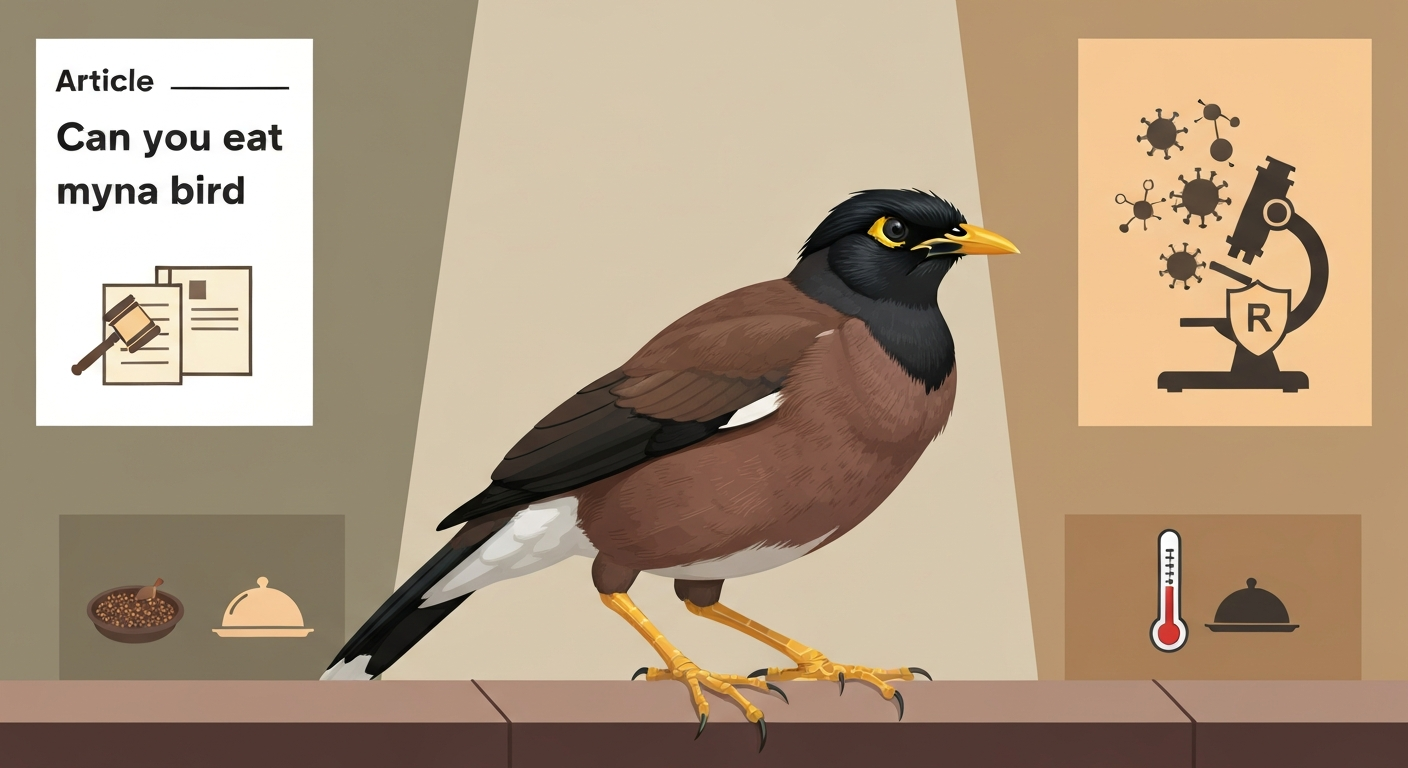
Legal and conservation checks you must do first
Before you touch a wild myna (or any wild bird) with the idea of eating it, you need to check three layers of law: international trade conventions, national wildlife legislation, and state or provincial rules. Getting this wrong is not a minor issue. In many jurisdictions, killing a protected bird without authorization is a criminal offence with serious fines and, in some cases, imprisonment.
The common myna is assessed as Least Concern on conservation metrics, which sounds reassuring, but it is simultaneously ranked among the world's most damaging invasive species outside its native South Asian range. That dual status means different jurisdictions treat it very differently. In New South Wales, Australia, the Indian myna is listed in Schedule 3 of the Game and Feral Animal Control Act 2002, classifying it as a feral pest animal subject to state-level control rules. That is one of the clearest legal frameworks allowing its lethal control. But the same bird in another country or another Australian state may fall under entirely different rules.
In the United States, the Migratory Bird Treaty Act (codified at 50 C.F.R. §10.13) protects most native wild birds, and the prohibition on 'take' (which includes hunting, wounding, killing, trapping, or collecting) is sweeping. Canada's Migratory Birds Convention Act, 1994 provides equivalent federal protection. Environment and Climate Change Canada, Nature / legal protections summary notes federal law makes it illegal to kill migratory birds or destroy nests without authorization Environment and Climate Change Canada — Nature / legal protections summary. Mynas are not native to North America and are not on the MBTA's protected list there, but you still need to confirm state or local ordinances before acting. And for other birds commonly asked about (herons, ibises, gray jays), the MBTA and its Canadian equivalent are very much in force.
The practical checklist before any lethal action:
- Look up the bird's status in your specific country, state, or province (not just globally).
- Check whether it appears on any national or state protected-species list.
- Check whether it is classified as a declared pest, invasive species, or game animal under local law.
- Confirm what permit, licence, or game tag (if any) is required for lethal control.
- Check whether the method of killing is regulated (it often is, even for pest species).
- Confirm whether possession or consumption of the carcass is explicitly covered or restricted.
- Contact your state wildlife agency, Department of Conservation, or equivalent body if you are unsure.
Health and food-safety risks you need to take seriously
This is where I want to be blunt: eating a common myna that has been foraging through urban rubbish, agricultural areas, and communal roost sites carries a genuine zoonotic disease risk. These birds are not clean, grain-fed poultry. Meta-transcriptomic surveillance of invasive Indian mynas in Australia has documented a diverse virome and microbiome, meaning researchers found a wide variety of viruses and microorganisms in these birds. Separately, field studies in South Asia report enteric bacteria and antimicrobial-resistant Enterobacteriaceae (including Salmonella and ESBL-producing E. coli) in myna droppings, including strains that resist commonly used antibiotics. Urban birds are exposed to antibiotic residues, heavy metals, pesticide-treated seeds, and pathogens from the same environments where humans and domestic animals live.
The risks fall into four main categories:
- Zoonoses (diseases transmissible from animals to humans): avian influenza (HPAI/LPAI), Salmonella, Chlamydia psittaci (psittacosis), Campylobacter, and Newcastle disease are all documented in wild bird populations. HPAI outbreaks have intensified globally, and the CDC recommends N95 respirators, gloves, and eye protection when handling wild birds during outbreak periods.
- Parasites: wild birds commonly carry external and internal parasites including mites, lice, roundworms, and tapeworms. Thorough cooking kills most internal parasites but does not eliminate the risk of transfer during field dressing.
- Toxins and environmental contaminants: urban mynas forage near roads, rubbish sites, and treated crops. Studies have documented heavy-metal accumulation (lead, cadmium) in urban-foraging birds. These contaminants are not destroyed by cooking.
- Cross-contamination during handling: improper field dressing of any wild bird can contaminate your hands, tools, and food-prep surfaces with bacteria from the gut, blood, and feathers.
If you are handling a wild bird carcass for any reason (including pest control where no consumption is intended), follow CDC and Public Health Agency of Canada guidance: wear disposable gloves, avoid touching your face, change clothes after handling, and wash hands thoroughly. If you develop flu-like symptoms within 10 days of exposure, mention your bird contact to a doctor.
What the meat is actually like: quality, taste, and nutrition
Setting aside legality and health risk for a moment, what would you actually get if you cooked a myna? The common myna is a medium-small bird, roughly starling-sized, weighing around 120 to 140 grams. After plucking and gutting, the edible meat is minimal, concentrated in the breast and thighs. Think of it as roughly comparable to a starling or a large sparrow: you are not getting a meal's worth of protein from one bird without harvesting multiple individuals.
In terms of flavour, small passerine and myna-type birds that forage on insects, fruit, and urban scraps tend to produce dark, strongly flavoured meat that requires braising, slow cooking, or marinating to be palatable. This is not a delicate, mild-flavoured bird. The fat content is low, so it dries out quickly with dry-heat cooking. From a pure nutrition standpoint, wild bird meat is generally high in protein and iron and low in saturated fat, but the caloric yield per bird is small enough that the effort-to-nutrition ratio for urban mynas is genuinely poor compared to almost any alternative protein source.
Species by species: mynas, whiskey jacks, herons, ibis, and kiwi compared
A lot of readers who land on this question are also wondering about other birds in similar 'can you eat this? If you're also asking about ibises, see can you eat ibis bird for a focused look at the legal, health, and practical issues for that species. ' categories. Here is a quick comparative look at the legal and safety picture for the species most commonly asked about. The framework is the same across all of them: check legal status first, assess health risk second, consider the practical yield third.
| Species | Conservation / Legal Status | Key Health Risks | Meat Yield / Quality | Practical Verdict |
|---|---|---|---|---|
| Common/Indian Myna (Acridotheres tristis) | Least Concern globally; invasive pest in Australia (Schedule 3, NSW); not MBTA-listed in USA | ESBL bacteria, diverse virome, urban contaminants | Very low (starling-sized); strong-flavoured dark meat | Legal in limited jurisdictions; high health risk from urban birds; poor yield |
| Whiskey Jack / Gray Jay (Perisoreus canadensis) | Not threatened; protected under MBTA (USA) and MBCA (Canada) as a migratory bird | Corvid diseases; campylobacter; low zoonotic profile compared to water birds | Small; lean dark meat; reportedly edible but bland | Illegal to hunt in USA and Canada without specific authorization; avoid |
| Great Blue Heron / similar herons (Ardea spp.) | Protected under MBTA (USA) and MBCA (Canada); often protected in other countries | Documented HPAI H5 and flaviviruses in surveillance studies; Salmonella; mercury bioaccumulation from fish diet | Moderate yield; reportedly fishy and tough; historically eaten | Illegal in most jurisdictions; high contamination risk from piscivorous diet; avoid |
| White/Glossy Ibis (Eudocimus / Plegadis spp.) | Protected under MBTA (USA) and MBCA (Canada); most species protected globally | Salmonella documented in urban-foraging ibis; HPAI detected in ibis genera in surveillance; heavy metals | Moderate; dark, fishy-tasting meat | Illegal in most jurisdictions; significant zoonotic and contamination risk; avoid |
| Kiwi (Apteryx spp.) | Vulnerable to Endangered depending on species; absolutely protected under NZ Wildlife Act 1953 | Not a relevant food-safety discussion; possession itself is an offence in NZ | Irrelevant | Illegal everywhere, full stop. Do not consider this. |
The whiskey jack (gray jay) question comes up often among Canadian and northern US foragers and survivalists. Because it is protected federally in both Canada and the United States, lethal take without special authorization is simply not legal regardless of how approachable these birds are at camp. The heron and ibis questions share a similar legal barrier in North America, compounded by the fact that both are wading/water birds with documented HPAI detections and, in the case of piscivorous species like herons, significant mercury and organochlorine accumulation from their fish-heavy diets. Regional surveillance has documented that urban‑foraging ibises (Plegadis/Eudocimus) can carry Salmonella and other enteric pathogens, increasing exposure risk where birds scavenge in anthropogenic environments (Molecular evidence of zoonotic pathogens in free‑living wild birds: surveillance study (includes Plegadis/ibis detections)). Kiwi are absolutely protected under New Zealand's Wildlife Act 1953, making any lethal take an offence without Department of Conservation authority. For details on legality and food considerations, see the related page 'is kiwi bird edible'. There is no practical food context in which kiwi should be considered.
If harvesting is legal where you are: humane dispatch basics
If you have confirmed that lethal control of common mynas is legal in your jurisdiction and you intend to use the carcass for food, humane and efficient dispatch matters both ethically and practically. Stressed animals flood their muscles with stress hormones that can affect meat quality, and prolonged suffering is both unnecessary and, in many jurisdictions, a welfare offence regardless of the pest status of the bird.
The most common methods used in regulated myna-control programs include approved cage trapping followed by CO2 euthanasia (recommended by RSPCA-affiliated programs in Australia), or shooting with an appropriate firearm or air rifle in open rural settings where this is permitted. Always confirm the approved dispatch method with your local wildlife or agriculture authority, as even pest-control rules can specify what is and is not acceptable. Do not attempt to dispatch a live bird by hand unless you have training in cervical dislocation technique, and be aware that regulations vary on whether untrained members of the public may perform this method.
Field dressing, safe transport, and preparation
If you are proceeding to use the bird for food, hygiene from the moment of dispatch is non-negotiable. These steps apply to myna or any legally harvested small wild bird.
- Put on disposable nitrile or latex gloves before handling the carcass. Do not touch your face.
- Work outdoors or in a well-ventilated space. Avoid enclosed spaces where dried feather dust can become airborne.
- Pluck or skin the bird promptly. Keep feathers and offal in a sealed bag for disposal. Do not leave feathers at your processing site.
- Remove the crop, intestines, and cloaca carefully, avoiding puncturing the gut. Gut contents are the primary source of bacterial contamination.
- Rinse the carcass under cold running water and inspect the flesh for discoloration, unusual odours, lesions, or signs of disease. If anything looks wrong, do not eat it.
- Chill the dressed carcass to below 4°C (40°F) within 2 hours of dispatch. Do not let it sit at ambient temperature.
- Transport in a sealed container or bag, kept cold with ice if refrigeration is not immediately available.
- Clean and disinfect all knives, cutting boards, and surfaces used during dressing with a 1:10 bleach solution or equivalent food-safe disinfectant.
- Wash hands thoroughly with soap and water for at least 20 seconds after removing gloves.
One point worth emphasizing: do not field dress a bird that appears sick, lethargic, disoriented before death, or that you found dead rather than freshly dispatching yourself. Found-dead birds are the highest-risk category for HPAI and other pathogens. If you find a dead myna (or any wild bird) in an area with a known HPAI outbreak, report it to your local wildlife authority rather than collecting it for food.
Cooking safely: temperatures, methods, and cross-contamination rules
The good news from public health guidance is that properly cooked wild bird meat is considered safe to eat even during HPAI outbreak periods, according to both the CDC and the Public Health Agency of Canada. The key word is 'properly cooked.' Avian influenza virus and most bacterial pathogens including Salmonella are inactivated by thorough cooking to safe internal temperatures.
| Rule | Detail |
|---|---|
| Minimum safe internal temperature | 74°C (165°F) measured at the thickest part of the meat with a food thermometer. No pink flesh, no red juices. |
| Best cooking methods for small wild birds | Braising, slow-cooking in liquid, or pressure cooking. These methods reach and sustain safe temperatures and help tenderize the tough, lean muscle. |
| Avoid undercooking | Do not serve rare or medium-rare. Unlike farmed duck or beef, wild bird should never be served pink. |
| Cross-contamination prevention | Use a dedicated cutting board for raw wild game. Never use the same board or utensils for ready-to-eat food without washing and sanitizing between uses. |
| Marinades | Always marinate in the refrigerator, not on the counter. Discard used marinade; do not use it as a sauce unless boiled first. |
| Handwashing | Wash hands before and after handling raw meat. Soap and water for at least 20 seconds. |
| Storage | Cooked wild bird meat can be refrigerated for up to 3 to 4 days or frozen for up to 3 months at -18°C (0°F). |
One myth worth busting: some people assume that marinating in acidic ingredients like vinegar or citrus 'kills' pathogens. It does not reliably eliminate bacteria at safe levels, especially inside thick muscle tissue. Only heat applied to the correct internal temperature is a reliable kill step for pathogens like Salmonella and avian influenza virus.
Better options: humane pest control for invasive mynas
If your actual goal is managing mynas in your backyard or local area rather than finding a new food source, there are a range of options that sidestep the legal complexity and health risk of handling carcasses entirely. Community-based myna control programs operate in parts of Australia and New Zealand, and the methods range from non-lethal deterrents to organized trap-and-euthanize programs run under proper authorization.
- Non-lethal deterrents: remove food sources (secure rubbish bins, avoid leaving pet food outside), install bird-proof netting on fruit trees and vegetable gardens, and use visual deterrents like reflective tape or predator decoys near roost sites.
- Habitat modification: mynas prefer open, manicured areas with low ground cover. Dense, native shrub planting near your home reduces the habitat appeal for mynas without harming other species.
- Nest-site removal: mynas nest in cavities in buildings, roofs, and trees. Blocking access to cavity nest sites (hollow trees, gaps in eaves) between breeding seasons reduces local breeding pairs. Check for active nests before blocking, as disturbing active nests may have legal implications depending on your jurisdiction.
- Community trap programs: several councils and Landcare groups in Australia run authorized Indian Myna trapping programs using cage traps baited with fruit or bread, with birds euthanized by CO2. Joining a coordinated program is safer and more effective than acting alone.
- Licensed pest controllers: in high-density urban areas, engaging a licensed pest controller removes individual liability and ensures dispatch methods are legally compliant.
- Reporting and advocacy: participating in citizen science myna monitoring programs (such as the Canberra Indian Myna Action Group model) contributes data to management efforts without requiring you to handle the birds at all.
The most effective long-term myna control in residential areas consistently comes from coordinated neighbourhood-level efforts rather than individual action. A single household removing mynas while neighbours provide food and habitat has minimal population impact. If mynas are genuinely disrupting native bird species at your feeders or nesting sites, a coordinated local response is the highest-leverage action you can take.
The bottom line: a decision checklist
Use this quick checklist to decide how to proceed if you encounter this question in practice:
- Is lethal control of common mynas explicitly legal in your state, province, or country? If no or unsure: stop here, contact your wildlife authority.
- Does the law require a permit, licence, or notification for lethal control? If yes: obtain it before acting.
- Is the bird you are considering an urban forager with unknown exposure history? If yes: the health risk from contaminants and antibiotic-resistant bacteria is elevated. Weigh this seriously.
- Is there an active HPAI outbreak in your area? If yes: use full PPE for any handling and consult your health authority before consuming any wild bird.
- Have you properly chilled, dressed, and cooked the carcass to 74°C (165°F) internal temperature? If no: do not eat it.
- Have you cleaned and disinfected all surfaces and tools used in processing? If no: do this before preparing any other food.
- Is your goal pest control rather than food? If yes: consider the community trap programs and non-lethal options above as a lower-risk first step.
For most readers, the honest assessment is that common mynas are not a practical food source. The legal landscape is patchy, the health risks from urban-foraging birds are real and documented, the meat yield is small, and the effort involved in safe handling and cooking is substantial relative to the return. Where they are a genuine pest problem, organized community control programs are safer, more effective, and legally cleaner than individual harvesting for food.
FAQ
Short answer: can you eat a myna bird (especially the common/Indian myna)?
Short answer: Possibly — but only when local law and public‑health conditions allow it, and after careful risk assessment. The common (Indian) myna is not globally threatened and is invasive in many places, so conservation status alone often won’t prohibit harvest. However, legal protections, disease risks (avian influenza, enteric bacteria, antimicrobial‑resistant organisms), urban contamination, and humane‑kill and food‑safety requirements mean eating a wild myna should be done only after checking laws, local advisories, and following strict safety protocols.
What legal and conservation checks should I perform before considering eating any wild bird?
Always check: 1) National/federal laws (e.g., Migratory Bird Treaty Act in the U.S., Migratory Birds Convention Act in Canada, Wildlife Acts elsewhere) — many native jays, herons and ibises are protected. 2) State/provincial and local regulations — some jurisdictions list common myna as a pest or game species (rules vary by state). 3) Special protections — species like kiwi are legally “absolutely protected” and may never be taken. 4) Property and landowner permission — private land and protected areas have their own rules. 5) Hunting and biosecurity advisories — during HPAI outbreaks or other public‑health events, authorities may ban or restrict taking wild birds. Action: contact your state/provincial wildlife agency or local conservation authority and confirm species‑specific rules before any harvest.
What are the main health and food‑safety risks of eating wild mynas (and similar species)?
Key risks: 1) Zoonoses: avian influenza (HPAI), West Nile and other viral infections have been detected in wild birds. 2) Enteric bacteria: Salmonella, Campylobacter and E. coli (including antimicrobial‑resistant strains) can be present in feces/intestine. 3) Parasites: internal (helminths) and external parasites can contaminate meat if not properly eviscerated and cooked. 4) Urban contamination: mynas that scavenge refuse or feed on sewage‑impacted sites can bioaccumulate heavy metals, pesticides or other toxins. 5) Secondary contamination: improper field dressing, cross‑contamination, or inadequate cooking increases foodborne illness risk. Mitigation: use PPE when handling, avoid harvesting sick birds, get carcasses tested if disease suspected, and always fully cook meat (recommended internal temp per poultry standards).
What should I expect about meat quality, taste and nutrition from myna and similar small wild birds?
Meat quality notes: 1) Size/taste: mynas and small jays are small and lean; flesh may be dark, strong‑flavored, or gamey, and yield is low. 2) Texture: small passerines can be tough if overcooked; low‑and‑slow or stewing can improve palatability. 3) Nutrition: like other small birds, meat provides protein and micronutrients but quantities are modest. 4) Wading birds (herons, ibises) may have stronger flavor and variable fat content tied to diet; they can also accumulate contaminants from wetlands. Expect variable quality and consider culinary methods for stronger game flavors.
If harvest is legal and you decide to proceed, what PPE and field‑handling precautions should you follow?
Field precautions: 1) Wear impermeable gloves (nitrile) whenever handling carcasses or viscera. 2) Use eye protection and a well‑fitting respirator (N95) if there’s risk of aerosolized material or during HPAI outbreaks. 3) Minimize contact with blood and feces; avoid mouth/face contact. 4) Carry clean tools and disposable bags; do field dressing on nonporous surfaces if possible. 5) Keep harvested birds cool and transport in sealed containers to a safe processing area. 6) Wash hands and disinfect clothing and tools after handling. If you develop flu‑like symptoms after exposure, seek medical advice and tell clinicians about the exposure.
What are evidence‑based humane‑kill and evisceration guidelines if harvesting is legal?
Humane‑kill & evisceration: 1) Use the most humane method available and legal in your area (e.g., single‑shot firearm at close range with correct caliber, or approved captive‑bolt or cervical dislocation performed by trained persons for small birds). Avoid prolonged suffering. 2) Follow local hunting regulations for acceptable methods. 3) After death, bleed promptly and begin evisceration using clean, dedicated tools; remove crop, intestines and air sacs carefully to avoid contaminating muscle with gut contents. 4) If the bird looks diseased (lesions, abnormal swelling, discolored organs), do not consume — contact wildlife/health authorities. 5) Dispose of offal and carcass parts following local rules (burial, incineration or designated disposal) and avoid leaving remains where scavengers or people are exposed.