Bird vetch (Vicia cracca) is technically edible in small quantities for most healthy adults, but it is not safe to eat freely. The seeds contain toxic glycosides, including vicine and convicine, that can trigger a serious hemolytic reaction in people with glucose-6-phosphate dehydrogenase (G6PD) deficiency, and repeated or large-quantity seed consumption poses real risks to livestock and birds. For pets, especially dogs and cats, the risk is higher than most owners assume. The practical answer: unless you are foraging with expert guidance and know your G6PD status, leave bird vetch alone.
Is Bird Vetch Edible? Safety, Toxicity, and Feeder Tips

Maya Bennett
14 Jul 2026
What is bird vetch?
Bird vetch is the common name most often applied to Vicia cracca L., a sprawling perennial vine in the legume family (Fabaceae). It goes by several other names including tufted vetch, cow vetch, and blue vetch. Native to Eurasia, it was introduced to North America and is now widespread across roadsides, hedgerows, meadows, and disturbed ground from coast to coast in the US and Canada. You will also encounter the name 'bird vetch' applied loosely to Vicia sativa (common vetch or garden vetch), which is an annual species used as a forage and cover crop. Both species share similar chemistry, so the risk profile discussed in this article applies across the group.
Both Vicia cracca and Vicia sativa are nitrogen-fixing plants that thrive in poor soils. Because they are vigorous climbers that readily seed into new areas, they can become weedy in managed gardens or around bird feeding stations. That is worth keeping in mind if you run a backyard feeding setup: vetch that establishes itself in the seed-drop zone beneath feeders is not just a garden nuisance, it is a plant your dogs, cats, and resident birds may nibble.
Visual ID: how to recognize bird vetch in the field
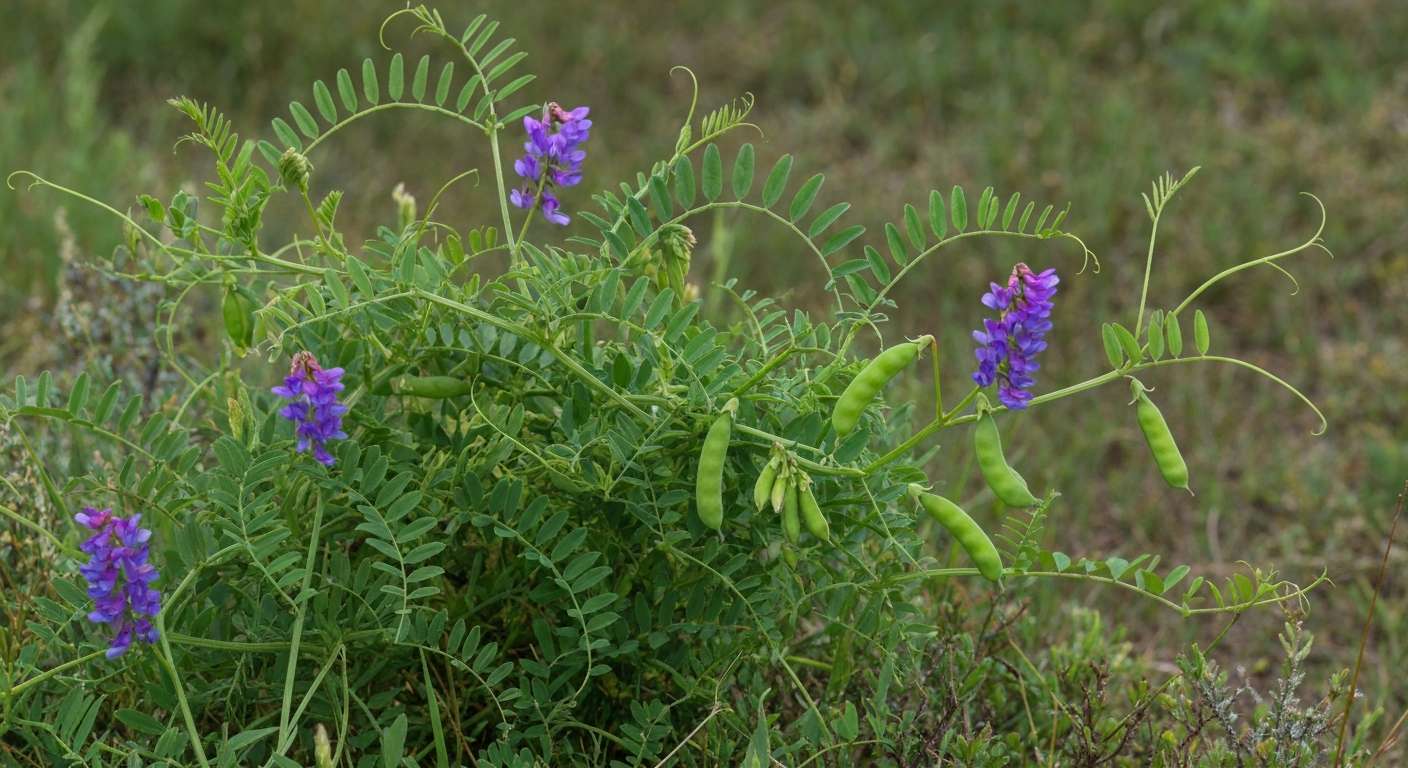
Getting the ID right matters before you make any decision about edibility or risk, so here are the features to look for. Vicia cracca has pinnate leaves (arranged in pairs along a central stem) that terminate in branching tendrils, not a single leaflet. Each leaf typically carries 8 to 12 pairs of small, narrow leaflets. The stem is softly hairy and the plant scrambles over neighboring vegetation using those tendrils.
The flowers are the most distinctive ID feature. They appear in long, one-sided racemes (clusters) of 20 to 40 drooping purple-blue pea-type flowers in late spring through summer. This dense, one-sided arrangement is quite different from the scattered flower pairs seen on many other vetches. After flowering, the plant produces small, flattened pea-like pods, typically 1.5 to 2.5 cm long, each holding 4 to 8 round dark seeds. The pods turn dark brown to black when ripe and split open audibly on warm days.
- Leaves: pinnate, 8-12 pairs of narrow leaflets, ending in branching tendrils (not a leaflet tip)
- Stem: softly hairy, twining, climbs to about 1-2 meters
- Flowers: dense one-sided raceme of 20-40 blue-purple pea-flowers, drooping, blooming May-August
- Pods: small, flat, pea-like, 1.5-2.5 cm, dark brown/black at maturity, 4-8 seeds per pod
- Seeds: small, round, dark brown to black
- Habitat: roadsides, meadows, hedgerows, disturbed ground, and garden edges
For photo reference, iNaturalist hosts thousands of verified, geotagged observations for both Vicia cracca and Vicia sativa under Creative Commons licenses, and Wikimedia Commons has high-resolution botanical illustrations and photographs of both species. Cross-referencing at least two clear photos against the features above before making any ID decision is a good habit.
Look-alikes and how to tell them apart
Vetch has several convincing look-alikes in the legume family, and misidentification is the most common reason people run into trouble with foraged legumes. Here are the ones worth knowing.
Tufted vetch vs. common vetch (Vicia cracca vs. Vicia sativa)
These two are closely related and both are sometimes called 'bird vetch.' Vicia sativa typically has fewer leaflet pairs (3-8), larger flowers that appear in pairs at leaf axils (not long racemes), and slightly larger pods. Both have similar toxic chemistry. The raceme-versus-paired-flower distinction is the quickest separator in the field.
Sweet pea (Lathyrus odoratus) and related Lathyrus species
Sweet peas and their wild relatives (genus Lathyrus) look very similar to vetches. Key differences: Lathyrus species often have winged stems and broader leaflets, and many have only 1-2 pairs of leaflets per leaf rather than the 8-12 pairs typical of Vicia cracca. Lathyrus species, particularly Lathyrus sativus (grass pea), contain neurotoxic amino acids (ODAP/BOAA) and are more acutely dangerous than most Vicia species. Never eat a Lathyrus species on the assumption it is safe vetch.
Hairy vetch (Vicia villosa)
Hairy vetch is the Vicia species with the most documented livestock toxicity (see the risk table below). It looks very similar to Vicia cracca but the whole plant is notably more hairy and shaggy. The flower racemes are also one-sided and purple, but the leaves tend to have more leaflet pairs and the plant often trails more aggressively. If you are unsure whether you have V. cracca or V. villosa, treat it as V. villosa from a safety standpoint.
Birdsfoot trefoil and other low-growing legumes
Birdsfoot trefoil (Lotus corniculatus) is sometimes confused with vetches at a distance, but it has only 5 leaflets in a trefoil arrangement and bright yellow flowers. Lupines (Lupinus spp.) also share the legume family but have distinctive palmate (hand-shaped) leaves and large upright flower spikes. Neither should be confused with Vicia if you check the leaf structure carefully.
Confusing names and myths: bird vetch, bird cherry, bird berries, and bird saliva
The word 'bird' in a plant name does not mean it is safe for humans or pets. Bird vetch, bird cherry, and bird berries are three completely different plants that cause different problems, and they are regularly confused in search results and casual conversation. For a specific discussion on bird cherry edibility, see can you eat bird cherry. Bird cherry (Prunus padus) is a tree with small dark fruits, while bird berries is a broad colloquial term that can refer to several unrelated species, some of which contain cyanogenic compounds. None of these are related to Vicia, and their edibility profiles are quite different. If you’re specifically wondering whether bird cherries are poisonous, see the section titled "are bird cherries poisonous" for details.
Another question I see come up in backyard birder communities is whether 'bird saliva' poses any risk, usually in the context of hand-feeding birds or handling feeder-visiting species. Bird saliva is not considered edible or a direct toxin, but it can carry Salmonella and other pathogens. A 2020-2021 CDC investigation linked a multistate human Salmonella outbreak to contact with wild songbirds and contaminated feeders. That is a real and documented risk, and it has nothing to do with plant toxicity, but it is worth flagging in any conversation about backyard bird safety.
Risk summary: toxicity by species and plant part
| Species/Audience | Leaves | Flowers | Seeds/Pods | Overall risk level | Notes |
|---|---|---|---|---|---|
| Humans (healthy adults) | Low risk in small amounts | Low risk | Moderate risk (especially large quantity) | Low-moderate | G6PD-deficient individuals face hemolytic anemia risk even from small seed doses |
| Humans (G6PD deficiency) | Uncertain/avoid | Uncertain/avoid | High risk | High | Vicine/convicine trigger hemolysis; treat as toxic |
| Dogs | Low-moderate risk | Low-moderate risk | Moderate-high risk | Moderate | GI upset likely at moderate doses; systemic signs possible with large ingestion |
| Cats | Low-moderate risk | Low-moderate risk | Moderate-high risk | Moderate | Similar to dogs; lower body weight increases relative dose risk |
| Wild birds | Low risk documented | Low risk documented | Low-moderate risk (large quantity) | Low-moderate | No well-documented fatal avian toxicosis from wild Vicia; feeder hygiene is a greater practical concern |
| Kept/pet birds (parrots, budgies) | Caution advised | Caution advised | Caution advised; avoid large amounts | Low-moderate | Limited peer-reviewed data; cyanogenic compounds present; do not make vetch seeds a dietary staple |
| Cattle/horses (Vicia villosa) | Moderate risk | Moderate risk | High risk at large dose | High | Hairy vetch toxicosis documented with systemic granulomatous disease; fatal cases on record |
| Poultry/broiler chicks | Low risk | Low risk | Moderate-high risk (large quantity) | Moderate | Vicine/convicine plus beta-cyanoalanine compounds depress growth; neurologic signs at high doses |
A note on Vicia species: the risk levels above are most directly supported for Vicia sativa and Vicia cracca. Vicia villosa (hairy vetch) consistently sits at the higher end of the risk range, especially for cattle and horses. When you cannot be certain which Vicia species you have, default to the higher risk category.
Is bird vetch edible for humans?
Young shoots and leaves of Vicia species have been eaten in parts of Europe and Asia, historically as a famine food or spring green, and there are foraging accounts of cooking the young tips as a pot herb. Seeds, however, are the real concern. Vicia sativa seeds contain vicine and convicine, oxidant glycosides that are also found in fava beans (Vicia faba) and are responsible for the condition called favism, a potentially life-threatening hemolytic anemia triggered in people with G6PD deficiency. Case reports document hemolytic anemia after ingestion of Vicia seeds in people with G6PD deficiency Case reports document hemolytic anemia after ingestion of Vicia seeds in people with G6PD deficiency.. If you have G6PD deficiency, or if you do not know whether you do, avoid vetch seeds entirely.
For healthy adults without G6PD deficiency, small experimental quantities of cooked young vetch greens are unlikely to cause serious harm, but this is not a plant with an established culinary tradition that justifies casual foraging. The seeds in particular should not be eaten raw. If seeds are consumed in significant quantity, the cyanogenic compounds and β-cyanoalanine-related toxins present in Vicia can cause nausea, vomiting, and in sensitive individuals, neurological effects.
Safe practices if you forage vetch
- Confirm your G6PD status with a blood test before consuming any Vicia species, especially seeds
- Harvest only young, unfurled shoot tips before the plant flowers, well away from roadsides or sprayed areas
- Boil greens thoroughly and discard the cooking water before eating
- Do not eat the seeds raw or dried; if you cook them, do so in multiple changes of water
- Start with a very small amount and wait 24 hours to monitor for any reaction before eating more
- Never forage from plants growing near bird feeders where seed contamination, mold, or Salmonella exposure from bird droppings is a real possibility
First aid for human ingestion
If someone eats a significant quantity of vetch seeds and develops symptoms including pallor, rapid heartbeat, dark or discolored urine (a sign of hemolysis), nausea, or weakness, treat this as a medical emergency. Call Poison Help at 1-800-222-1222 (AAPCC, US) for immediate free clinical guidance, or call 911 if the person is unconscious, having seizures, or having difficulty breathing. For skin or eye contact with plant sap, rinse with clean water for 15 to 20 minutes and contact poison control for further advice.
Is bird vetch poisonous to pets (dogs and cats)?
The honest answer is: it can be, and the risk scales with how much the animal eats, its body weight, and its age. See the article Is bird vetch poisonous for a focused summary of toxicity, symptoms, and species-specific risks (internal reference d46a3c6e-7232-48e8-a607-c0e4bacecec7). A large adult dog that sniffs or briefly chews a few leaves is unlikely to show more than mild gastrointestinal upset. A small dog or a puppy that eats a handful of ripe seeds is in a different category. For suspected pet poisoning, contact Pet Poison Helpline – contact and hotline information at 855-764-7661 (or your veterinarian or emergency clinic) for urgent guidance. The same logic applies to cats, and because cats tend to be lighter, a smaller absolute dose delivers a proportionally larger toxic load.
The toxic compounds in Vicia seeds, particularly vicine, convicine, and beta-cyanoalanine-related compounds, can cause oxidative stress and cyanide-like effects at higher doses. In livestock (especially cattle and horses grazing hairy vetch), documented toxicosis has included severe systemic granulomatous disease with skin lesions, diarrhea, wasting, and death. While this level of exposure is unlikely in a backyard pet scenario, the underlying chemistry is real. Consistent or repeated nibbling of vetch growing under a feeder is worth addressing.
Symptoms to watch for in dogs and cats
- Vomiting or diarrhea within 1-6 hours of ingestion
- Drooling or lip-licking (nausea sign in dogs)
- Lethargy or weakness
- Skin irritation or redness (especially with hairy vetch/V. villosa)
- Pale gums (possible sign of hemolysis at higher doses)
- Neurological signs: tremors, wobbliness, or seizures (large-quantity ingestion)
What to do if your pet eats bird vetch
- Do not wait to see if symptoms develop if your pet ate seeds or a significant amount of plant material
- Call ASPCA Animal Poison Control Center at 888-426-4435 or Pet Poison Helpline at 855-764-7661 immediately; have the pet's weight and an estimate of the quantity eaten ready
- Contact your veterinarian or nearest emergency clinic for guidance on whether to induce vomiting at home or bring the animal in
- Do not attempt to induce vomiting in cats or in dogs that are already showing signs of sedation or neurological symptoms without veterinary instruction
- If your pet shows pale gums, seizures, collapse, or extreme lethargy, go to an emergency vet immediately rather than calling first
Managing bird vetch in your yard and around feeders
If you run a bird feeder, the ground beneath it is prime real estate for opportunistic plants. Spilled seed creates disturbed, nutrient-rich soil that vetch loves. Once established, it spreads quickly by seed and can smother low plants within a season. Here is how to keep it from becoming a problem.
- Clear spilled seed from beneath feeders at least twice a week to reduce germination-friendly soil disturbance
- Hand-pull young vetch plants before they flower and set seed; place pulled material in a sealed bag for trash, not compost, to prevent seed spread
- If pulling established plants, wear gloves and wash hands thoroughly afterward; plant sap can carry soil pathogens near bird feeding areas
- Avoid using weed killers directly beneath feeders where residue could contaminate seed that falls to the ground and is eaten by ground-feeding birds
- Store bird seed in sealed, dry containers to prevent moisture-driven germination and mold; moldy seed poses its own documented risks to birds (aspergillus, aflatoxins) entirely separate from vetch toxicity
- If vetch has seeded heavily in your yard, consider a barrier cloth or gravel apron beneath the feeder to interrupt germination without chemicals
A final practical note: feeder hygiene matters more to the health of your backyard birds than vetch in the adjacent planting. The well-documented Salmonella risk from contaminated feeders, established by CDC investigation, is a higher daily-probability threat than birds eating wild vetch. Clean your feeders every 1 to 2 weeks with a 10 percent bleach solution, rinse thoroughly, and dry completely before refilling. Removing moldy or caked seed promptly is non-negotiable. Keeping the space safe for birds, pets, and your family is really about consistent maintenance, not just plant removal.
FAQ
Short verdict: Is bird vetch (Vicia spp.) edible or poisonous?
Verdict: Bird vetch (common/tufted vetch and close Vicia relatives) is not a safe general food. Small accidental tastes are unlikely to cause major harm in healthy humans or birds, but seeds and large ingestions can contain toxic compounds (vicine/convicine and related metabolites) that have caused illness in livestock, occasional human hemolysis in G6PD‑deficient people, and documented disease in grazing animals. Treat it as potentially toxic and avoid deliberate consumption or allowing pets/stock to eat large amounts.
How do I visually identify bird vetch (key features)?
ID checklist: twining or sprawling herbaceous vine/annual or perennial stems; pinnate leaves with 6–12 small leaflets ending in a tendril; one‑sided racemes of drooping pea‑type flowers (purple/blue, sometimes pink/white) resembling garden pea/bean flowers; slender pea pods with several round seeds; stems often hairy on Vicia cracca. Use the combination (leaflet number + terminal tendril + pea‑flowers + pods) to confirm Vicia vs look‑alikes.
What common look‑alikes should I watch for and how to tell them apart?
Look‑alikes: Lathyrus (sweet/vetchling) species have similar pea flowers but often broader leaflets and a winged or flattened pod; Lupinus (lupine) has palmately divided leaves, not pinnate; Lotus (birds‑foot trefoil) has distinctive clustered pods resembling a bird's foot. Focus on leaflet arrangement (pinnate vs palmate), presence of terminal tendril (Vicia usually has one), and pod/flower arrangement to distinguish species.
Is bird vetch poisonous to humans? What are typical symptoms and risk factors?
Humans: Generally low risk from incidental contact or tiny tastes, but seeds contain vicine/convicine and related compounds that can cause oxidant‑induced hemolysis in people with G6PD deficiency (favism‑like reaction) and GI upset in larger ingestions. Symptoms (if they occur) may include nausea, vomiting, abdominal pain, weakness, dark urine or jaundice (hemolysis). Onset: hours to a few days depending on dose and individual susceptibility.
Is bird vetch poisonous to pet mammals (dogs, cats, livestock)?
Pets & livestock: Dogs and cats are unlikely to suffer severe effects from a small nibble, but large ingestions of seeds or mature plants can cause gastrointestinal upset and, in livestock (cattle, horses, sheep), documented syndromes include dermatitis, wasting, diarrhea, neurologic signs, and sometimes fatal granulomatous disease — risk increases with amount consumed and species (livestock > companion pets).
Are wild or pet birds at risk from eating bird vetch?
Birds: There is limited evidence of routine fatal toxicity to wild or companion birds from Vicia spp.; small amounts of foliage or seed are unlikely to kill most passerines. However, poultry and rapidly growing/young birds can be more sensitive — studies report adverse effects when vetch seeds are a large dietary component. More important risks for backyard birds are moldy/spilled seed, contaminated feeders, and infectious agents (Salmonella, Aspergillus).
Next Article
Are Bird Berries Poisonous to Humans? What to Do Now
How to tell if bird berries are toxic, what to do after tasting, and safer backyard and pet prevention tips.