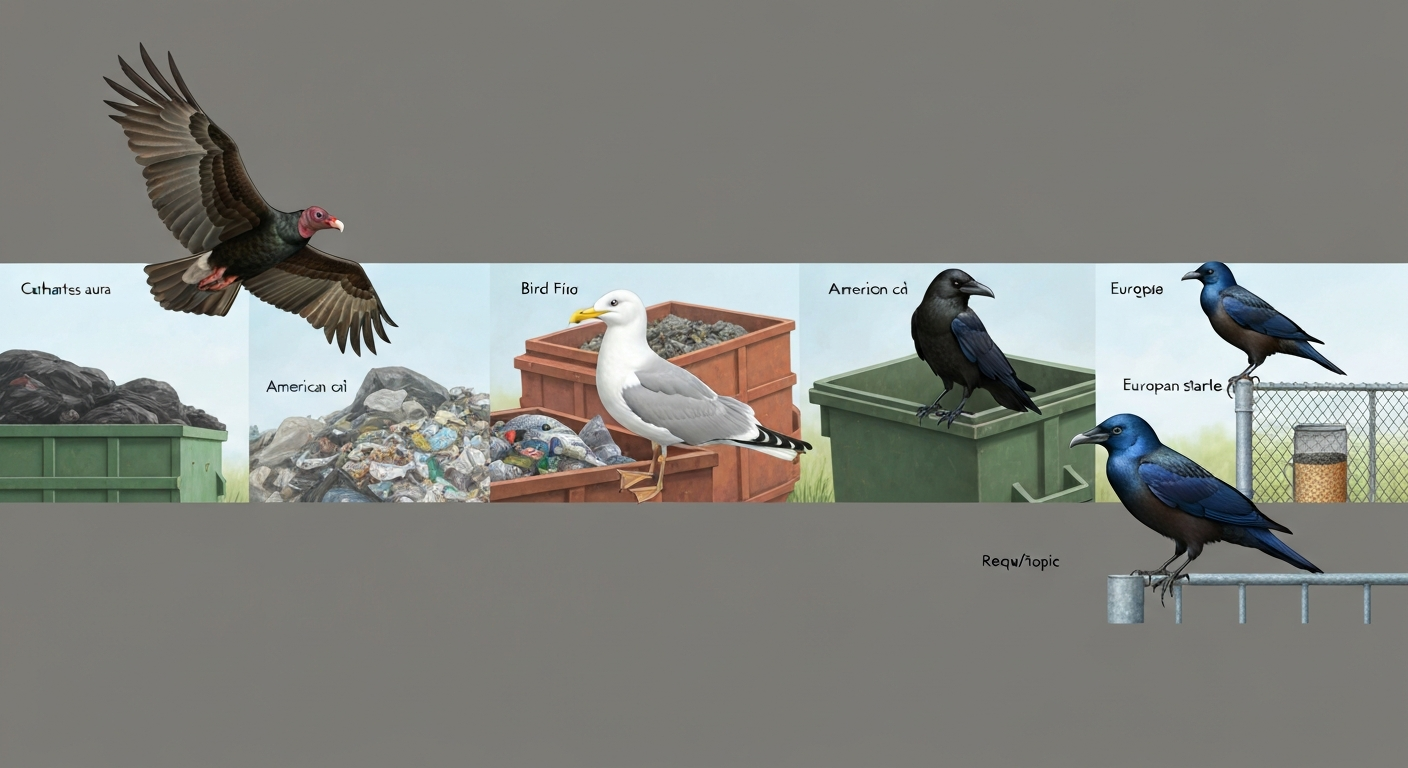
If you had to name a bird that would make a disgusting meal, the turkey vulture tops the list without much competition. After that, garbage-foraging gulls, crows, ravens, European starlings, and grackles round out the group. These birds taste foul (sometimes literally), carry heavy bacterial and toxin loads, bioaccumulate mercury and lead, and in most cases are legally protected anyway. There is no safe, legal, or remotely appetizing reason to eat one, and this article explains exactly why.
Name a Bird That Would Make a Disgusting Meal: Vultures, Gulls
Maya Bennett
18 Jul 2026
The birds you really do not want on your plate
This list is aimed at backyard birders and nature educators who might encounter these species regularly at feeders, in parks, or along the waterfront. None of these birds should ever be harvested for food, both for practical reasons you will read below and for legal ones covered later in this article.
- Turkey vulture (Cathartes aura): obligate scavenger, feeds almost exclusively on carrion, notoriously contaminated with lead and putrefaction bacteria
- Black vulture (Coragyps atratus): similar diet to turkey vulture, also a roadkill and carcass specialist
- Herring gull and other large gulls: regular visitors to landfills, sewage outfalls, and fish-processing waste sites; high Campylobacter and Salmonella detection rates
- American crow and common raven: highly intelligent omnivores that readily eat garbage, carrion, and waste — documented carriers of Salmonella, Cryptosporidium, and Giardia
- Blue jay: less of a scavenger than crows but still an omnivore that eats carrion and waste when opportunity arises
- European starling: non-native invasive species, feeds heavily around livestock waste and grain stores, strongly linked to Salmonella contamination in agricultural settings
- Common grackle and great-tailed grackle: urban omnivores that forage in dumpsters, fast-food parking lots, and animal waste — poor flavor and bacterial risk
- Rock pigeon (feral pigeon): congregates around human food waste, carries Histoplasma, Cryptococcus, and various enteric bacteria in fecal matter
Why garbage-feeders and scavengers taste so bad
Flavor in meat is a direct reflection of what the animal ate and how its tissues processed those inputs. Scavengers and garbage-feeders eat decomposing protein, salt-laden human food waste, industrial runoff, soap residues, and rotten fish. That diet saturates muscle tissue with volatile fatty acids, sulfur compounds, and bile byproducts that no seasoning can fully mask. Old-world hunters who have reluctantly eaten crow or raven describe the flesh as bitter, stringy, and sometimes with an almost ammonia-like aftertaste. Vulture flesh is generally described as smelling of decay even before cooking, because the birds regurgitate stomach acid onto their legs as a cooling mechanism and the acid also permeates the feathers.
Beyond flavor, the biochemistry matters. Gulls that feed at landfills and sewage sites bioaccumulate mercury through aquatic food chains, and elevated mercury levels have been well documented in large gull tissues and eggs. Turkey vultures in California show lead levels directly associated with ingesting animals killed with lead ammunition, according to research published in PLoS ONE (2009). Anticoagulant rodenticides and organochlorine pesticides have also been documented in wild scavenging birds that consume poisoned carcasses or contaminated prey. None of those toxins cook out. High heat destroys botulinum toxin (which is heat-labile), but it does not remove heavy metals, and it does not destroy Clostridium botulinum spores themselves, which can survive normal cooking and later germinate in improperly stored meat.
The actual health risks: pathogens, parasites, flu, and toxins
Eating or even handling these birds creates a real spectrum of health risks. The pathogen load in scavengers and garbage-feeders is not theoretical. Multiple published studies have detected Campylobacter spp. and antimicrobial-resistant Salmonella in gull feces, particularly in birds using human waste sites. Corvids (crows, ravens, and jays) have been shown to carry Salmonella, Cryptosporidium, and Giardia in fecal and environmental samples. European starlings have been directly implicated in amplifying Salmonella on dairy farms through feed-site contamination. A longitudinal study of feed contamination by European starling excreta in Ohio dairy farms (Sanad et al., 2013) documented starling fecal contamination at feed sites and linked starlings to Salmonella amplification A longitudinal study of feed contamination by European starling excreta in Ohio dairy farms (Sanad et al., 2013) documented starling fecal contamination at feed sites and linked starlings to Salmonella amplification.. These are not rare findings; they represent consistent patterns across geographies.
Highly Pathogenic Avian Influenza (HPAI H5N1) is a current and serious concern. CDC interim guidance from 2024 explicitly warns against contact with sick or dead wild birds and identifies direct contact with carcasses and organs as a recognized exposure pathway. The virus is circulating in wild bird populations across North America right now. Any dead wild bird you find could be an HPAI casualty, and there is no visual test that rules it out in the field.
| Bird | Primary health risk | Toxin/contaminant concern | Pathogen examples |
|---|---|---|---|
| Turkey vulture | Botulism toxin concentration in carcasses it feeds on | Lead (from ammunition in carcasses) | Clostridium spp., HPAI exposure risk |
| Herring/large gulls | Zoonotic enteric bacteria, antimicrobial resistance | Mercury, persistent organic pollutants | Campylobacter, Salmonella (resistant strains) |
| American crow / raven | Multi-pathogen fecal contamination, mechanical vector | Rodenticide secondary poisoning | Salmonella, Cryptosporidium, Giardia |
| European starling | Salmonella amplification at feed sites | Pesticide residues | Salmonella spp. |
| Grackles | Urban waste diet, enteric bacteria | Low but present contaminant exposure | Salmonella, Campylobacter |
| Rock pigeon | Fungal and bacterial fecal hazard | Low heavy-metal load | Histoplasma capsulatum, Cryptococcus, Salmonella |
It is also illegal: protected species and harvest laws
Most birds you encounter in a backyard or at a feeder are protected under the Migratory Bird Treaty Act of 1918 (MBTA), which makes it illegal to take, kill, capture, possess, or transport covered species without federal authorization. The list of protected species is codified in 50 CFR §10.13 and is extremely broad: it covers virtually all native North American birds including vultures, gulls, crows, ravens, jays, grackles, and most songbirds. Violations can result in civil fines and criminal prosecution.
There are exactly three common backyard species that are not protected under the MBTA because they are non-native invasives: the European starling, the house sparrow, and the feral rock pigeon. USDA APHIS explicitly lists these as species that can be controlled without MBTA permits, though state and local regulations still apply. Even for these three, eating them carries the bacterial and contaminant risks described above, and no health agency recommends it. For every other backyard bird, harvesting is simply illegal regardless of how you feel about the flavor question.
How to recognize these risky species in your yard
Being able to identify these birds quickly is genuinely useful for backyard birders: it helps you understand what is visiting your feeder, assess any disease risk to your pets or other backyard birds, and report unusual die-offs to wildlife authorities. Here are the key field marks for each group.
Turkey vulture and black vulture
- Turkey vulture: large (26-32 inches), all-black body, naked red head, two-toned underwing (black leading edge, silver-gray flight feathers), holds wings in a shallow V (dihedral) while soaring, rocks side to side in flight
- Black vulture: slightly smaller and stockier, black head (not red), white patches at wingtips visible from below, shorter tail, flaps more frequently than turkey vulture
- Both: often seen roosting in groups on dead trees, utility poles, or rooftops near open land; rarely visit feeders but may appear if a carcass is nearby
Gulls
- Herring gull (adult): large (22-26 inches), pale gray back, white head and underparts, pink legs, yellow bill with red spot, wingtips black with white spots
- Ring-billed gull: medium-sized, similar gray-and-white pattern, black ring around yellow bill, yellow-green legs — very common at parking lots and fast-food areas
- Laughing gull (coastal): dark gray back, black hood in breeding season, red bill — common scavenger at beach boardwalks and seafood docks
- Key behavior clue: any gull seen working a landfill, dumpster, or sewage outfall has an elevated pathogen burden; treat with extra caution
Crows, ravens, and jays
- American crow: all black, fan-shaped tail, nasal 'caw' call, medium size (17-21 inches), common in suburbs, parks, and agricultural areas
- Common raven: much larger (22-27 inches), wedge-shaped tail, deep gurgling or croaking call, heavy curved bill, often seen near highways and open country
- Blue jay: unmistakable blue, white, and black plumage, prominent crest, 9-12 inches, loud 'jay-jay' call, common at feeders but also an opportunistic omnivore
European starlings and grackles
- European starling: stocky, short-tailed, iridescent black with purple-green gloss, yellow bill in breeding season (dark in winter), heavily spotted with white in winter plumage, walks rather than hops, travels in large murmurations
- Common grackle: long-keeled tail, iridescent black with bronze or purple sheen, pale yellow eye, 11-13 inches, male has boat-shaped tail in flight
- Great-tailed grackle: larger version common in the South and Southwest, very long wedge-shaped tail on males, loud rattling calls
Busting the myths: birds that eat birds, fire, and humans
Questions about bird diets can get surprisingly creative, and some of the sibling questions that circle this topic deserve straight answers. Yes, quite a few birds eat other birds. Raptors like Cooper's hawks, sharp-shinned hawks, and peregrine falcons are dedicated avian predators. Crows and ravens will take nestlings and eggs, and great horned owls will eat almost any bird they can catch. For more detail on corvid predation and whether a crow will eat another bird, see will a crow eat another bird. Whether that constitutes cannibalism depends on the species involved: a crow eating another crow's chick is arguable cannibalism, while a hawk eating a sparrow is predation. Birds do not eat fire, obviously, though some species like black kites in Australia have been documented carrying burning sticks to spread grass fires and flush out prey, which is a remarkable but very different behavior. If you’re wondering which bird eat fire, documented behaviour shows black kites in Australia carrying burning sticks to spread grass fires and flush out prey.
The idea that birds eat humans is a myth in any meaningful sense. For more detail on the question 'what bird eats humans', see the section addressing folklore and documented incidents. Large raptors like golden eagles and harpy eagles can theoretically inflict serious wounds, and cassowaries (which are technically birds) are genuinely dangerous and have killed people, but no bird species hunts humans as prey. The question tends to come from folklore about giant eagles carrying off children, which does not have credible modern documentation. What is documented is that several of the corvids and scavengers on this list will feed on a human corpse if one is left accessible outdoors, because they are opportunistic carrion feeders. That is a biological fact rather than predatory intent, and it underscores why these birds carry such heavy pathogen loads.
Do not cook that carcass you found outside
Every now and then someone finds a dead bird in the yard and wonders whether anything useful can be done with it. The answer is no. Penn State Extension's Proper Field Dressing and Handling of Wild Game and Fish explains that prompt evisceration, rapid cooling, hygienic field‑dressing, and cooking wild‑game poultry to at least 165°F (74°C) reduce bacterial and parasitic risks Proper Field Dressing and Handling of Wild Game and Fish — Penn State Extension. A found carcass cannot be visually inspected for HPAI, Salmonella, or botulism toxin concentration. You cannot smell or see lead contamination in muscle tissue. Decomposition can begin within hours in warm weather and progresses from the inside out, meaning the surface of a carcass can look intact while the interior has already crossed into dangerous bacterial territory. USDA FSIS notes that while botulinum toxin is heat-labile and can be destroyed by thorough cooking, C. botulinum spores are heat-resistant and can survive normal cooking temperatures, meaning improper storage after cooking can allow the toxin to reform. That is a very tight margin of error for a bird that was already sitting on the ground.
CDC guidance for HPAI specifically warns against any contact with dead wild birds. If you find one in your yard, use gloves or an inverted plastic bag to pick it up, place it in a sealed bag, and dispose of it in the trash or report it to your state wildlife agency if you suspect disease. Wash your hands thoroughly afterward. Do not allow pets to mouth or carry dead birds, since this is a genuine exposure pathway for both HPAI and Salmonella. That guidance applies to any wild bird carcass regardless of species.
Keeping your feeder safe when these birds show up
Scavengers like vultures rarely come to feeders, but corvids, starlings, grackles, and gulls do. When they arrive in numbers they can introduce disease to your feeder environment, contaminate seed with fecal matter, and create a transmission risk for the smaller songbirds you actually want to attract. Feeder hygiene becomes especially important when these species are around regularly. Audubon and Utah State University Extension both recommend cleaning feeders and birdbaths at least once a week using a 10 percent bleach solution or hot soapy water, rinsing thoroughly and allowing to dry before refilling. Rake or remove seed debris and droppings from under the feeder, and consider suspending feeding temporarily during any local disease outbreak or HPAI alert in your area.
You can also reduce the appeal of your setup to garbage-feeders specifically. Grackles and starlings prefer platform feeders and open-tray designs. Switching to tube feeders with small ports, weight-sensitive feeders that close under heavier birds, or upside-down suet feeders (which many woodpeckers and nuthatches use easily but larger corvids and grackles find awkward) will deter the worst offenders without removing the birds you want. Store seed in sealed, hard-sided containers rather than soft bags, and check for moisture or mold before every refill. Spoiled seed is a Salmonella risk in its own right and attracts exactly the species you are trying to keep at a distance.
Feeder hygiene quick checklist
- Clean feeders and baths weekly with 10% bleach solution; rinse and dry completely before refilling
- Remove and dispose of wet, clumped, or discolored seed immediately
- Rake droppings and seed hulls from beneath feeders at least every two weeks
- Store seed in sealed metal or hard plastic containers, away from moisture
- Suspend feeding for 1-2 weeks if a disease event (Salmonella, HPAI, trichomonosis) is reported in your area
- Use weight-sensitive or small-port tube feeders to deter starlings and grackles
- If you find a dead bird near feeders, remove it with gloves, bag it, and clean the surrounding area with diluted bleach
The birds that would make the most disgusting meals are also, conveniently, the ones you have the strongest practical reasons to keep at arm's length: legally protected, pathogen-loaded, toxin-contaminated, and genuinely foul-tasting by any account. Knowing what they look like, why they are a risk, and how to manage your feeder setup around them is the most useful takeaway here. Let the vultures and crows do their ecological jobs, and keep your feeder clean for the birds you actually enjoy watching.
FAQ
Which common backyard bird species would likely make a foul or unsafe meal?
Scavengers and opportunistic garbage‑feeders: turkey vultures and other vultures, many gull species (large, dump‑feeding gulls), corvids (crows, ravens, jays), feral pigeons, European starlings, and house sparrows. These species frequently consume carrion, human waste, sewage, spoiled food, or contaminated animal feed, increasing the chance of foul taste and of carrying pathogens, toxins, or contaminants.
Why would those birds taste foul or be unsafe to eat?
Diet and decomposition: scavengers eat carrion and spoiled meat that concentrates decay products, botulinum toxin, and bacteria. Human‑waste feeders pick up enteric pathogens (Salmonella, Campylobacter) and antimicrobial‑resistant strains. Aquatic/shore birds can bioaccumulate mercury and persistent pollutants. Scavengers may also carry lead or rodenticide residues from contaminated carcasses. All these factors can make meat taste bad, be toxic, or pose infection risk.
What specific health risks are associated with eating or handling these birds?
Risks include bacterial infections (Salmonella, Campylobacter), parasites (Giardia, Cryptosporidium), botulism from preformed toxin in decomposed meat, exposure to avian influenza in sick or dead wild birds, heavy metals (lead, mercury), and rodenticide/pesticide poisoning. Improper field dressing and undercooking increase these risks. Public‑health agencies advise avoiding contact with sick/dead wild birds.
Are there legal or ethical constraints about killing or eating wild backyard birds?
Yes. Many native species are protected under the Migratory Bird Treaty Act; killing, possessing, transporting, or selling protected migratory birds without authorization is illegal. Some non‑native/invasive species (European starlings, house sparrows, feral pigeons) may be subject to control, but state and local rules still apply. Ethical concerns include conservation, animal welfare, and disease transmission. Always check federal, state, and local regulations before attempting to harvest any wild bird.
How can I visually identify risky backyard species (scavengers, gulls, corvids, starlings, pigeons)?
Visual ID clues: vultures — large, broad wings, soaring flight, often bare red or dark head; gulls — medium/large seabird shape, white/gray plumage, black wingtips, noisy coastal/urban behavior and visits to dumpsters; corvids — medium‑large black or dark birds (crows, ravens) with strong bills and upright posture; starlings — chunky, iridescent with short tails and spotted plumage in winter; feral pigeons — stocky, gray with two wing bars and variable coloring. Note behavior: scavenging, frequenting garbage dumps, and congregation at feeders or livestock feed indicates higher risk.
What safer, legal alternatives are there if someone wants to eat wild or backyard birds?
Safer choices are legally harvestable game birds where local regulations permit (e.g., certain game species during regulated seasons) or domestic poultry purchased from inspected sources. If harvesting wild birds, use species that are legal to take, follow local hunting regulations, field‑dress hygienically, cool meat rapidly, and cook to recommended internal temperatures (generally ≥165°F/74°C for poultry). Prefer birds that are not scavengers or garbage feeders to reduce contamination risk.
Next Article
What Bird Eats Upside Down? How to Identify and Attract Them
Identify the bird that eats upside down, match field marks, confirm the culprit, and attract them safely with the right