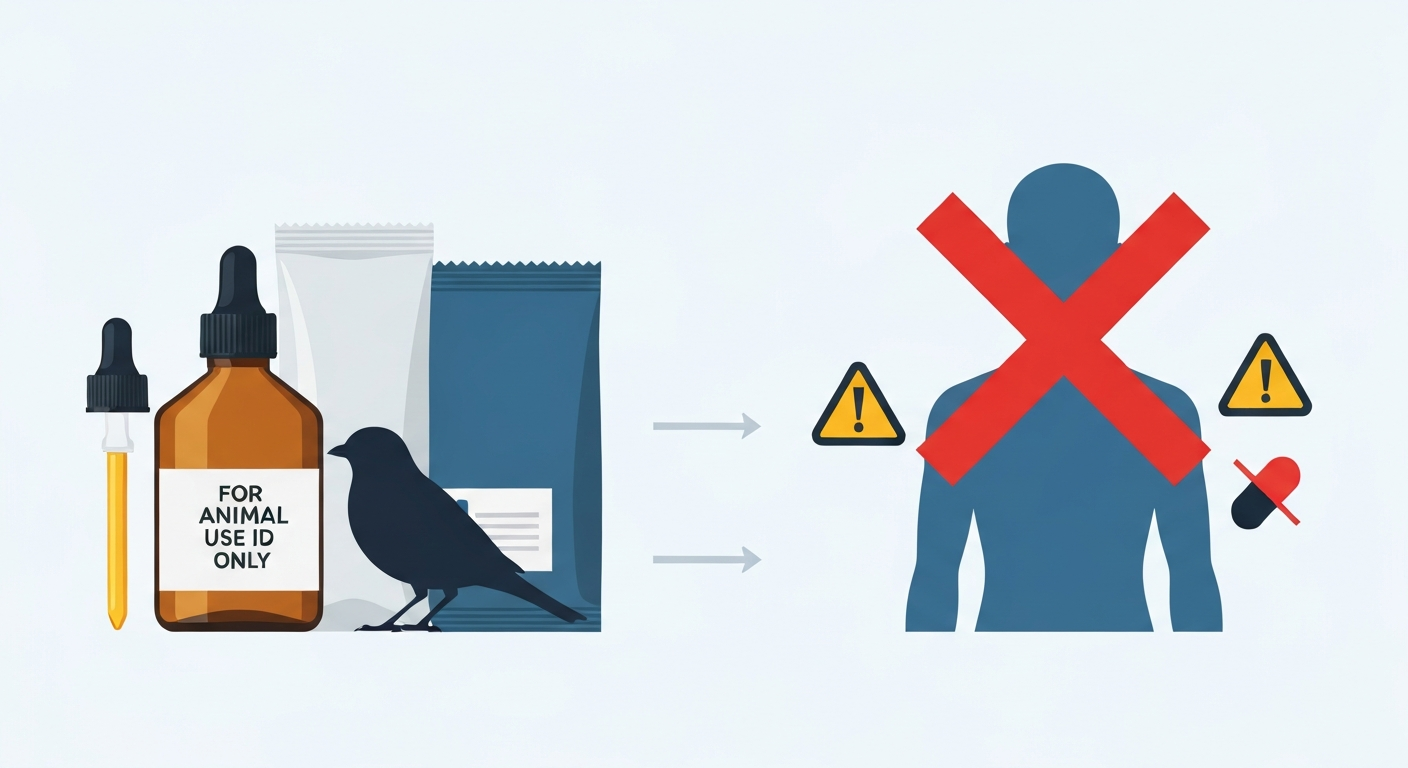
No, humans should not take antibiotics sold for birds. Bird antibiotics are not approved for human use, are often formulated at concentrations or with excipients that are unsafe for people, and using them carries real medical risks including allergic reactions, dangerous side effects, and contributing to antibiotic-resistant infections. If you or someone you know needs an antibiotic, the only safe path is a prescription from a licensed clinician.
Can Humans Take Bird Antibiotics? Safety, Risks & Advice

Maya Bennett
12 Aug 2026
Why this question keeps coming up
I hear this more than you might expect from backyard birders and wildlife rehabilitators. Someone has a sick bird, picks up a product at the feed store or online, and then wonders whether the leftover powder or solution could treat their own sore throat or a skin infection. For more on safe feeding practices and what foods are appropriate for wild and companion birds, see our guide on can bird eat nuts. The short version: it cannot, and trying is a genuinely bad idea. The longer version involves formulation chemistry, regulatory law, and some pharmacology that is worth understanding if you keep birds or stock a feeder.
What "bird antibiotics" usually are
Most products sold as antibiotics for birds fall into a handful of drug classes. Tetracyclines, especially oxytetracycline, are among the most common and are sold as water-soluble powders or feed premixes measured in grams per litre. Macrolides such as tylosin (sold as Tylan) are used in poultry and some cage birds and come as soluble powders with dosing instructions written for mass medication of flocks. Fluoroquinolones, particularly enrofloxacin (brand name Baytril), are used in companion birds and veterinary practice and are formulated as concentrated oral solutions up to 100 mg/mL (a 10% solution). Aminoglycosides appear in some injectable or topical veterinary products as well. These drugs are chosen for their activity against common avian bacterial pathogens, and their formulations are designed for birds, not people.
| Drug class | Common product name(s) | Typical bird formulation | Primary avian use |
|---|---|---|---|
| Tetracycline | Oxytetracycline powders | Water-soluble powder, g/L dosing | Respiratory, systemic infections |
| Macrolide | Tylan (tylosin) | Soluble powder or premix | Poultry respiratory disease |
| Fluoroquinolone | Baytril (enrofloxacin) | Oral solution up to 100 mg/mL | Companion bird bacterial infections |
| Aminoglycoside | Gentamicin (various) | Injectable or topical | Gram-negative infections |
| Penicillin-type | Amoxicillin (some formulations) | Powder or suspension | Broad-spectrum infections |
It is worth noting that enrofloxacin, one of the most widely recognised bird antibiotics, was withdrawn from approved use in poultry in the United States in September 2005. The FDA pulled the approval because evidence linked fluoroquinolone use in poultry to fluoroquinolone-resistant Campylobacter infections in people. That history alone tells you something important about how bird antibiotic use and human health are already connected, and not in a good way.
How bird antibiotics differ from human medicines
The active ingredient in a bird antibiotic and a human antibiotic can share the same chemical family, and that is exactly where the confusion starts. But sharing a drug class is not the same as being interchangeable. The differences in formulation, concentration, excipients, and regulatory standards are significant enough that treating them as equivalent is a mistake.
Concentration and dosing units
Baytril oral solution comes at concentrations up to 100 mg/mL, a density far above typical human oral antibiotic preparations. Veterinary water-soluble powders are dosed in milligrams per litre of drinking water for an entire flock, meaning the math behind a single bird's dose involves knowing the bird's body weight, daily water consumption, and species-specific pharmacokinetics. Published pharmacokinetic reviews confirm that avian absorption rates, half-lives, and clearance values vary so widely between species that you simply cannot convert a bird dosing regimen into a safe human dose without species-specific data. A backyard birder doing that calculation for themselves is not a safe workaround.
Excipients and solvents
Active ingredient aside, veterinary formulations contain excipients chosen for stability in animal use, not human ingestion. Safety data sheets for enrofloxacin liquid formulations list components such as n-butanol and potassium hydroxide as non-active ingredients. See the manufacturer's Enrofloxacin 2.5% Formulation, Safety Data Sheet (MSD example) for the listed non-active ingredients and disposal guidance Enrofloxacin 2.5% Formulation — Safety Data Sheet (MSD example). These are solvents and pH adjusters that work fine in a product meant for a bird's metabolism but are not approved for human consumption at the concentrations present. The SDS for these products uses hazardous-waste disposal language, which should give anyone pause about drinking or self-administering even a small amount.
Regulatory approval and quality standards
Human pharmaceutical manufacturing is held to Current Good Manufacturing Practice (cGMP) standards specifically designed to ensure purity, consistency, and sterility for human ingestion. Veterinary drug manufacturing follows its own standards, but those standards are calibrated for animal use and do not carry the same human-safety assurance. Enrofloxacin is not approved for human therapy anywhere. EMA referral document, Baytril 10% oral solution (enrofloxacin) describes Baytril as a veterinary-only product and outlines regulatory restrictions and safety concerns EMA referral document — Baytril 10% oral solution (enrofloxacin). It is partially metabolised to ciprofloxacin in the body, but that does not make enrofloxacin equivalent to taking ciprofloxacin; the pharmacology and metabolism differ between species, and the formulation quality assurances for human ciprofloxacin do not apply to a veterinary enrofloxacin solution.
| Feature | Human antibiotic (e.g., doxycycline hyclate) | Bird antibiotic (e.g., enrofloxacin solution) |
|---|---|---|
| Regulatory approval | FDA-approved for specific human indications | Approved for veterinary use only; not approved for human therapy |
| Formulation standard | Human cGMP; excipients tested for human safety | Veterinary manufacturing standards; excipients not tested for human ingestion |
| Concentration | Standardised mg/tablet or mg/mL for human dosing | Can reach 100 mg/mL; designed for avian or flock dosing |
| Dosing units | mg per dose, specific to human body weight/indication | mg/kg for birds or mg/L of drinking water for flocks |
| Labelling | Human Rx legend, FDA-approved prescribing information | "For Animal Use Only" / "Not for Human Use" required on label |
| Excipients | Approved for human oral/injectable use | May include solvents (e.g., n-butanol) not safe for human ingestion |
How to read a bird antibiotic label (and what the red flags look like)
If you handle bird medications for a companion parrot, backyard flock, or wildlife rehab work, understanding the label is a genuine safety skill. The FDA's Center for Veterinary Medicine requires animal drug labels to carry statements such as "For Animal Use Only" or "Not for Human Use" precisely to prevent confusion. Here is what to look for when you pick up a product.
- "For Animal Use Only" or "Not for Human Use": required language on veterinary products; if this is absent on a claimed antibiotic, treat the product with extra suspicion.
- Rx symbol or "Federal law restricts this drug to use by or on the order of a licensed veterinarian": this is the veterinary prescription legend and means the product legally requires a vet's involvement.
- Concentration listed as mg/mL or % solution: concentrations like 10% (100 mg/mL) are far above what human oral preparations use; they are not directly translatable to human doses.
- Dosing instructions in mg/L of water or g per ton of feed: these are flock-level or weight-adjusted bird doses, not individual human doses.
- Excipient or inactive ingredient list: if the SDS or label mentions industrial solvents, this is a hard stop for any thought of human use.
- Withdrawal period statements for food animals: these exist because residues in meat or eggs can harm people, which is itself a signal that these are not human-safe compounds at typical veterinary use levels.
- No expiry date or batch number visible: unregulated or grey-market products lack quality assurance and carry additional contamination risk.
One red flag I see regularly in online bird-keeping groups is products marketed with vague claims like "broad-spectrum" or "natural antibiotic" without listing an active pharmaceutical ingredient. These are often unregulated supplements with unknown contents, which creates a different category of risk on top of everything covered here.
Medical risks of self-medicating with bird antibiotics
This is where things get clinically serious. Pharmacovigilance analyses of FDA adverse-event data confirm that human misuse of veterinary drugs is documented and comes with real clinical consequences. The risk categories are not theoretical.
Allergic reactions
Allergic reactions to antibiotics, including anaphylaxis, can happen with any antibiotic exposure regardless of whether it came from a human pharmacy or a feed store. With a veterinary product, you have no way of knowing whether the excipients in that specific formulation will trigger a reaction. Human antibiotic preparations go through allergenicity testing as part of approval; veterinary formulations do not carry that assurance for human use.
Incorrect dosing
Getting the dose wrong with antibiotics creates two problems: too little and you fail to clear the infection, potentially selecting for resistance; too much and you risk direct toxicity. Fluoroquinolones at therapeutic human doses carry FDA boxed warnings about serious and potentially permanent adverse effects including tendinitis, tendon rupture, peripheral neuropathy, and CNS effects. These warnings apply when ciprofloxacin or levofloxacin are prescribed at known human doses by a clinician monitoring the patient. With a 100 mg/mL veterinary solution and no clinician involvement, getting that dose right is essentially impossible.
Contamination and excipient toxicity
As noted above, veterinary liquid formulations can contain solvents that are toxic to humans at the concentrations present in the product. Beyond listed excipients, veterinary manufacturing does not guarantee the absence of microbiological contaminants to human pharmaceutical standards. Feed-grade or bulk powders sold for flock treatment may also contain fillers, carriers, or anti-caking agents at concentrations designed for animal digestive systems.
Masking a serious diagnosis
Self-treating with any antibiotic, human or veterinary, can partially suppress symptoms of a bacterial infection while leaving the underlying cause untreated or undertreated. This delays a correct diagnosis, and for infections like pneumonia, sepsis, or endocarditis, that delay can be life-threatening. It can also cause false-negative results on cultures taken after antibiotic exposure, making it harder for a clinician to identify what is actually causing the illness.
The bigger picture: antimicrobial resistance and public-health risk
Beyond individual harm, using veterinary antibiotics in humans feeds a public-health problem that is already serious. The CDC, WHO, and EMA all describe antimicrobial resistance (AMR) as a One Health issue, meaning resistance develops and spreads across humans, animals, and the environment in connected ways. The 2005 FDA withdrawal of enrofloxacin from poultry use is a concrete example: fluoroquinolone use in birds was directly linked to fluoroquinolone-resistant Campylobacter infections in people. That connection ran from poultry farms to human hospitals.
WHO guidance specifically recommends restricting the use of medically important antibiotics in food-producing animals to preserve their effectiveness for human medicine. Fluoroquinolones and third- and fourth-generation cephalosporins are classified as critically important antimicrobials for human health. When people self-treat with sub-therapeutic or incorrectly dosed veterinary fluoroquinolones, they create selection pressure for resistant bacteria in their own gut microbiome, which can then spread to household contacts and the broader community.
- Incomplete antibiotic courses (common with self-treatment) are a well-documented driver of resistance development.
- Resistant bacteria can transfer resistance genes to other bacterial species, spreading resistance beyond the original pathogen.
- Fluoroquinolone resistance in Campylobacter, Salmonella, and E. coli is already a documented clinical problem partly linked to veterinary antibiotic use.
- Using veterinary antibiotics outside medical supervision means no culture and sensitivity testing, so you may be treating with a drug the bacteria are already resistant to.
Legal and regulatory issues you need to know
This is not just a medical question; it has a legal dimension that affects backyard birders, poultry keepers, and pet bird owners. In the United States, many veterinary antibiotics including enrofloxacin (Baytril) carry the veterinary prescription legend, meaning they can only be dispensed by or on the order of a licensed veterinarian. Obtaining these drugs without a valid veterinary-client-patient relationship and using them in humans is outside the law.
Import restrictions also apply. Buying veterinary antibiotics from international online sources and importing them for personal use runs into U.S. Customs and FDA import regulations. Products that have not been approved by the FDA for any use in the U.S. may be seized at the border, and using them carries additional liability because their content and purity cannot be verified.
- Prescription-only veterinary antibiotics (Rx legend products) cannot legally be dispensed without a veterinarian's order in the U.S.
- Using a veterinary drug in a human is an off-label, unapproved use that is not protected by any regulatory framework.
- Reselling veterinary antibiotics to others for human use could constitute distribution of an unapproved drug.
- If an adverse event occurs after self-treating with a veterinary antibiotic, standard pharmaceutical liability protections for patients do not apply.
- Some over-the-counter veterinary antibiotic products (a narrowing category under recent FDA rules) are still formulated and legally designated for animal use only.
If someone has already taken a bird antibiotic: what to do right now
If you or someone else has taken a bird antibiotic, contact Poison Control immediately. In the U.S., the national hotline is 1-800-222-1222 (available 24/7 through America's Poison Centers, PoisonHelp.org). Have the product label or packaging ready so the toxicologist can identify the active ingredient, concentration, and any excipients. Do not wait for symptoms to develop; some adverse effects from veterinary formulations can have a delayed onset.
- Call 1-800-222-1222 (U.S. Poison Control) immediately. If outside the U.S., contact your national poison control centre.
- Keep the product container and label. The toxicologist needs to know exactly what was taken, at what concentration, and how much.
- Do not induce vomiting unless explicitly told to do so by medical professionals.
- Go to an emergency department if you are told to, or if symptoms such as difficulty breathing, severe rash, chest pain, or confusion develop.
- Tell the clinician you saw a veterinary product and show them the label. This affects treatment decisions.
- Report the exposure to the FDA's MedWatch programme if directed; this contributes to pharmacovigilance data on veterinary drug misuse.
Safe storage and disposal for bird owners
If you keep bird antibiotics on hand for a flock or a companion bird, safe storage is a practical step that protects everyone in the household, including children, pets, and any adults who might be tempted to self-treat. For guidance on safe foods for backyard birds, including whether birds can eat peanut butter, see our related article on can bird eat peanut butter. Veterinary antibiotic powders and liquids should be stored in their original labelled containers, in a locked cabinet away from food storage areas and out of reach of children. Do not transfer them to unlabelled jars or food containers.
Disposal matters too. Safety data sheets for products like Baytril specify licensed hazardous-waste disposal and explicitly warn against allowing the product to enter the environment. Do not pour liquid veterinary antibiotics down the drain or into the garden. Many communities have pharmaceutical take-back programmes or hazardous household waste collection days. Check with your local waste authority for the correct disposal route in your area.
- Store in original labelled container, locked away from general household access.
- Keep away from food storage areas to prevent accidental ingestion or contamination.
- Never transfer to unlabelled containers or food jars.
- Check product SDS for disposal instructions; many require hazardous-waste disposal.
- Use pharmaceutical take-back programmes where available; do not flush or pour down drains.
- Dispose of expired products promptly; do not stockpile "just in case" for human use.
What this article does not provide, and why that matters
This article does not provide human dosing guidance for any veterinary antibiotic, and it will not. That is not a legal disclaimer for its own sake; it reflects a clinical reality. There is no safe human dose for enrofloxacin because it is not approved for human therapy, the formulations are not designed for human use, and the pharmacokinetics have not been validated in people. Providing a "conversion" dose would be inventing a medical recommendation with no supporting evidence or regulatory framework, and doing so could cause direct harm. The same applies to tetracyclines and macrolides sold for birds: while doxycycline and azithromycin have approved human forms, those are different salt forms, different concentrations, different excipients, and different regulatory standards from the feed-grade or veterinary products.
If you genuinely cannot access or afford a human antibiotic prescription, the right answer is to contact a community health clinic, urgent care centre, telehealth provider, or local health department, not to self-treat with a veterinary product. Many areas have low-cost or sliding-scale antibiotic access options that do not carry the medical and legal risks described here. This article's role is to make those risks clear so you can make an informed decision.
Practical checklist for backyard birders and flock keepers
If you keep birds and routinely have antibiotics on hand, here is a straightforward reference to keep things safe. For related information on bird diets, see the article what bird eats large hard shelled nuts. For guidance on feeding birds, including which species commonly eat peanuts, see what bird eats peanuts.
| Action | Do this | Avoid this |
|---|---|---|
| Storing bird antibiotics | Original container, locked cabinet, labelled clearly | Transferring to food jars, leaving accessible |
| Dosing sick birds | Follow vet prescription or veterinary label exactly, use a calibrated syringe | Guessing doses, using human dosing charts |
| Disposing of unused product | Hazardous-waste collection or take-back programme | Pouring down drain, putting in household rubbish |
| Responding to accidental human ingestion | Call 1-800-222-1222 (Poison Control) immediately | Waiting to see if symptoms develop |
| Treating your own infection | See a clinician or telehealth provider for a prescription | Using leftover bird antibiotics |
| Buying antibiotics online for birds | Purchase only from licensed veterinary suppliers with valid Rx | Importing unapproved products from overseas |
The bottom line for birders
Bird antibiotics are formulated for birds, regulated for veterinary use, and carry genuine medical and legal risks when used in humans. The active ingredients overlap in name with human drugs, but the formulation, concentration, excipients, dosing, and quality standards do not. Beyond individual risk, using veterinary antibiotics in humans contributes to antimicrobial resistance in a way that harms everyone. If you have bird antibiotics in your supplies, store them safely, dispose of them properly, and if there is ever an accidental human exposure, call Poison Control at 1-800-222-1222 before doing anything else.
FAQ
Can humans take antibiotics sold for birds to treat human infections?
No — you should not take antibiotics intended for birds to treat human infections. Veterinary antibiotics often contain different active salts, much higher concentrations, non‑human excipients, and dosing designed for animals. Using them risks incorrect dosing, allergic or toxic reactions, and promotes antimicrobial resistance. Always see a licensed healthcare provider for human infections.
What are the main medical risks if a person takes a “bird antibiotic”?
Risks include incorrect dose (overdose or ineffective dose), exposure to harmful excipients or solvents not tested for humans, allergic reactions, serious adverse effects associated with antibiotic classes (e.g., fluoroquinolone‑linked tendon rupture, neuropathy, QT effects), interactions with other medicines, and increased risk of selecting drug‑resistant bacteria that harm the individual and the community.
How do veterinary antibiotic formulations for birds usually differ from human antibiotics?
Differences include: active ingredient form (different salt or ester), much higher concentration (e.g., enrofloxacin products up to 100 mg/mL), dosing units intended for water/feed or mg/kg for many bird species, non‑pharmaceutical excipients/solvents, different purity and sterility standards, labeling that states “For Animal Use Only,” and absence of human safety/efficacy clinical data and regulatory approval for human use.
Is enrofloxacin (Baytril) the same as ciprofloxacin used in humans?
No. Enrofloxacin is a veterinary fluroquinolone that is metabolized in part to ciprofloxacin in some species, but it is not approved for human therapy. Pharmacology and metabolism vary by species and the veterinary product contains different concentrations and excipients. Human ciprofloxacin has its own approved formulations, doses, and safety warnings.
Could using bird antibiotics contribute to antimicrobial resistance (AMR)?
Yes. Using veterinary antibiotics improperly (including self‑medicating humans) can drive selection of resistant bacteria. Public‑health authorities treat AMR as a One‑Health issue: misuse in animals or humans can reduce effectiveness of antibiotics important to human medicine and has motivated restrictions on some veterinary uses of medically important drugs.
Are there legal or regulatory issues with humans obtaining or using veterinary antibiotics?
Yes. Veterinary drugs are labeled and regulated for animal use; many are sold only to or through veterinarians in certain jurisdictions. Labels commonly state “Not for Human Use.” Using or prescribing animal drugs for people can violate regulations and professional standards. Buying veterinary antibiotics for human self‑treatment is medically and legally discouraged.
Next Article
What Bird Eats Large Hard-Shelled Nuts: Species, Safety & Setup
Which birds eat large, hard‑shelled nuts? Species, safe nut types, feeder setup, storage & hazards, practical how‑to.