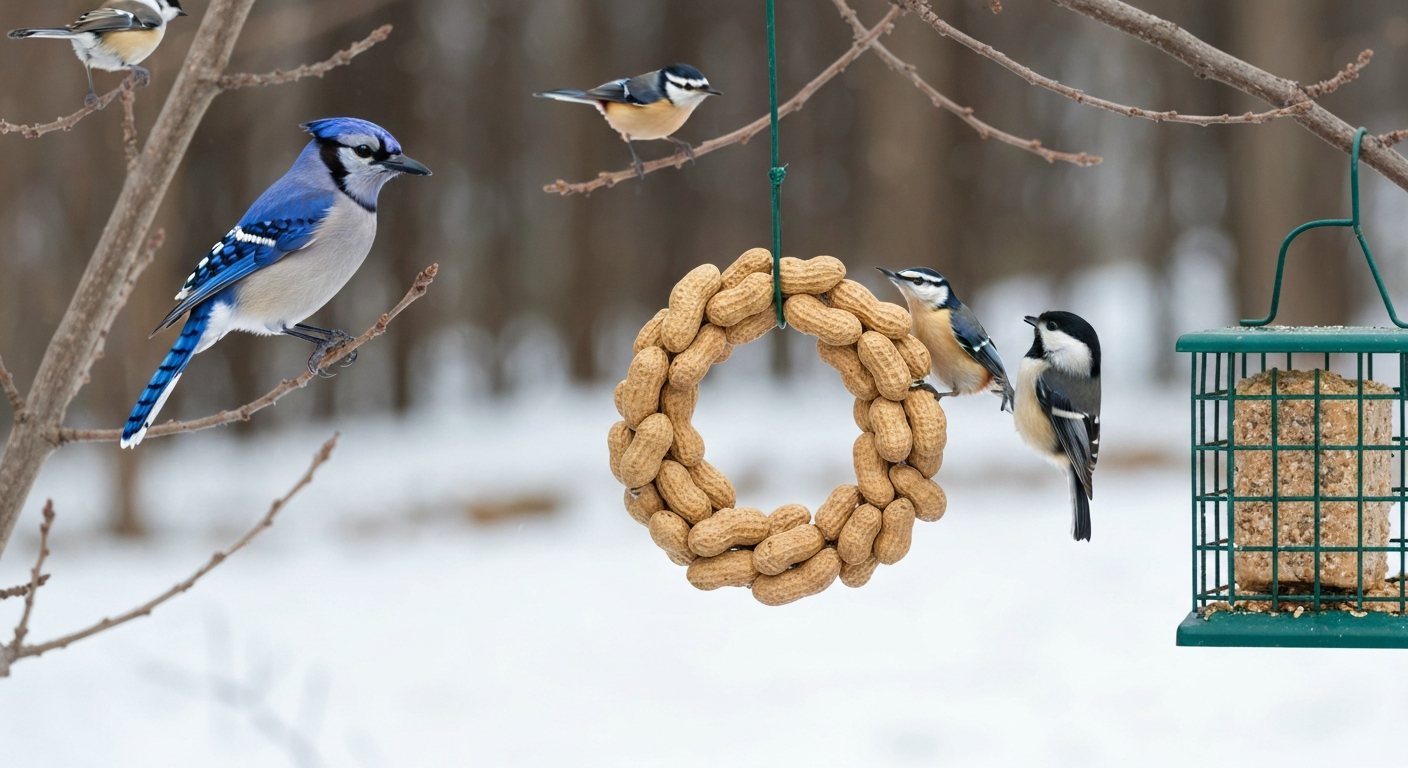
The birds that most reliably eat and crack large, hard-shelled nuts are macaws (especially Hyacinth and Lear's Macaws), Blue Jays, Clark's Nutcrackers, Acorn Woodpeckers, Hawfinches, and several other corvids and grosbeaks. Each of these species has a bill shape, jaw musculature, or behavioral trick that lets it get through shells that would defeat most other birds. If you want to attract nut-eating birds to a feeder, or you keep one as a pet, knowing which species can actually handle whole hard nuts, which nuts are safe, and how to store and serve them without creating a mold or predator problem is the practical core of this guide.
What Bird Eats Large Hard-Shelled Nuts: Species, Safety & Setup

Maya Bennett
7 Aug 2026
Which birds crack large, hard-shelled nuts: species profiles and ID tips
Not every bird that eats a nut can crack one. The species below are the genuine heavy-hitters: birds documented in field studies and behavioral research to handle genuinely hard-shelled nuts, not just soft seeds or pre-shelled pieces.
Hyacinth Macaw and other large macaws
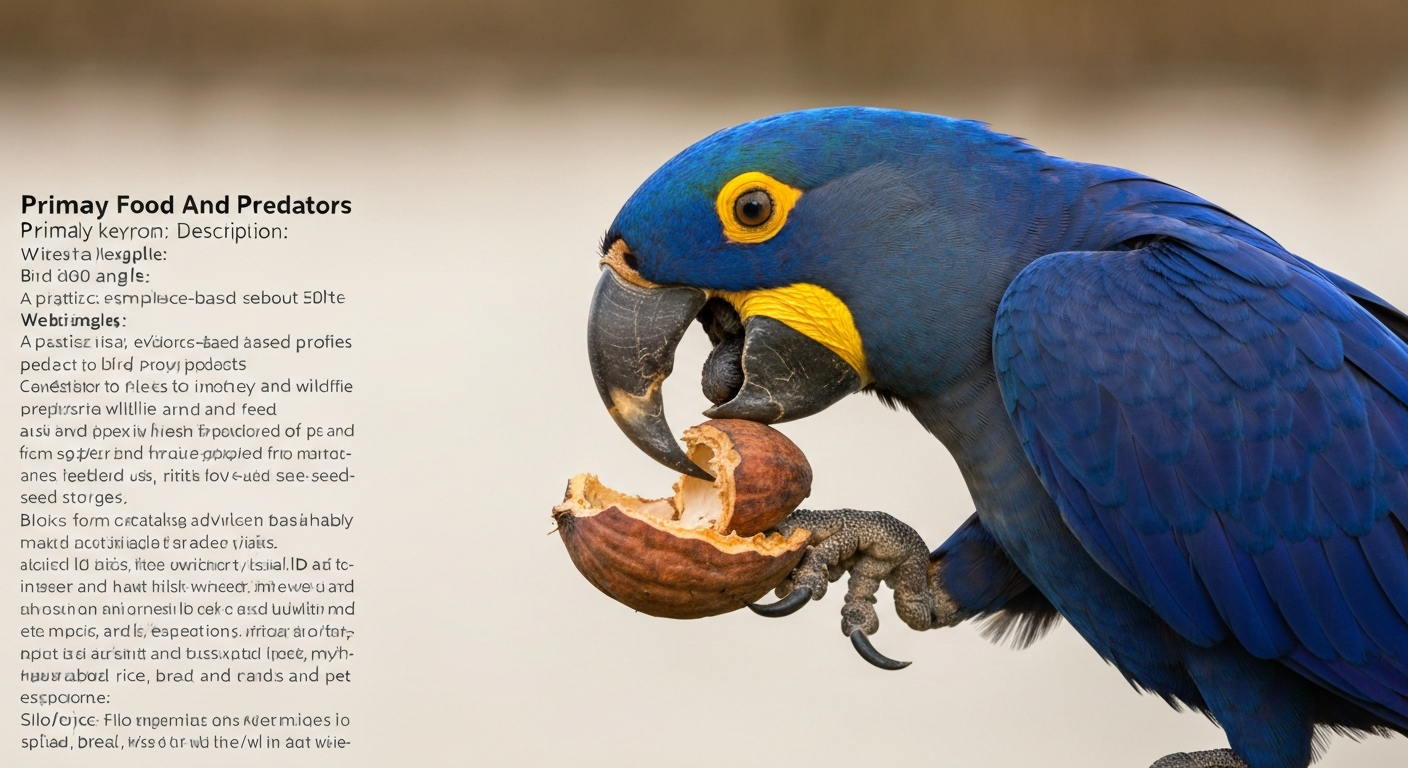
The Hyacinth Macaw (Anodorhynchus hyacinthinus) is probably the most extreme nut-cracker on the planet. In the wild it feeds almost exclusively on the extraordinarily hard nuts of Attalea and Acrocomia palm species in Brazil's Pantanal. Its bill applies bite forces that a 2024 Journal of Anatomy study confirmed are among the highest measured in any bird, backed by a reinforced skull architecture and decoupled upper mandible that channels force directly onto the shell. Visually, the Hyacinth is unmistakable: 100 cm from bill to tail, deep cobalt blue all over, with a bright yellow bare eye-ring and a matching yellow patch at the base of the lower mandible. Lear's Macaw (Anodorhynchus leari), slightly smaller and darker, performs the same feat on licuri palm nuts in Brazil's caatinga, with field studies recording individuals processing around 350 nuts in a single day. Large Ara macaws (Scarlet, Blue-and-Gold, Green-winged) follow the same general pattern and are common in aviculture.
Blue Jay and Eurasian Jay
Blue Jays (Cyanocitta cristata) are the backyard nut-crackers most North American readers will actually see. They take whole unshelled peanuts directly from platform feeders, fly to a branch, pin the nut underfoot, and hammer it open with repeated strong blows. They do the same with acorns. The Blue Jay's bright blue-and-white plumage, black necklace, and crested head make it one of the easiest feeder birds to ID. The Eurasian Jay (Garrulus glandarius) fills a similar role in European gardens: pinkish-brown body, a flashing white rump in flight, and a vivid blue-barred wing patch. Research published in the Journal of Ornithology (2024) confirmed Eurasian Jays as primary acorn dispersers, selecting and scatter-hoarding thousands of acorns each autumn in locations often far from the source tree.
Clark's Nutcracker
Clark's Nutcracker (Nucifraga columbiana) is built for high-elevation pine forests in western North America. It has a long, chisel-like bill that pries open pine cones and extracts the large, energy-dense seeds inside. What sets it apart is a sublingual pouch under its tongue that lets it carry up to 95 pine seeds at once to cache sites up to 20 km away. Gray body, black wings with white patches, and white facial markings make it distinctive. If you are in the Rocky Mountains or Sierra Nevada and see a gray bird the size of a jay systematically working a pine cone, it is almost certainly this species.
Acorn Woodpecker
The Acorn Woodpecker (Melanerpes formicivorus) takes a different approach: it drills individual storage holes into dead wood (called a granary tree) and hammers acorns in one at a time, building communal larders that can hold thousands of nuts. The clown-like face pattern (red crown, yellow-white forehead, black mask, white eyes) and black-and-white body make it one of the more distinctive western woodpeckers. It is found along the Pacific Coast and into the Southwest and Mexico.
Hawfinch and large-billed grosbeaks
The Hawfinch (Coccothraustes coccothraustes) is a chunky European finch with a comically oversized bill that can crack cherry stones and beech mast, seeds that most birds cannot touch. A 2023 Royal Society Open Science study confirmed it selects some of the hardest available seeds in mixed woodland habitats. The bill appears silver-blue in breeding plumage, the body is a warm orange-brown, and the white wing patches flash conspicuously in flight. The Evening Grosbeak (Hesperiphona vespertina) fills a parallel role in North America: large conical bill, yellow and black body in males, and a taste for hard maple and box elder seeds as well as sunflower seeds and peanuts at feeders.
Other corvids worth knowing
Common Ravens (Corvus corax) and American Crows (Corvus brachyrhynchos) handle large nuts opportunistically, sometimes dropping walnuts from height onto hard surfaces to crack them. Rooks (Corvus frugilegus) in Europe use similar techniques. None of these are as specialized as the macaws or nutcrackers, but they are intelligent problem-solvers you will encounter at feeders or in gardens.
How their bills and jaws actually crack hard shells
Nut-cracking ability in birds comes down to three things working together: bill geometry, jaw muscle mass, and skull structure. Research comparing jaw musculature and bite force across bird families (Journal of Zoology, 2022) shows that bite force scales directly with jaw adductor muscle mass relative to body size. Parrot skulls take this further with a specialized kinetic joint that decouples the upper mandible, allowing the bird to generate and redirect force more efficiently than a fixed-beak bird of comparable size. The result, documented in the 2024 Journal of Anatomy parrot bite-force study, is bite forces that are genuinely exceptional relative to body mass. For jays and corvids, the strategy is different: they use the bill as a chisel and rely on repeated impact rather than a single sustained squeeze. Woodpeckers use the same impact principle. Hawfinches and grosbeaks occupy a middle ground, with enormously deep bills that give mechanical advantage through lever geometry, allowing a relatively small bird to crack seeds that require surprisingly high force to split.
Skull reinforcement matters too. Finite element modeling of bird beaks shows that the multi-layered keratin structure of the bill dissipates stress during hard impacts, protecting the skull from damage that would otherwise occur when hammering or cracking dense materials. Birds that crack hard nuts regularly have measurably thicker or more reinforced bill keratin than closely related species that do not.
Which nuts are actually safe to offer
The key safety rules are simple: unsalted, unflavored, mold-free, and ideally sourced as bird-grade or human-grade product. Here is how the common nut types stack up.
| Nut type | Safe to offer? | Shell on or off? | Key notes |
|---|---|---|---|
| Peanuts (in-shell) | Yes, with caveats | Either | Bird-grade, aflatoxin-tested preferred; discard any with mold or musty smell |
| Peanuts (shelled halves) | Yes | Off | Easiest for small birds; still source carefully |
| Walnuts | Yes | Halves best for feeders | High fat, good energy; do not offer salted or honey-roasted |
| Hazelnuts | Yes (mainly for jays/nutcrackers) | Whole or cracked | Too hard for small birds whole; crack for broader access |
| Almonds | Yes (raw, unsalted only) | Split or slivered | Whole almonds are very hard; split for most feeder birds |
| Macadamia nuts | Avoid | N/A | Toxic to dogs; safety for birds not well established; skip |
| Cashews | Occasionally, in moderation | Off (shelled) | Raw only, no salt; limited data for regular feeding |
| Brazil nuts | Occasionally | Off | Very high fat; offer sparingly |
| Pecans | Yes | Halves | Popular with jays and woodpeckers; source unsalted |
| Acorns | Yes (for jays, woodpeckers) | Whole or cracked | Wild-sourced; tannins not a problem for birds adapted to them |
| Honey-roasted or salted nuts (any) | No | N/A | Salt damages kidneys; sweeteners and flavorings add no benefit and may harm |
The single biggest hidden risk in nuts is aflatoxin, a mycotoxin produced by Aspergillus mold that can grow on improperly stored nuts before or after you buy them. Birds, especially poultry and many wild species, are highly sensitive to aflatoxins: even low-level exposure causes liver damage, immune suppression, and in historically documented outbreaks (such as the 1960 'Turkey X' disease traced to moldy peanut meal), mass mortality. See blank" rel="noopener noreferrer">Avian Disease Manual (avian mycotoxicosis / aflatoxicosis overview) for an avian veterinary overview of sensitivity to aflatoxins and historical outbreaks such as Turkey X linked to moldy peanut meal. Crucially, roasting does not destroy aflatoxin. A review (Aflatoxin Contamination, Its Impact and Management Strategies: An Updated Review, International Journal / PMC (2022)) notes aflatoxin is chemically stable to roasting and household heat treatments, so roasting alone does not reliably eliminate the hazard blank" rel="noopener noreferrer">A review (Aflatoxin Contamination, Its Impact and Management Strategies: An Updated Review — International Journal / PMC (2022)) notes aflatoxin is chemically stable to roasting and household heat treatments, so roasting alone does not reliably eliminate the hazard.. The toxin is chemically stable at standard cooking temperatures, so a roasted nut can still carry active aflatoxin if the underlying nut was contaminated before roasting. Safe sourcing, good storage, and discarding anything that smells musty or shows visible mold are your only reliable defenses.
Storage best practices to prevent aflatoxin
- Buy from reputable suppliers who sell bird-grade or human-grade product; avoid bulk bins where turnover is unknown
- Store in a cool, dry, dark location, ideally below 15°C (59°F) with relative humidity below 70%
- Use airtight containers (glass or hard plastic with locking lids); avoid paper or mesh bags for long-term storage
- Buy in quantities you will use within 4 to 6 weeks and rotate stock rather than topping up old product
- Before every fill, check for any musty or rancid smell and discard the batch if in doubt
- Never offer nuts that have been sitting in a wet feeder; mold can begin growing on damp nuts within 24 to 48 hours
Peanuts and peanut butter: guidance, risks, and how to serve them safely
Peanuts are one of the most popular and effective feeder foods for nut-eating birds. Blue Jays, woodpeckers, chickadees, nuthatches, and many others take them eagerly. The guidance on peanuts for birds is the same as for other nuts: unsalted, unflavored, no visible mold, sourced as bird-grade or human-grade product. Shelled peanut halves reach the widest range of species; whole in-shell peanuts are best for jays, which relish the challenge and will carry them off to cache. For a quick list of common backyard species that eat peanuts, see the article on what bird eats peanuts.
Peanut butter is genuinely useful, especially in winter when birds need high-calorie food and suet is sometimes unavailable. The rules are stricter here because commercial peanut butters vary enormously in additives. Choose natural, plain peanut butter with only peanuts (and possibly salt at low levels) in the ingredient list. Avoid anything with xylitol, which is toxic to many animals and has no safe level for birds. Avoid heavily sugared, honey-sweetened, or hydrogenated-oil products. The most cautious option is unsalted natural peanut butter (peanuts only). You can smear it into the bark of a tree, pack it into a commercial peanut butter feeder tube, or mix it with cornmeal to reduce stickiness. The stickiness concern (that thick peanut butter could clog a bird's throat) is sometimes overstated, but mixing with cornmeal or oats to create a crumblier consistency is a reasonable precaution, especially in warm weather when it softens further. For more detail on peanut butter specifically, that topic has its own deep dive on this site.
If you keep pet parrots or other psittacines and are wondering about peanuts as a treat, the aflatoxin risk is worth taking seriously for birds that eat peanuts every day over years. Use certified aflatoxin-tested product or substitute with other tree nuts (walnuts, almonds, pecans) to diversify the diet and reduce reliance on any single high-risk item.
Preparing nuts for wild birds vs. pet birds
The preparation rules differ a little depending on whether you are feeding wild birds at a garden feeder or a pet bird in an aviary or cage.
For wild feeder birds
Raw and unsalted is the standard. For species like Blue Jays, whole in-shell peanuts or unshelled walnuts are fine because the bird has the bill strength and motivation to open them. For smaller birds (nuthatches, chickadees, smaller finches), shelled halves or coarsely chopped pieces are more accessible and reduce waste. Avoid roasted nuts if you can, not because roasting itself is harmful, but because commercially roasted nuts almost always carry added salt or oil. If you do use roasted product, check the label: plain dry-roasted with no salt added is acceptable.
For pet parrots and other captive birds
Nuts should be treats, not staples. For large macaws, a few whole hard-shelled nuts per day serve double duty as enrichment and nutrition. For smaller parrots (cockatiels, conures, small Amazons), whole walnuts or hazelnuts may be too large to handle comfortably; offer halves or quarters. Raw is better than roasted for pet birds to avoid the salt and oil issue entirely. Portion size matters: nuts are calorie-dense and can contribute to obesity in captive birds that do not fly the distances wild birds do. A rough guideline used by many avian vets is that nuts should make up no more than 10 to 15% of a psittacine's daily diet by caloric contribution, with the rest coming from a balanced pellet diet and fresh vegetables.
| Preparation type | Best for | Avoid if | Notes |
|---|---|---|---|
| Whole in-shell | Jays, macaws, ravens, large corvids | Small birds at mixed feeders | Great enrichment for strong-billed birds; adds foraging challenge |
| Shelled halves | Most feeder birds, smaller parrots | Never avoid; broadest appeal | Best all-round choice for mixed-species feeders |
| Chopped/slivered | Small finches, sparrows, pet birds | Unnecessary for large birds | Reduces waste; useful in mix with other seed |
| Raw, unsalted | All species; preferred default | N/A | Safest option; no added sodium or fat |
| Plain dry-roasted, no salt added | Acceptable when raw unavailable | Any salted or flavored product | Aflatoxin risk still present if sourcing is poor |
| Honey-roasted / salted / flavored | Never | Always avoid | Salt, sugar, and flavorings offer no benefit and cause harm |
Feeder types and how to present whole and split nuts
The feeder you choose determines which species you attract and how safely the nuts are presented. Nuts left in open trays without drainage can become waterlogged and mold within hours in wet weather. Matching the feeder to the nut type and target species makes a real difference.
| Feeder type | Best nut types | Target species | Key consideration |
|---|---|---|---|
| Mesh peanut tube feeder | Whole or halved peanuts in-shell | Blue Jays, woodpeckers, nuthatches, titmice | Choose stainless or galvanized mesh; clean weekly |
| Platform / tray feeder with drainage | Shelled halves, walnuts, pecans, chopped pieces | All nut-eating species; broadest audience | Must have drainage holes; cover or bring in during rain |
| Suet/peanut butter log or bark press | Peanut butter mixed with cornmeal | Woodpeckers, nuthatches, chickadees | Natural-feeling substrate; easy to refill |
| Caged or squirrel-proof peanut feeder | Whole or halved in-shell peanuts | Smaller birds excluding squirrels | Cage gap size determines which birds fit |
| Open dish or ground tray | Halved walnuts, pecans for corvids and jays | Jays, crows, corvids, doves | High predator-visibility risk; use only where cats are not present |
| Hanging wire basket | Whole in-shell peanuts or halved walnuts | Jays, starlings, woodpeckers | Simple, durable; position high to deter squirrels |
Mesh tube feeders specifically designed for peanuts (with wider mesh than standard seed feeders, roughly 12 to 15 mm openings) are probably the best all-round choice for most backyard setups. They keep nuts off the ground, allow drainage, give birds a perching grip, and are easy to inspect and clean. Avoid wooden feeders for nuts unless they have a waterproof liner or floor, because porous wood absorbs moisture and accelerates mold growth.
Setting up your nut feeder safely: step-by-step checklist
Getting the setup right from the start saves time and reduces the risk of attracting the wrong visitors or creating a health hazard for the birds you are trying to help. Work through this checklist in order.
Step 1: Choose and assemble the feeder
- Select a feeder rated for nut or peanut use (mesh tube, caged feeder, or draining platform) and confirm the mesh or opening size matches your intended nut type
- Inspect for sharp edges, loose screws, or gaps where nuts could jam and trap a bird's foot or bill
- If the feeder has a roof, check it fits tightly to shed rain away from the nut compartment
- Wash the feeder with hot water and mild dish soap before first use; rinse thoroughly and allow to dry completely before filling
Step 2: Choose placement for accessibility and safety
- Mount or hang the feeder at least 1.5 m (5 ft) off the ground to reduce ground predator access
- Position it within 3 m (10 ft) of shrub or tree cover so birds can retreat quickly, but not so close that a cat can use a branch as a launch pad; a minimum clear gap of 1.5 m between any branch and the feeder is a practical rule
- Avoid placing feeders directly over paths, seating areas, or vegetable gardens; nut debris and shells accumulate below
- Site the feeder where you can see it from a window for monitoring but where it is not in a high-traffic area that flushes birds repeatedly
- If you have multiple feeders, space nut feeders at least 2 to 3 m apart to reduce crowding and competition, which can cause injuries among aggressive species
Step 3: Mounting and squirrel management
- Use a smooth metal pole with a baffle (a dome or cylinder of smooth metal or PVC, at least 45 cm wide) mounted below the feeder; squirrels cannot grip smooth metal and cannot get past a properly sized baffle
- The baffle should be at least 45 cm (18 inches) in diameter and positioned so its top is at least 1.5 m above the ground
- Hanging feeders on a thin wire stretched between two poles (with baffles on both poles) is more squirrel-resistant than hanging from a branch
- Caged peanut feeders with a cage gap of 45 to 50 mm allow most songbirds in but exclude squirrels and large nuisance birds like starlings
Step 4: Filling and daily management
- Fill with only as much as birds will consume in one to two days; smaller fills reduce spoilage and force you to check quality more regularly
- Smell the nuts before each fill: any musty, rancid, or chemical odour means the batch should be discarded, not just partially topped up
- In wet weather, check the feeder after rain; remove and discard any nuts that have become damp or clumped
- In summer, fill in the morning only and remove any remaining nuts by evening to reduce overnight rodent visits
Step 5: Cleaning and maintenance
- Clean the feeder at least once every two weeks during regular use, and more frequently in wet or humid conditions
- Empty the feeder completely before cleaning; do not simply top up old nuts
- Scrub with a 1-part white vinegar to 9-parts water solution, or a dedicated bird-feeder cleaner; rinse well and allow to dry fully before refilling
- Rake up or remove shell debris beneath the feeder weekly; debris accumulates mold and attracts rats, mice, and other rodents which in turn attract predators that also target birds
Step 6: Predator and pet safety around the feeder
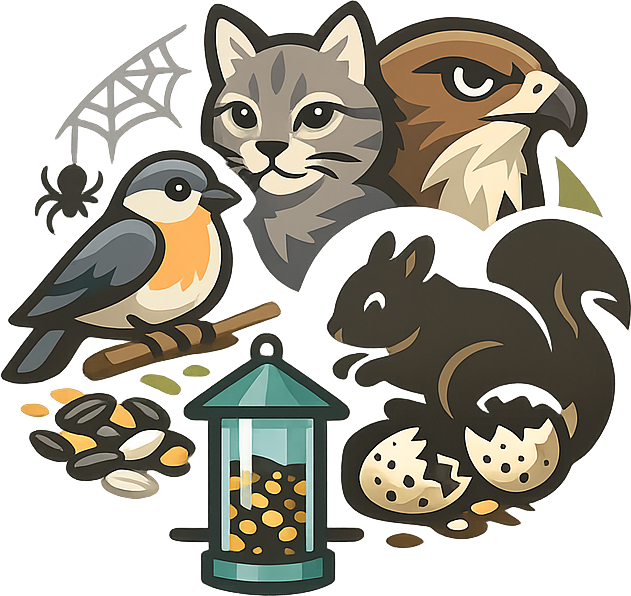
- Keep cats indoors or within a cat-proof enclosure if you operate a ground or low-mounted feeder; cats are documented predators of garden birds at feeders
- If you have a dog that eats dropped food, be aware that macadamia nuts (sometimes sold in nut mixes) are toxic to dogs; check any mixed nut product before offering at a feeder accessible to pets
- Raptors such as Cooper's Hawks and Sharp-shinned Hawks are attracted to the concentration of birds feeders create; this is natural and generally not something to prevent, but temporarily moving or taking down feeders for a few days will usually cause a hunting hawk to move on if it becomes a concern
- Avoid placing feeders near windows without window decals or break-up markings; concentrations of excited birds at feeders increase window-strike risk
A quick comparison: which nut is best for which bird
If you are trying to attract a specific species and want to know what to stock, this summary table cuts through the options quickly.
| Target bird | Best nut to offer | Whole or shelled? | Feeder type |
|---|---|---|---|
| Blue Jay | Peanuts in-shell, acorns, pecans | Whole in-shell ideal | Platform tray or open mesh basket |
| Clark's Nutcracker | Pine nuts, hazelnuts | Whole or cracked | Platform feeder; mainly wild forager |
| Acorn Woodpecker | Acorns, peanuts | Whole for storage behavior | Drilled log or platform feeder |
| Downy / Hairy Woodpecker | Shelled peanut halves | Shelled halves | Peanut tube mesh feeder |
| Hawfinch | Beech mast, sunflower, walnuts | Halves | Platform or ground tray in woodland garden |
| Evening Grosbeak | Sunflower, walnuts, peanut halves | Shelled halves | Large platform feeder |
| Hyacinth / large Ara macaw (pet) | Palm nuts, walnuts, Brazil nuts, macadamia-free mix | Whole in-shell for enrichment | Stainless steel bowl or foraging toy |
| Smaller parrots (pet) | Walnuts, almonds, pecans | Quartered or halved | Bowl; nut as occasional treat only |
| Eurasian Jay | Acorns, peanuts, hazelnuts | Whole preferred for caching | Ground tray or low platform |
| Raven / Crow | Walnuts, peanuts, pecans | Whole (they drop to crack) | Ground or large platform |
What I have learned from watching nut feeders over the years
The most common mistake I see at nut feeders is bulk buying. People buy a 5 kg bag of peanuts, fill the feeder to the top, and top it up without ever emptying or cleaning the feeder until birds stop visiting. By that point the nuts at the bottom are often damp, discolored, or genuinely moldy. The birds are not being fussy; they are detecting something wrong that you cannot yet see. Smaller, more frequent fills and a fortnightly clean are by far the most impactful things you can do for feeder bird health, more impactful than which exact nut variety you choose.
If you want to start attracting nut-eating birds today and currently attract none, the single best first step is a mesh peanut tube feeder, hung about 1.8 m up on a smooth metal pole with a baffle, filled with no more than a cup of raw unsalted shelled peanut halves. Check it the next morning. In most North American or European gardens with decent tree cover nearby, you will have a nuthatch or chickadee investigating within 24 to 48 hours, and a Blue Jay or Eurasian Jay will usually find it within a week.
For anyone keeping parrots, the nut question also connects to broader diet topics covered elsewhere on this site, including the full breakdown of whether birds can eat nuts generally and the specific guidance on peanut butter. For guidance on cross-species medication safety, see our guide 'Can humans take bird antibiotics'. For a general overview of which nuts are safe and how they fit into a bird's diet, see the short guide titled "Can birds eat nuts?". Those pieces go deeper on the nutritional side; this article has focused on the species that actually crack large hard shells and the safety framework around offering those nuts in the first place.
FAQ
Which wild and captive bird species reliably eat and can crack large, hard‑shelled nuts?
Species with the bill morphology and bite force to crack very hard shells include large parrots (macaws, cockatoos, some amazons), jays (blue jay, Eurasian jay), nutcrackers (Clark’s nutcracker), acorn woodpeckers, large grosbeaks and hawfinches, and some corvids. Parrots (Psittaciformes) have exceptional bite forces; macaws regularly crack palm nuts (Attalea, Acrocomia, licuri). Nutcrackers and jays specialize on large seeds (pine seeds, acorns, peanuts) and use foot‑holding, pinning or hammering techniques to open them.
What nut types are safe to offer to wild and pet birds?
Safe choices: raw, unsalted, unseasoned nuts such as peanuts (shelled or unshelled if birds are accustomed), shelled walnuts, hazelnuts, almonds (in small amounts), whole acorns (if local species use them), and commercially tested bird‑grade nuts. Avoid heavily salted, honey‑roasted, chocolate‑coated, spiced or sweetened nuts. Discard nuts with visible mold or a strong musty odour (aflatoxin risk).
Can birds eat peanut butter? Is it safe?
Yes—but only plain, natural peanut butter made from peanuts with no added salt, sugar, hydrogenated oils or xylitol. Offer in small quantities and as occasional enrichment (smeared on pine cones, in suet feeders or stuck on branches). Avoid sticky overly sugary varieties and any containing xylitol (highly toxic to pets). Monitor captive birds for weight gain and wild feeding sites for mess and predator attraction.
How should nuts be prepared and presented to maximize bird safety and accessibility?
Preparation: use fresh, mold‑free nuts; split very large shells for smaller birds; provide unshelled nuts for species that crack or shelled for species that prefer kernels. Presentation: offer in sturdy feeders (platforms, hopper feeders, or tray feeders), in crevice or bolt‑on nut feeders for parrots, or scatter/split on the ground for jays/nutcrackers. For macaws/large parrots, present whole palm nuts or large unsplit nuts on heavy perches or in PVC/metal feeders that withstand strong bills. For small backyard species, offer chopped/split nuts or peanut pieces to reduce choking and waste.
How do birds crack and handle large nuts—what behaviour and bill adaptations should I expect?
Parrots use powerful raking and crushing bites with reinforced beaks and strong jaw muscles; they often hold fruit with feet and manipulate under a perch. Jays and nutcrackers may pin nuts under a foot and hammer with the bill, or wedge into crevices. Woodpeckers (acorn woodpecker) drill storage holes and remove caps with chisel‑like bills. Observe species‑specific handling to choose feeder type and nut size.
How can I reduce aflatoxin and spoilage risk when offering nuts?
Key steps: buy fresh, reputable or bird‑grade nuts; store in cool, dry, airtight containers (refrigerate or freeze long‑term); discard any nuts with stain, odour or visible mold; rotate stock and use older nuts first. Roasting does not reliably destroy aflatoxins—prevention (proper sourcing and storage) is essential. For commercial or flock feeding, consider certified low‑aflatoxin batches and follow regulatory guidance for animal feeds.
Next Article
Can Bird Eat Peanut Butter? Safe Feeding Guide for Birds
Can birds eat peanut butter? Safe feeding tips, species guidance, hazards, recipes & feeder methods.