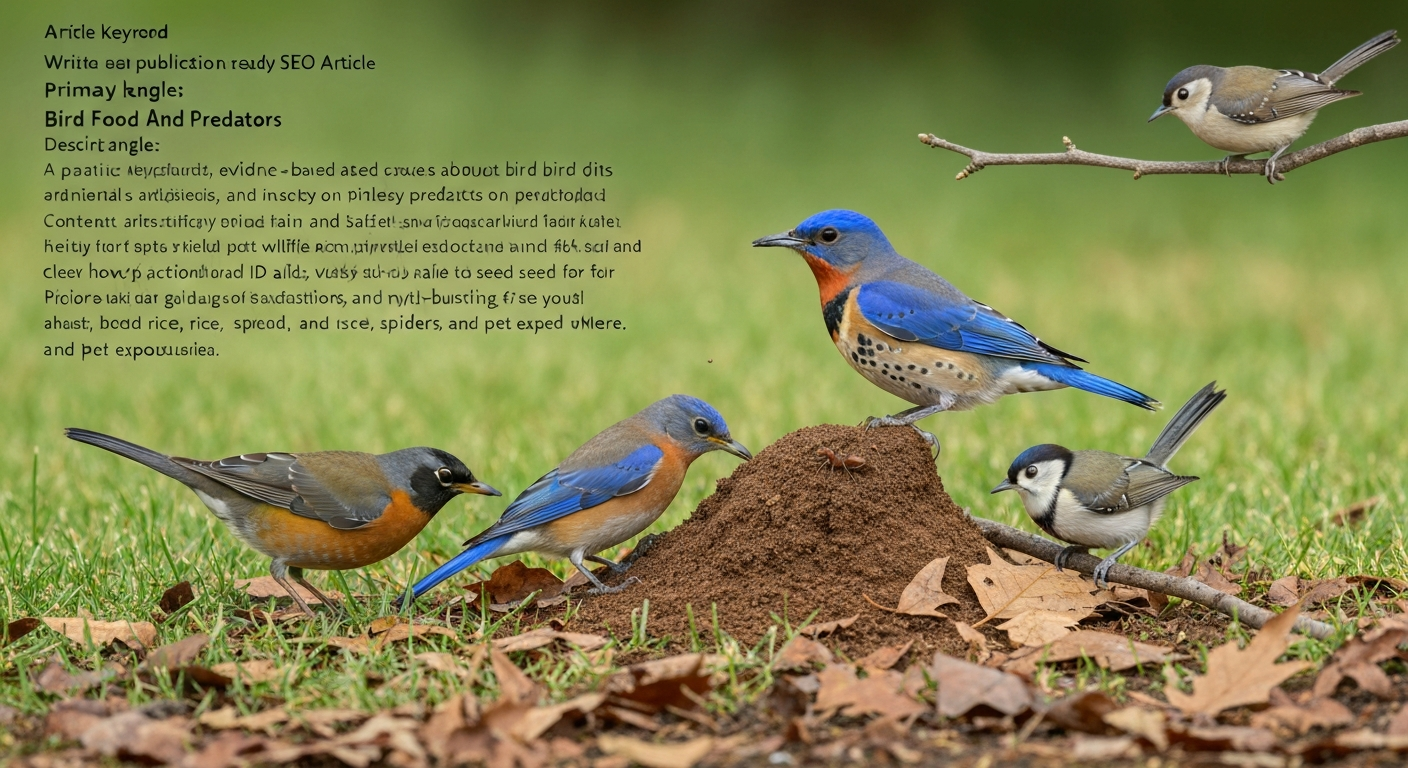
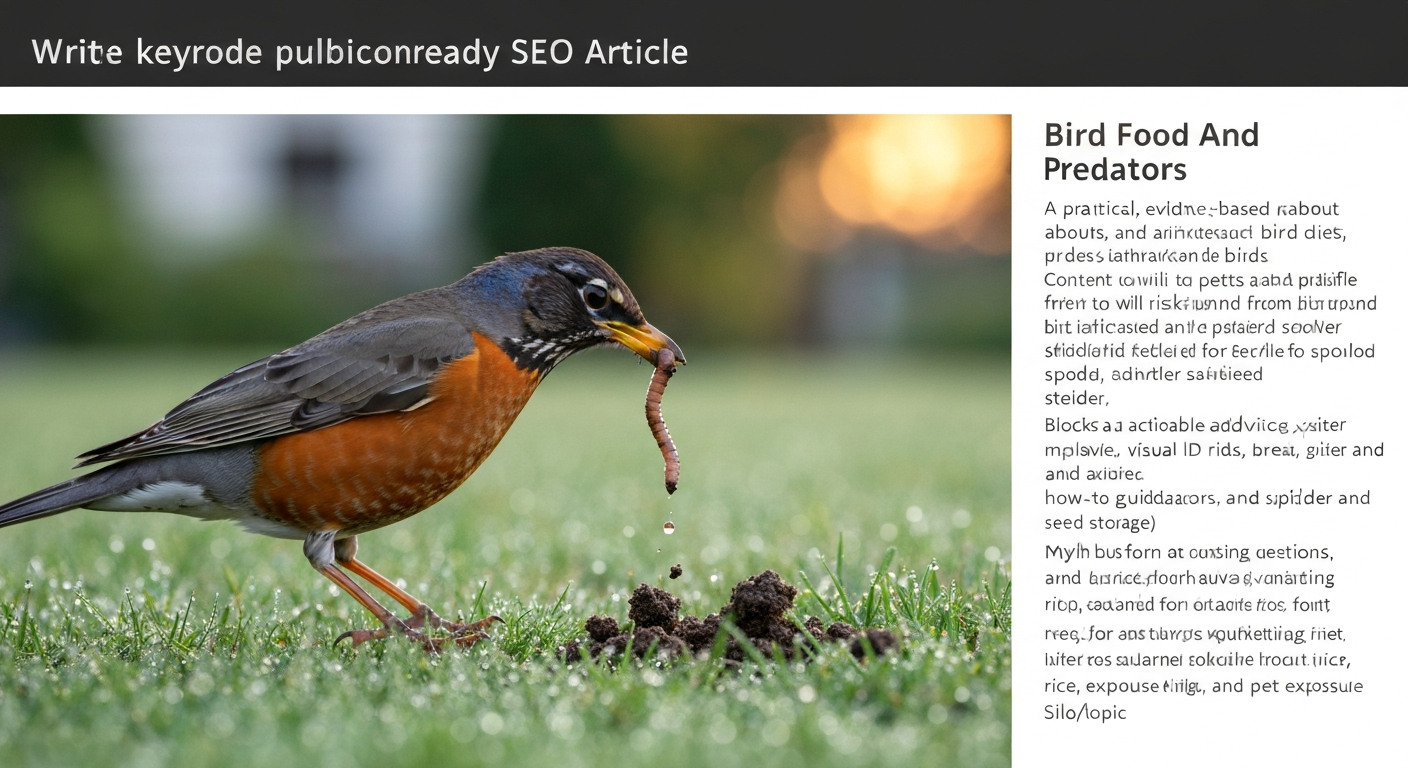
When a bird eats a worm, the bird is the predator and the worm is the prey. That is the straightforward ecological answer, and it holds whether the bird is an American Robin pulling an earthworm from a lawn or a bluebird snatching a live mealworm from a feeder dish. The bird actively hunts, captures, and consumes the worm, which is exactly what predation means by any standard definition in ecology.
A Bird Eats a Worm: Who Is the Predator? Backyard Guide

Maya Bennett
29 Jul 2026
Predator vs. prey: what the terms actually mean
In ecology, a predator is any organism that obtains energy by killing and consuming another organism. The organism being killed and eaten is the prey. This is a clean, species-neutral relationship: size, cuteness, and cultural feelings about animals have nothing to do with it. A robin on a lawn is doing the same thing functionally as a hawk circling overhead. Both are predators in that moment. Both are involved in predation, which ecologists (following textbooks like Krebs and Begon et al.) treat as one of the central organizing processes in food-web theory.
The confusion in the original question usually comes from people thinking of predators only as large, aggressive carnivores. But predation is defined by the interaction, not the size of the participants. An earthworm, a mealworm larva, and an ant are all prey when a bird eats them. The bird is always the predator in that interaction, even if the same bird is itself prey for a hawk or a cat five minutes later. Animals can occupy different roles in the food web depending on context.
The three main worm and insect feeds: what they are and why birds eat them
Not all 'worms' birds eat are the same organism, and the nutritional case for each one is different. Here is a quick breakdown of the three most relevant types for backyard birders and nature educators.
Earthworms
Earthworms (family Lumbricidae and relatives) are soft-bodied annelid invertebrates that live in moist soil. They are protein-dense, moisture-rich, and easy to extract from the ground after rain or irrigation. For ground-foraging birds during breeding season, earthworms are a high-value prey item: a single large worm delivers significant protein and water in one catch. That is why thrushes and robins time their most intensive worm-hunting to spring mornings after overnight rain, when worms come close to the surface or emerge entirely.
Mealworms
Mealworms are the larval stage of the darkling beetle (Tenebrio molitor). They are not worms at all in the biological sense, but the name has stuck because of their worm-like appearance. Live mealworms are high in fat and protein, which makes them attractive to insectivorous birds and especially useful for provisioning nestlings. Dried mealworms are more widely available, easier to store, and still accepted by most species that take live ones, though live mealworms tend to draw more hesitant birds in faster.
Ants
Ants (family Formicidae) are insects that several bird species target specifically, not just as opportunistic snacks. Ants contain formic acid, which some birds exploit deliberately in a behavior called 'anting,' where the bird rubs ants through its feathers, possibly to deter parasites. As food, ants are protein-rich but smaller than earthworms or mealworms, so birds that eat significant quantities of ants (like flickers) have to consume large numbers to meet energy needs.
Birds that eat earthworms: species, diet profiles, and ID cues
Ground-foraging passerines dominate this category. Most are members of the thrush family (Turdidae) or closely associated groups. Here are the key species backyard birders are most likely to observe hunting worms.
| Species | Region | Key Diet Notes | Visual ID Cues |
|---|---|---|---|
| American Robin (Turdus migratorius) | North America | Earthworms are a major spring/summer food; also takes fruit and berries seasonally. Ground-forages on lawns. | Orange-red breast, dark gray-black back, yellow bill. About 25 cm long. Runs and stops on grass. |
| European Robin (Erithacus rubecula) | Europe, UK | Regularly takes earthworms and soil invertebrates when soil is disturbed; supplements with berries and seeds in autumn-winter. | Rounded body, bright orange-red face and breast, brown upperparts. Small (14 cm). Often follows gardeners. |
| Common Blackbird (Turdus merula) | Europe, Asia, Australasia | Earthworms are important in the breeding season; shifts to fruit in autumn-winter. Forages by sight and sometimes by sound. | Male: all-black with bright yellow-orange bill and eye ring. Female: brown with streaked breast. About 25 cm. |
| Common Starling (Sturnus vulgaris) | Europe, N. America (introduced) | Opportunistic omnivore; probes soil for earthworms and larvae, especially when breeding. Also eats seeds, fruit, and scraps. | Iridescent black plumage with white speckles in winter. Short tail, long pointed yellow bill in breeding season. Walks rather than hops. |
American Crows (Corvus brachyrhynchos) will take earthworms opportunistically, but they are generalist omnivores rather than specialized worm hunters. You are more likely to see a crow eating carrion, seeds, or human food waste than deliberately hunting worms. If you want to dig deeper into which species are the most dedicated worm hunters and how they locate prey underground, the site has a full profile on what bird eats worms that covers additional species and sensory mechanisms in detail.
Birds that eat mealworms: species, diet profiles, and ID cues
Mealworms at feeders attract a slightly different roster of birds than earthworms on the lawn. Insectivorous species that might never approach a seed feeder will often investigate a shallow dish of live mealworms within days of it being put out.
| Species | Region | Key Diet Notes | Visual ID Cues |
|---|---|---|---|
| Eastern Bluebird (Sialia sialis) | North America (east) | Primarily arthropods (grasshoppers, crickets, beetles) in breeding season; fruit in winter. Readily takes live mealworms at feeders for nestling provisioning. | Vivid blue upperparts, rusty-orange breast, white belly (male). Female duller with blue-tinged wings. Cavity nester; perches on wires and fence posts. |
| Black-capped Chickadee (Poecile atricapillus) | North America (north) | 80-90% animal food (insects, spiders) in spring-summer; roughly half plant matter in winter. Takes mealworms, sunflower seed, suet, and peanuts at feeders. | Black cap and bib, white cheeks, gray back, buffy sides. 12-15 cm. Acrobatic; often hangs upside-down on branches. |
| Tufted Titmouse (Baeolophus bicolor) | North America (east) | Arthropods in summer, seeds and berries in winter. Accepts mealworms, sunflower, and suet at feeders. | Gray above, pale below with rusty flanks, prominent pointed crest. Large dark eyes. About 16 cm. |
| Tree Swallow (Tachycineta bicolor) | North America | Almost exclusively aerial insects; will take mealworms offered near nest boxes, especially in cold snaps when insects are scarce. | Iridescent blue-green above, clean white below. Pointed wings, slightly forked tail. Frequently seen near water. |
| Carolina Wren (Thryothorus ludovicianus) | North America (east) | Primarily insects and spiders year-round; readily takes mealworms at feeders. | Rich reddish-brown above, buffy-orange below, bold white eyebrow stripe. Small (12-14 cm), often cocks tail upward. |
Nuthatches and starlings also visit mealworm feeders regularly. If you want a focused guide to these mealworm specialists, the site's dedicated article on what bird eats mealworms goes into greater depth on feeder placement strategies to target bluebirds specifically and exclude starlings.
Birds that eat ants: species, diet profiles, and ID cues
Ant-eating birds are not a single guild. Some target ants as a major dietary staple; others eat them opportunistically or use them in anting behavior without significant consumption. The site covers this topic in depth in the articles on when a bird is alive it eats ants and does bird eat ants, but here are the core species to know.
| Species | Region | Key Diet Notes | Visual ID Cues |
|---|---|---|---|
| Northern Flicker (Colaptes auratus) | North America | Unusually ground-foraging for a woodpecker. Ants can comprise up to 40-45% of diet in some populations. Also eats other insects and seasonal fruit. | Brown-barred back, spotted underparts, red nape patch (red-shafted form has red mustache stripe; yellow-shafted has black). Large; 28-31 cm. Undulating flight. |
| European Green Woodpecker (Picus viridis) | Europe, western Asia | Ants are the dominant prey item; uses long, sticky tongue to extract ants from grass and anthills. | Bright green above, pale below, vivid red crown, yellow-green rump. Laughing 'yaffle' call. Ground-forages heavily. |
| American Robin | North America | Primarily an earthworm predator but will take ants and other ground insects opportunistically. | See earthworm table above. |
| Common Starling | Europe, N. America | Probes turf and takes ants along with other invertebrates. | See earthworm table above. |
How birds find, catch, grab, and manipulate worms
The hunting sequence a robin uses to catch an earthworm is more sophisticated than it looks from across the garden. Understanding the steps helps you make better sense of what you are watching and helps educators explain predator behavior to students.
Detection
Ground-foraging birds primarily use vision to detect worms. Robins cock their heads to one side when hunting on lawns, bringing one eye closer to the ground to spot surface movement or soil disturbance. There is ongoing research debate about whether some species (including American Robins) also use low-frequency vibration sensing, but vision is the best-supported primary detection mechanism in the peer-reviewed literature. Flickers probing for ants use both vision and bill-tapping to locate ant galleries.
Capture
Once a worm is spotted, the bird runs toward it and strikes with the bill in a quick downward jab. Earthworms resist extraction by contracting against their setae (tiny bristle-like structures that grip the soil). Robins and blackbirds respond by bracing with their feet and pulling the worm steadily rather than jerking, which would break it. What Blackbirds Eat, Woodland Trust (diet summary) reports that Common Blackbirds (Turdus spp.) are ground foragers that commonly take earthworms by sight during the breeding season and switch to fruit and berries in autumn–winter What Blackbirds Eat — Woodland Trust (diet summary). Starlings use bill-gaping: the bill is pushed into soil closed, then forced open to create a cavity, exposing hidden invertebrates. This is a fundamentally different technique from the visual strike-and-pull used by thrushes.
Prey manipulation and sundering
Large earthworms are sometimes too long to swallow whole comfortably, especially when a parent bird is provisioning nestlings that need manageable pieces. A behavior called 'sundering' has been peer-reviewed and documented across multiple vermivorous species: the bird grasps the worm at one point and shakes or rubs it against a hard surface (a rock, a branch, the ground) to break it into shorter sections. A 2021 study in the Journal of Ornithology documented this in the Fairy Pitta using photographic evidence from the Macaulay Library archive as part of the evidence base, establishing sundering as a deliberate, repeatable prey-preparation behavior rather than accidental worm breakage.
Summary of foraging modes
- Gleaning: picking prey from surfaces (leaves, bark, soil surface) without penetrating the substrate
- Probing: inserting the closed bill into soft soil, leaf litter, or bark crevices to locate hidden prey
- Gaping (rhynchokinesis): inserting the bill closed and forcing it open underground to expose invertebrates (characteristic of starlings and some sandpipers)
- Strike-and-pull: visual detection followed by rapid bill jab and steady extraction tug (characteristic of robins, blackbirds, and thrushes on earthworms)
- Tossing and pounding: manipulating prey against hard surfaces to remove soil, reduce size, or neutralize chemical defenses (used for ants, beetles, and long worms)
Photo and illustration guidance for showing feeding behavior
Visual documentation of birds catching and handling worms is genuinely useful for educators and backyard birders trying to confirm species ID or explain predator behavior to children. The Macaulay Library at Cornell Lab of Ornithology is the most authoritative searchable archive for this kind of material: you can search by species and behavior keyword (for example 'robin earthworm' or 'flicker foraging'). For publication, redistribution, or classroom use beyond personal viewing, you need to follow Cornell Lab's Terms of Use, and most commercial or redistributed uses require explicit licensing permission from Cornell.
For your own garden documentation, a smartphone camera or a trail camera placed low to the ground near a regularly-foraged lawn patch will capture most of what you need. Early morning after rain is the best window: worms are near the surface, light is soft, and bird activity is highest. If you are filming for a classroom presentation, position yourself at least 5-10 meters from the foraging bird; approaching closer usually interrupts the hunting sequence and can stress the bird enough to change its behavior.
- Use the Macaulay Library for reference images and check licensing terms before any publication use
- For field photography: film from a distance with a telephoto lens or zoom function; do not bait birds into unnatural positions to stage shots
- Illustrate the bill-tilt (head cock) of robins hunting to visually demonstrate how detection works
- Sequence photos (detection, strike, extraction, swallow or sunder) work better for educational purposes than a single still
- Avoid posting images or video that show nest locations or reveal hidden nest entrances, as this can attract nest predators
Live-feed practices for mealworms and ants: sourcing, husbandry, and what you need to know
Offering live mealworms is one of the most effective ways to attract insectivorous birds like bluebirds, wrens, and chickadees to a feeder. See Sialia sialis, Eastern bluebird, US Forest Service species review (notes on diet and attraction to mealworms) for documentation that Eastern Bluebirds commonly take live mealworms at feeders Sialia sialis, Eastern bluebird — US Forest Service species review (notes on diet and attraction to mealworms). But live feed comes with responsibilities that dried seed does not.
Sourcing mealworms responsibly
Buy live mealworms from reputable suppliers (pet stores, specialist bird food suppliers, or online insect farms). Do not collect mealworms or beetle larvae from unknown substrates: wild-collected insects can carry pesticide residues, pathogens, or parasites. In the United States, Tenebrio molitor is not regulated as an invasive species, but some states have rules about importing live insects; check your state's department of agriculture website before ordering interstate. In the UK, the sale of live mealworms for bird feeding is subject to welfare regulations for the larvae themselves.
Storing and maintaining live mealworms
- Keep live mealworms refrigerated (7-10°C / 45-50°F) to slow their metabolism and extend shelf life; they will remain viable for 2-4 weeks at this temperature
- Use a ventilated container (a deli container with a mesh lid works well) with bran or oat substrate as bedding and a small slice of carrot or apple for moisture
- Do not freeze live mealworms: freezing kills them. If you want to store a large quantity long-term, buy dried mealworms instead
- Check mealworms every 2-3 days: remove any dead larvae immediately to prevent mold and bacterial growth in the container
- Wash hands thoroughly after handling mealworm containers; mealworm frass (waste) can contain allergenic proteins, particularly relevant for people with pre-existing dust or grain allergies
Feeding live ants: not recommended
Offering live ants as supplemental bird feed is generally not practical or advisable for backyard birders. Ants are difficult to confine in a feeder, can bite handlers, and many species use formic acid or venom defensively. Flickers and green woodpeckers that eat large quantities of ants do so by probing natural colonies in the wild, not by visiting feeders. If your goal is to attract ant-eating birds, maintaining a lawn with natural ant populations (by avoiding broad-spectrum pesticide application) is more effective and lower-risk than attempting to offer ants as supplemental feed.
Risks from spoiled or inappropriate feed: protecting birds, pets, and people
Spoiled bird food is one of the most underappreciated hazards in backyard feeding. Wet or old seed, rancid suet, and mealworms that have been left in a feeder in summer heat can all become vectors for bacterial and fungal pathogens that harm birds, and in some cases pose risks to pets and people who handle contaminated feed or cleaning equipment.
Key health risks
- Aspergillosis: a fungal lung disease in birds caused by Aspergillus fumigatus, which grows in damp or moldy seed and peanuts. Birds inhale spores; it is fatal in many cases. Wet or clumped seed that is left in a feeder for more than a few days in warm weather is the most common source.
- Salmonellosis: bacterial infection spread through contaminated seed, fecal matter in feeders, or infected birds feeding communally. Siskins, finches, and sparrows are particularly susceptible during winter finch irruptions.
- Trichomoniasis (canker): a protozoal disease that affects pigeons, doves, and occasionally finches and raptors. Spread through contaminated water in bird baths and feeders.
- Aflatoxin: a potent carcinogenic mycotoxin produced by Aspergillus molds in improperly stored peanuts and corn-based feeds. Toxic to birds and potentially to dogs and cats that access fallen seed.
- Pet exposure risks: dogs and cats that eat fallen or spoiled seed can ingest aflatoxins, mold, or Salmonella from contaminated ground feeding areas. Keep ground clean and consider raised or baffled feeders in households with pets.
Seed and mealworm storage checklist
- Store dry seed in airtight, rodent-proof metal or hard plastic containers with sealed lids
- Keep storage containers in a cool, dry location out of direct sunlight; humidity above 60% promotes mold growth
- Check seed for clumping, unusual smell, or visible mold before filling feeders; discard any suspect seed in a sealed waste bag, not on the ground
- Do not mix fresh seed on top of old seed in a feeder: empty and clean the feeder first
- Buy seed in quantities you will use within 4-6 weeks during warm weather; larger quantities are safer in winter
- Store dried mealworms in a sealed container in a cool, dry location; they will remain fresh for 12 months if kept dry
- Refrigerate live mealworms as described above; never leave live mealworms at room temperature for more than a few hours in summer
- Label all containers with the purchase or pack date so you can track age
Safe feeder setup, placement, and predator-reduction tactics
The feeder itself is only part of the equation. Where you place it, how you maintain it, and what physical barriers you use determine whether it attracts birds or becomes a hazard to them. These are the practical steps that make the biggest difference.
Placement rules
- Place feeders either within 1 meter (3 feet) of a window or more than 9 meters (30 feet) away: the 1-meter rule reduces fatal collision speed, while the 9-meter rule gives birds enough space to avoid the window entirely. The danger zone is 2-9 meters.
- Position feeders where you can see them from the house, which lets you monitor for sick birds or predator activity
- Use baffles: a smooth cone or cylinder baffle on a pole feeder prevents cats, squirrels, and raccoons from climbing up to the feeder platform
- Keep feeders at least 1.5 meters off the ground to reduce ground predator access, but avoid placing them directly next to dense shrubs where cats can hide and ambush visiting birds
- Maintain a clear area of at least 2 meters around the base of any feeder; this gives foraging ground birds a sight line to detect approaching predators
Cleaning schedule
- Clean feeders every 1-2 weeks during warm weather (above 15°C / 60°F); monthly cleaning is a minimum in cold weather
- Use a 10% bleach solution (1 part bleach to 9 parts water) or purpose-made feeder disinfectant; scrub all surfaces including ports and perches
- Rinse thoroughly and allow to dry completely before refilling; damp feeders accelerate mold growth
- Clean bird baths every 2-3 days in warm weather; change the water daily if possible
- Rake and remove seed husks and fallen food from the ground beneath feeders weekly to reduce disease transmission and rodent attraction
Predator-reduction tactics
- Pole-mounted feeders with squirrel baffles are the most effective setup for reducing mammalian predator access
- If cats are a regular problem, consider a motion-activated deterrent (water spray or ultrasonic) placed near the feeder base
- Avoid leaving mealworm dishes on the ground; use a raised, open tray feeder so approaching cats are visible to feeding birds
- Remove feeders entirely for 1-2 weeks if you observe a hawk or cat making repeated, successful strikes: allowing predators to learn a feeder location as a reliable hunting spot is counterproductive
- Check for and remove dense low shrubs within 2 meters of feeders to eliminate cat ambush cover
Guidance for pet owners and nature educators
Pet owners
Cats and dogs that have access to bird feeding areas face real health risks that are easy to overlook. Dogs that eat fallen seed can ingest aflatoxins from moldy peanuts or Salmonella from contaminated hulls. Cats that hunt birds visiting a feeder may catch birds carrying avian diseases, including Salmonella and Trichomoniasis. Keep ground feeding areas clean, consider using feeders that minimize spill, and if your cat is an outdoor hunter, fit them with a bell collar or bird-safe collar (there is evidence these reduce bird catches). If your dog regularly investigates under feeders, weekly ground cleaning and a raised feeder setup are your most effective risk-reduction tools.
Nature educators
A live mealworm dish or an earthworm in a clear container is one of the most effective teaching tools for predator-prey concepts at K-8 level. If you are using live mealworms in a classroom, keep them in a ventilated container with bran substrate and supervise hand-washing after any student contact with the container or the larvae. Discuss the predator-prey relationship explicitly: the bird is the predator, the worm is the prey, and this same relationship applies at every level of the food web. If you photograph or film birds during outdoor sessions, use the 5-10 meter observation distance rule and remind students not to approach foraging birds, as disturbance affects the very behavior you are trying to observe. Check with your school or institution about liability and hygiene policies before introducing any live invertebrate feed into a classroom.
Myth-busting: common backyard questions answered
Can you feed birds bread?
Bread is not toxic to birds in tiny amounts, but it is nutritionally empty: it provides calories without the protein, fat, or micronutrients birds need. Regular bread feeding, especially in large amounts or to waterfowl, can lead to a developmental condition called 'angel wing' in young birds, associated with rapid carbohydrate loading without adequate nutrition. The practical rule: do not deliberately offer bread. If a bird takes a crumb that fell on the ground, that is not a crisis; making bread a regular feeder offering is.
Does rice harm birds?
The idea that dry rice expands fatally in birds' stomachs is a persistent myth with no supporting evidence. Birds have strong, muscular gizzards that easily handle dry or cooked rice. Wild birds routinely eat rice grains in agricultural fields without harm. You can feed cooked, plain rice as an occasional supplement, but it offers limited nutritional value compared to seed or mealworms.
Do birds eat spiders? Is that natural?
Yes, many birds eat spiders, and it is entirely natural. Spiders are a protein-rich prey item taken by chickadees, wrens, warblers, and many other insectivorous species. Chickadees, for example, shift to 80-90% animal food in spring and summer, and spiders feature prominently in that diet. There is nothing unusual or concerning about birds taking spiders from garden plants; it is normal predation.
Should I put out ants for birds?
As covered above, offering ants at feeders is not practical and can be counterproductive. The species that eat large quantities of ants (flickers, green woodpeckers) extract them by probing natural colonies and are not feeder birds in the conventional sense. Reducing pesticide use in your garden so that natural ant colonies remain is a better contribution to ant-eating bird populations than attempting supplemental ant feeding.
Are mealworms addictive? Will birds stop foraging naturally?
There is no evidence that birds become 'addicted' to mealworms in a physiological sense, but habituation is a real concern. Bluebirds and wrens that are offered unlimited mealworms year-round can become over-reliant on the feeder, which can be a problem if supply is interrupted during nesting season. The practical guidance from avian conservationists is to offer mealworms in limited quantities (no more than what the visiting pair can take in 15-20 minutes) during breeding season, and to taper off in late summer to encourage birds to forage naturally again.
Quick checklists and action plan
Backyard birder setup checklist
- Choose feeder type: tube feeder for seed, open tray for mealworms, nyjer sock for finches
- Place feeder within 1 meter or beyond 9 meters of windows to prevent collision
- Install a baffle on any pole-mounted feeder before the first fill
- Buy seed and mealworms from a reputable supplier; check pack dates
- Store all feed in airtight containers in a cool, dry place; label with purchase date
- Set a recurring calendar reminder to clean feeders (every 1-2 weeks in warm weather)
- Remove fallen seed husks from the ground weekly
- Keep a written log of species visiting: useful for detecting disease (sick or lethargic birds) early
Emergency steps if you find a sick or dead bird near a feeder
- Do not handle the bird with bare hands; use disposable gloves or a bag turned inside-out
- Remove and discard all remaining feed from the feeder immediately
- Take the feeder down and disinfect it with a 10% bleach solution before reusing
- Report the incident to your local wildlife authority or bird monitoring scheme (eBird, BTO BirdTrack in the UK) if you see multiple affected birds
- If a pet has come into contact with the sick bird or contaminated feed, contact your veterinarian
- Do not put the feeder back up for at least two weeks if Salmonella or Trichomoniasis is suspected in your area
Educator quick-reference checklist
- Use live or dried mealworms to demonstrate predator-prey behavior: bird is predator, worm is prey
- Supervise hand-washing after all student contact with live invertebrates or feeder equipment
- Use sequence photography or slow-motion video to illustrate the detection-strike-extraction-swallow sequence
- Keep live mealworms refrigerated in ventilated containers at school; check daily for dead larvae
- Review your institution's hygiene and liability policies before bringing live invertebrates into the classroom
- Direct students to Macaulay Library for reference behavior footage (personal viewing is free; publication use requires licensing)
Where to find more on this site
This article has covered the broad picture, but each of the species and interactions described here has its own depth. If you want a focused guide to which species are the most dedicated earthworm hunters and how they locate prey underground, the full profile on what bird eats worms is the right next read. For a deep dive into feeder techniques specifically designed to attract bluebirds and other mealworm specialists, see what bird eats mealworms. The site's articles on when a bird is alive it eats ants and does bird eat ants cover the ant-eating guild in detail, including the anting behavior debate and species-by-species diet breakdowns. And if you have ever watched a bird grab a long worm and wondered exactly how it holds and manipulates it without dropping it, the dedicated article on what bird grabs and holds worms covers bill morphology, grip mechanics, and the documented sundering behavior with photographic references.
FAQ
Core question: a bird eats a worm — who is the predator?
In that interaction the bird is the predator and the worm is the prey. Ecological and dictionary definitions describe a predator as an organism that hunts, captures or kills another organism for food; prey is the animal being eaten (see Merriam‑Webster, Cambridge, and ecological textbooks/reviews).
What is the difference between 'predator' and 'prey' in simple, evidence‑based terms?
Predation is a species interaction where one organism obtains food by capturing and consuming another. The predator does the capturing/consuming; the prey is the organism eaten. This framing is standard in ecology and food‑web theory (textbook and review sources).
Which common backyard bird species eat earthworms, mealworms or ants?
Earthworms: American Robin (Turdus migratorius), Common/European Blackbird (Turdus spp.), European Robin (Erithacus rubecula), Common Starling (Sturnus vulgaris). Mealworms at feeders: Eastern Bluebird (Sialia sialis), Tree Swallow (Tachycineta bicolor), Black‑capped Chickadee (Poecile atricapillus), Tufted Titmouse (Baeolophus bicolor), nuthatches. Ant specialists/regulars: Northern Flicker (Colaptes auratus) and some thrushes. Sources: Cornell Lab (All About Birds), USFS reviews, field guides.
Quick visual ID cues and short diet profiles for those species?
American Robin — plump, gray back, orange breast; forage on lawns, take many earthworms and invertebrates, also fruit seasonally (Cornell). European/Common Blackbird — glossy black (male) or brown (female), longish tail; ground forager, eats earthworms and berries. Eastern Bluebird — small, blue upperparts, rusty throat/breast; mainly insectivorous in season, readily accepts live mealworms at feeders. Black‑capped Chickadee — small, black cap and bib, white cheeks; mixed diet, will take mealworms and seeds. Northern Flicker — medium woodpecker with barred back, spotted belly and distinctive flight; often feeds on ants on the ground. For deeper species pages see Cornell Lab and regional bird orgs (links in other answers).
How do birds find and catch worms — behavior and handling?
Common foraging modes include probing (inserting the bill into soil or leaf litter), gleaning from surfaces, pecking, tossing and bill‑pounding, and gaping/probing. Many thrushes and robins sight and sometimes hear worm movement, then probe or pull worms from soil. Some species 'sunder' long worms (break into pieces) before swallowing or taking to nestlings — this is documented in ornithological studies. Photo/video archives like Macaulay Library have many examples that illustrate these behaviors.
What are good photo/illustration suggestions to show these behaviors?
Suggested visuals: (1) Robin pulling a long earthworm from turf (side view showing bill and worm); (2) bill‑probing sequence (three frames: locate, probe, extract); (3) bird sundering a worm and feeding nestling; (4) bluebird at a shallow mealworm dish; (5) Northern Flicker foraging among ants. Use licensed media from Macaulay Library or your own photos; note Cornell Lab licensing terms for reuse.
Next Article
Does Bird Eat Ants? Why Birds Eat Ants and Safe Feeding Tips
Do birds eat ants? Which species do, why, risks, and safe feeder tips for backyard birders.