The most common birds that eat or peck tomatoes in North American gardens are American Robins, European Starlings, Northern Mockingbirds, Cedar Waxwings, grackles, and corvids like Blue Jays and crows. In British and European gardens, Common Blackbirds and Starlings are the usual suspects. In Australia and New Zealand, Silvereyes and Rainbow Lorikeets frequently pierce soft fruit. All of these species target ripe or blushing tomatoes for moisture and sugar, especially during late summer when other food and water sources run low.
What Bird Eats Tomatoes: ID, Damage, Safety & Prevention

Maya Bennett
5 Aug 2026
Why birds target tomatoes in the first place
Tomatoes become attractive to birds at a very specific window: once the fruit starts changing color and softening, it broadcasts both visual cues (red, orange, and yellow are attention-grabbing for frugivorous species) and scent signals. At this blushing stage, the sugar content rises and the skin becomes easier to breach. Birds are not trying to eat a full tomato the way you would. They are after moisture, juice, and seeds, so they puncture and probe rather than devour.
Timing matters a lot. Late summer into early autumn is peak activity because many frugivorous species shift their diets dramatically at this point. Cedar Waxwings, for example, can move to nearly 100% fruit in late summer, and thrushes make a similar switch. If there has been a dry spell, birds may target juicy tomatoes simply to get water, even if plenty of other food is available. Gardens with fruit-bearing plants clustered together, or those without competing natural fruit sources nearby, tend to see heavier damage.
Which birds eat tomatoes: species profiles and ID cues
Knowing which species is responsible helps you choose the right deterrent and tells you something about local bird ecology. Here are the main offenders, with enough ID information to make a confident garden-side identification.
American Robin (Turdus migratorius)
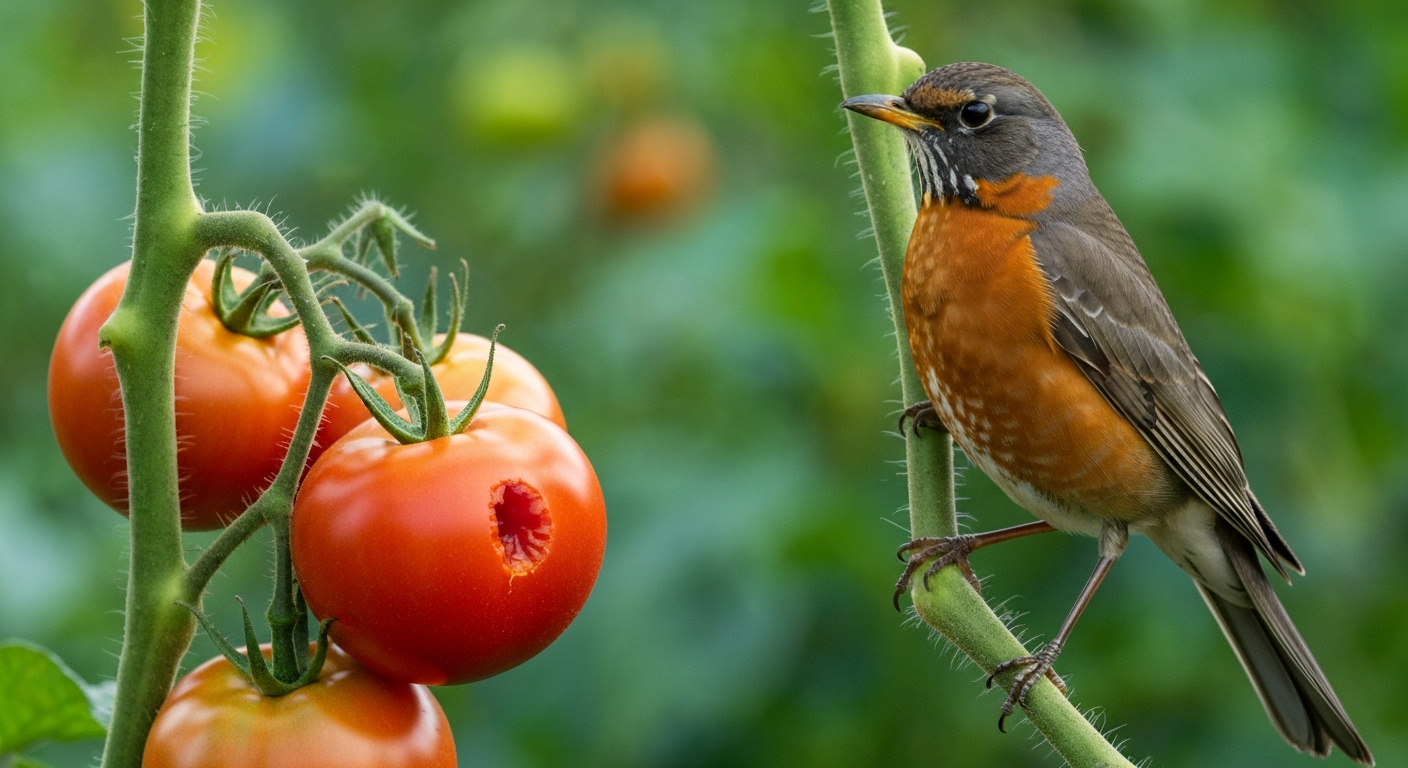
Robins are among the most frequently reported tomato peckers in North America. They are medium-sized thrushes (about 10 inches long) with a distinctive brick-red to orange-red breast, dark gray-black back, and yellow-orange bill. They forage at ground level and in shrubs, but will readily access low or mid-height tomato plants. Robins are strongly frugivorous by nature and have been documented feeding on over 100 fruit species. Damage is typically shallow, conical puncture wounds on the upper or outer face of ripe fruit, often in the morning.
European Starling (Sturnus vulgaris)
Starlings are stocky, short-tailed birds about 8 to 9 inches long, iridescent black with white speckles in winter plumage and a yellow bill in breeding season. They are aggressive, social, and opportunistic omnivores. They often feed in groups, so damage from Starlings can be extensive and sudden. Pecks tend to be forceful and may open fruit more completely than Robin damage. Starlings are present year-round across much of North America, Europe, Australia, and New Zealand.
Northern Mockingbird (Mimus polyglottos)
Mockingbirds are slender, gray birds about 10 inches long with long tails, white wing patches visible in flight, and a habit of aggressively defending feeding territories. They eat a wide range of fruit and will repeatedly return to a productive tomato plant. Their territorial behavior means a single bird can monopolize an unprotected bed for weeks.
Cedar Waxwing (Bombycilla cedrorum)
Cedar Waxwings are sleek, crested birds about 7 inches long with silky brown and yellow plumage, a black eye mask, and distinctive red waxy tips on the secondary wing feathers. They travel in flocks and can strip fruit quickly from multiple plants. Their late-summer diet is almost entirely fruit, making them particularly active in the garden during tomato season.
Grackles and Blackbirds
Common Grackles and Red-winged Blackbirds are large, bold, iridescent black birds (grackles have a distinctive long keel-shaped tail). They are omnivores and will opportunistically take ripening fruit, particularly in agricultural and suburban settings. Their beaks are strong enough to open fruit cleanly.
Corvids: Blue Jays and Crows
Blue Jays (bright blue and white, about 11 inches) and American Crows (all black, 17 to 21 inches) are highly intelligent and will investigate and sample garden produce. Crow damage tends to be more destructive given their bill size, while Jays make smaller, exploratory punctures. Both are generalist omnivores rather than dedicated frugivores.
UK, European, and Australasian species
In British and European gardens, the Common Blackbird (Turdus merula, the Old World equivalent of the Robin, glossy black in males, brown in females) and Starlings are the dominant soft-fruit raiders, particularly in autumn. The British Trust for Ornithology notes Common Blackbird commonly takes soft fruit in UK gardens and recommends physical exclusion such as netting blank" rel="noopener noreferrer">Blackbird — British Trust for Ornithology (BTO). In Australia and New Zealand, the Silvereye (Zosterops lateralis, a tiny green bird with a distinctive white eye-ring, about 4 inches) and the Rainbow Lorikeet (Trichoglossus spp., brightly colored nectarivorous parrot) are documented damaging soft fruit including tomatoes, with Silvereyes capable of piercing through grape and tomato skin with surprising efficiency. NSW DPI documents that Silvereye (Zosterops lateralis) and nectarivorous parrots such as Rainbow Lorikeet (Trichoglossus spp.) commonly pierce soft fruit and recommends using netting to protect orchards and vineyards.
Quick-reference: species, ID, and damage patterns
| Species | Visual ID cues | Typical tomato damage pattern |
|---|---|---|
| American Robin | Orange-red breast, dark back, yellow-orange bill, ~10 in | Shallow conical punctures on upper/outer ripe fruit, often single holes, morning feeding |
| European Starling | Stocky, iridescent black, yellow bill (breeding), ~8–9 in | Forceful pecks, often multiple wounds, fruit may be opened; flock damage can be extensive |
| Northern Mockingbird | Slender gray, long tail, white wing patches, ~10 in | Repeated single-bird visits; targeted punctures; will defend plant territorially |
| Cedar Waxwing | Crested, silky brown/yellow, black mask, red wing tips, ~7 in | Flock damage in late summer; multiple shallow surface piercings; rapid stripping |
| Grackle / Blackbird | Large, iridescent black, keel-shaped tail (grackle), ~11–13 in | Deep, clean pecks; fruit may be fully opened; damage can look more violent than Robin work |
| Blue Jay / Crow | Jay: blue/white ~11 in; Crow: all-black ~17–21 in | Jay: small exploratory holes; Crow: larger ragged damage, may remove fruit segments |
| Common Blackbird (UK/EU) | Male glossy black/orange bill; female brown, ~10 in | Similar to Robin; shallow gouges on ripe fruit, often from top; autumn peak activity |
| Silvereye (AUS/NZ) | Tiny green, white eye-ring, ~4 in | Small, neat pierce marks; works in groups; can damage multiple fruit quickly |
| Rainbow Lorikeet (AUS/NZ) | Brightly colored nectarivorous parrot, ~10–12 in | Punctures and partial excavation of fruit; juice extraction; noisier, more visible raiding |
Bird peck vs disease vs insects: how to tell the difference
This is where gardeners often go wrong. A cracked or blemished tomato does not automatically mean a bird did it, and misdiagnosing the cause leads to the wrong fix. Here is what to look for when you pick up a damaged fruit.
Signs it was a bird
- Small, clean, conical or stab-like puncture holes, often 5–15mm in diameter, on the upper or outer surface of the fruit
- Juice or seeds extracted from the wound; the surrounding flesh is clean, not discolored or sunken
- Damage concentrated on ripe or blushing fruit, not green tomatoes
- Multiple fruits on the same plant affected, often near the top of the truss
- Feathers, droppings, or disturbed soil nearby
- Damage appears suddenly, typically after a dry spell or in late summer
Signs it was insects (e.g., tomato fruitworm)
- Ragged, irregular entry hole, often with frass (dark, granular insect excrement) at or near the wound
- Internal feeding channels or hollowed chambers inside the fruit
- Caterpillar or larvae present inside or on the fruit surface
- Discolored internal tissue extending deeper than the surface wound
Signs it is a physiological disorder, not pests
- Blossom-end rot: water-soaked, sunken, leathery brown-to-black lesion at the bottom (blossom end) of the fruit. No puncture, no external wound. Caused by calcium uptake problems, not birds or insects.
- Sunscald: pale, bleached, papery flattened areas on the side of fruit facing the sun. The tissue feels dry and papery, not punctured.
- Catfacing: scarring, puckering, and deformity around the blossom end, often on large beefsteak varieties. A developmental disorder, not a wound.
- Cracking (radial or concentric): smooth splits in the skin, often after heavy rain following dry weather. No hole, no missing tissue.
Quick inspection checklist
- Look at wound location: top/side of fruit = likely bird; bottom lesion = likely blossom-end rot
- Check wound shape: clean conical hole = bird; ragged hole with frass = insect; sunken leathery patch = disorder
- Probe gently with a toothpick: if there is internal tunneling, suspect insects
- Look for frass, larvae, or eggs at or inside the wound
- Check nearby fruit: if only ripe fruit is damaged, birds are more likely; if green and ripe fruit are equally damaged, look for insects
- Scan for bird sign: droppings on leaves, feathers, disturbed mulch below the plant
Can you eat a tomato that a bird has pecked?
In many cases, yes, with conditions. The short practical answer is: if the peck wound is small, the fruit was just discovered and has not been sitting open in warm conditions for hours, and you cut away the damaged area generously plus wash the rest, the remaining flesh is generally safe for most healthy adults. But there are real risks you should understand before making that call. For more detailed guidance on risks and safe handling, see the companion piece titled "is it safe to eat bird pecked fruit" (document ID b9f010a0-9b9f-4897-9a9a-b258924fc66f). For more detail, read our full guidance on whether you should eat food that a bird has pecked. As a strict precaution for high-risk households, many health guides advise to eat no food a bird has touched. See the companion guide “Can I eat a tomato that a bird has pecked?” for more detailed safety steps and decision criteria.
What is the actual contamination risk?
Wild birds can carry enteric pathogens including Campylobacter, Salmonella, and Shiga toxin-producing E. coli (STEC) in their gut and feces. Research suggests Campylobacter is the most commonly detected, found in roughly 8% of wild birds in pooled datasets, with Salmonella and STEC being less common but not rare. When a bird pecks a tomato, it can deposit fecal bacteria directly into the wound via its bill or droppings. The risk is not zero. Wild birds have been implicated in documented produce contamination events in commercial agriculture.
That said, risk depends heavily on several factors: how long the wound has been open (bacteria multiply quickly at warm temperatures), whether there is visible fecal contamination at the wound, and how the fruit is handled afterward. A fresh, clean peck in the morning that you discover and process the same day carries far less risk than a fruit sitting open and fermenting in the sun for two days.
Who is at higher risk
- Pregnant women: Salmonella and Campylobacter infections carry higher complication risk during pregnancy
- Young children (under 5): more vulnerable to STEC and Salmonella complications, including hemolytic uremic syndrome
- Older adults (65+): reduced immune resilience means foodborne illness can escalate faster
- Immunocompromised individuals (chemotherapy, HIV, organ transplant recipients): should apply commercial-produce food-safety standards and avoid pecked fruit when in doubt
- Pets: dogs and cats that eat bird-pecked or bird-feces-contaminated fruit face the same pathogen exposure risks as humans, with Salmonella being particularly concerning for cats
Myth-busting: common backyard questions
Myth: cooking or cooking eliminates all risk from a contaminated tomato. Partly true. Heat will kill pathogens that are on or near the surface, but if you are using a pecked, raw tomato in a salad or handling it before cooking, cross-contamination risk to hands, cutting boards, and other produce is still real. Myth: washing with soap or bleach is safer. False. FDA guidance is clear: do not use soap, detergent, or bleach on fresh produce. These substances can contaminate the fruit themselves. Rinsing and rubbing under clean running water is the correct method. Myth: if the tomato looks fine on the outside, it is fine to eat. Not always. If the wound has closed or dried over several days, bacteria may have migrated into surrounding tissue beyond what is visible. When in doubt with high-risk household members, discard. The topic of whether bird-pecked fruit is generally safe to eat is worth reading more about if this is a recurring issue in your garden, and a companion piece covering the full food-safety picture for bird-pecked fruit goes into more detail on these questions. For a related high-profile incident and its investigation, see Did Nick Avocado eat his bird Did Nick Avocado eat his bird?. For a related cultural myth about birds and celebrities, see Did Ozzy Osbourne eat a bird Did Ozzy Osbourne eat a bird?.
How to inspect, salvage, and prepare a pecked tomato
When you find a bird-pecked tomato, do not just wipe it on your shirt and eat it. Here is the practical process I use and recommend.
- Assess the wound immediately: is it fresh (moist, bright red flesh) or old (darkened, dry, or fermented)? If it smells off, discard. Do not taste-test.
- Check for fecal matter at or near the wound. Bird droppings are white and pasty. If droppings are present at the wound site, discard the fruit entirely or compost it properly.
- Wash your hands before handling the fruit further.
- Rinse the whole fruit under cool, clean running water while rubbing gently with clean hands or a produce brush. No soap, no detergent, no bleach.
- Using a clean knife and cutting board (not one used for raw meat), cut away the damaged area plus at least a 1-inch (2.5 cm) margin of visibly normal flesh around it.
- Inspect the internal flesh in the cut area: if you see discoloration, softening, or off-smell extending deeper than the surface cut, remove more flesh or discard the whole fruit.
- Check for insect tunneling or larvae in the flesh while you have it cut open. If found, discard.
- If the remaining fruit passes this inspection, use it promptly. Do not store cut pecked fruit for later use. Cook it if you are uncertain, especially for higher-risk household members.
- Sanitize your knife, cutting board, and sink after processing.
When to discard without trying to salvage
- Visible bird droppings at or in the wound
- Wound is old (more than a few hours in warm weather), darkened, or fermenting
- Off smell from the wound or surrounding flesh
- More than 30% of the fruit surface is damaged
- Internal discoloration extends more than 1 inch from the wound
- You are preparing food for pregnant women, young children, or immunocompromised individuals and you are uncertain about wound age or contamination
Safe preparation and composting of spoiled or pecked fruit
If a tomato is not safe to eat, how you dispose of it matters. For cooking: if a pecked tomato has passed your inspection and is going into a cooked dish (sauce, soup, roasting), the heat will address most surface pathogens, and this is a reasonable use of fruit that is borderline for raw consumption. For guidance on safely using bird‑pecked produce in cooked dishes, see good eats a bird in the pan. Bring the dish to a proper cooking temperature and do not partially cook and refrigerate for later without bringing it to a full food-safe temperature.
For composting: this is where most home gardeners go wrong. A standard cold backyard compost pile does not reliably reach or hold the temperatures needed to kill foodborne pathogens or many plant pathogens. Hot composting requires sustained temperatures above 55°C (131°F) for multiple days, and most home piles never get there consistently. If you have a certified hot-composting system or access to a municipal composting facility, those are appropriate destinations for diseased or heavily contaminated fruit. Otherwise, bag the discarded fruit and put it in your household waste, or bury it deeply (at least 12 inches) in an area away from the vegetable garden. Do not toss discarded tomatoes into a cold pile and assume the problem is solved.
A note on pets and wildlife around spoiled fruit
Dogs in particular will investigate and eat fallen, pecked, or fermenting tomatoes from the garden. Ripe and overripe tomato fruit is generally low in solanine (the green parts of the plant are the concern), but fermented or contaminated fruit is a real food-safety issue for dogs and cats too. Salmonella infections in pet cats and dogs from contaminated garden produce are documented. For a related celebrity food-safety controversy involving pets, see did nikocado avocado eat his bird. If you have free-roaming pets in your vegetable garden, clear fallen or damaged fruit promptly and compost or dispose of it before it becomes a source of pathogen exposure.
Humane prevention and exclusion: what actually works
Prevention is much easier than dealing with damage and contamination after the fact. Here are the most effective techniques, with honest notes on their limitations.
Physical netting (most effective)
Draping or enclosing tomato plants with bird netting (mesh size 19mm or smaller) is consistently the most effective non-lethal exclusion method recommended by extension services from UC IPM to NSW DPI. The netting must be properly supported so birds cannot reach through it, and the base must be secured to prevent ground access. Loose, unsupported netting can actually trap birds, which defeats the purpose and causes welfare problems. Use a frame (PVC hoops, bamboo canes, or a proper cage structure) and check regularly for entangled wildlife.
Timing your harvest early
Birds target ripe and blushing fruit, not green tomatoes. Harvesting at the blushing stage (when the color has begun to change but the fruit is not yet fully ripe) and letting tomatoes finish ripening indoors on a countertop eliminates the window of vulnerability almost entirely. Tomatoes ripen adequately at room temperature (65 to 70°F) without significant flavor loss. This is the simplest no-cost solution for smaller harvests.
Visual deterrents and decoys
Reflective tape, old CDs hung near the plants, and predator decoys (owl or hawk silhouettes) can work in the short term but most bird species habituate to them within days to a couple of weeks. If you use them, move them frequently, at least every 3 to 5 days, to maintain any deterrent effect. They are best used as a temporary supplement to netting rather than a standalone solution.
Providing alternative water and food sources
During dry spells, birds often target juicy tomatoes simply for water. Keeping a clean, freshwater bird bath or dish topped up near (but not directly adjacent to) the vegetable garden can reduce tomato damage by addressing the moisture need directly. This is a low-effort, wildlife-friendly approach that is especially effective in summer droughts.
Physical row covers and paper bags
Individual fruit can be enclosed in paper bags (like the waxed paper bags used in vineyards) or fine mesh bags secured at the stem. This is labor-intensive but very effective for protecting individual prize fruits. Avoid plastic bags, which trap heat and moisture and can cause fruit to rot.
Pros and cons at a glance
| Prevention method | Effectiveness | Effort/cost | Limitations |
|---|---|---|---|
| Properly framed bird netting | High | Medium (initial setup) | Must be secured; check regularly for trapped birds |
| Early/blushing-stage harvest | High | Low (no cost) | Requires daily monitoring; not for all tomato uses |
| Reflective tape / CDs / decoys | Low–Medium (short-term only) | Low | Birds habituate quickly; must be moved every 3–5 days |
| Fresh water source nearby | Low–Medium (drought conditions) | Low | Addresses water need only, not fruit-pecking for food |
| Individual fruit bagging (paper) | High | High (labor) | Impractical for large harvests; paper only, not plastic |
| Row covers (fabric) | Medium–High | Medium | Reduces air circulation; check for heat buildup |
Troubleshooting: if birds keep coming back
If you have tried deterrents and are still seeing damage, run through this short checklist before spending more time or money.
- Check your netting: is it touching the fruit? Birds can peck through netting that rests directly on the fruit. Raise the support frame.
- Check for gaps at ground level: Starlings and Robins will walk under loose netting. Secure all edges.
- Is your bird bath positioned too close? A water source right next to the tomatoes encourages birds to linger. Move it at least 10 feet away.
- Are you leaving damaged or fallen tomatoes on the ground? Rotting fruit attracts birds and teaches them the garden is a food source. Clear fallen fruit daily.
- Are neighboring gardens or trees providing staging perches directly above your beds? Pruning nearby branches reduces convenient launch points.
- If using decoys, when did you last move them? If it has been more than a week, they have lost their effect.
FAQ
What is a good SEO title and 160‑character description for an article about birds eating tomatoes?
Title: Which Birds Eat Tomatoes — ID, Why They Peck, Food‑Safety & Humane Protection 160‑character description: Learn which bird species peck tomatoes, how to tell peck damage from disease or insects, whether pecked fruit is safe to eat, and humane prevention tips.
Which bird species commonly peck or eat tomatoes?
Common species vary by region but often include American Robin, European Starling, Northern Mockingbird, Cedar Waxwing, grackles/blackbirds and corvids (jays, crows). In the U.K./Europe, common blackbirds and starlings are frequent; in Australia/New Zealand species such as Silvereye and lorikeets are reported. These species are documented fruit‑eaters or opportunistic omnivores that will peck soft, ripe or water‑stressed fruit.
How can I visually identify the bird species that are eating my tomatoes?
Use these visual ID cues: robins and thrushes: medium‑sized, upright, often take small pecks and may sit on low branches; starlings: short tails, spotted/iridescent plumage, peck in groups and leave many punctures; mockingbirds: long tails, bold hops on plant supports, single cleaner punctures; corvids (jays/crows): larger, bigger bites and more torn flesh; cedar waxwings: sleek, crested flocks nibbling whole small fruit. Camera traps, binoculars, or watching at dawn/dusk helps confirm culprits.
What do bird‑peck wounds on tomatoes look like compared with insect or disease damage?
Bird pecks: small, shallow conical punctures or gouges, often on upper/outer surfaces or the fruit shoulder, with exposed juicy flesh or missing seeds. Insect damage: ragged entry holes, frass (droppings) or internal tunneling and sometimes the insect nearby. Blossom‑end rot (physiological): sunken, leathery brown patch at the blossom end (bottom), not a puncture. Sunscald/catfacing: bleached patches or misshapen scarred areas. Use pattern/location and presence of frass or internal feeding to distinguish.
When and why do birds target tomatoes?
Birds target tomatoes when fruit is ripening (color change), during food shortages, after drought/water stress that softens fruit, or when fruit is left exposed and easily reachable. Many species switch to more fruit in late summer–winter. Birds seek sugar/juice and seeds; some species probe to sample multiple fruits rather than removing whole fruits.
Are tomatoes pecked by birds safe to eat?
Often yes, if damage is superficial and there is no visible fecal contamination, mold, fermentation or soft rot. Wash intact fruit under running potable water, cut away damaged areas generously and use promptly. Do not eat fruit that has been contaminated by bird or animal feces, is visibly moldy, fermenting, or has deep internal browning. People at higher risk (young children, pregnant people, elderly, immunocompromised) should be more cautious and discard any fruit with fecal contact or deep tissue damage.