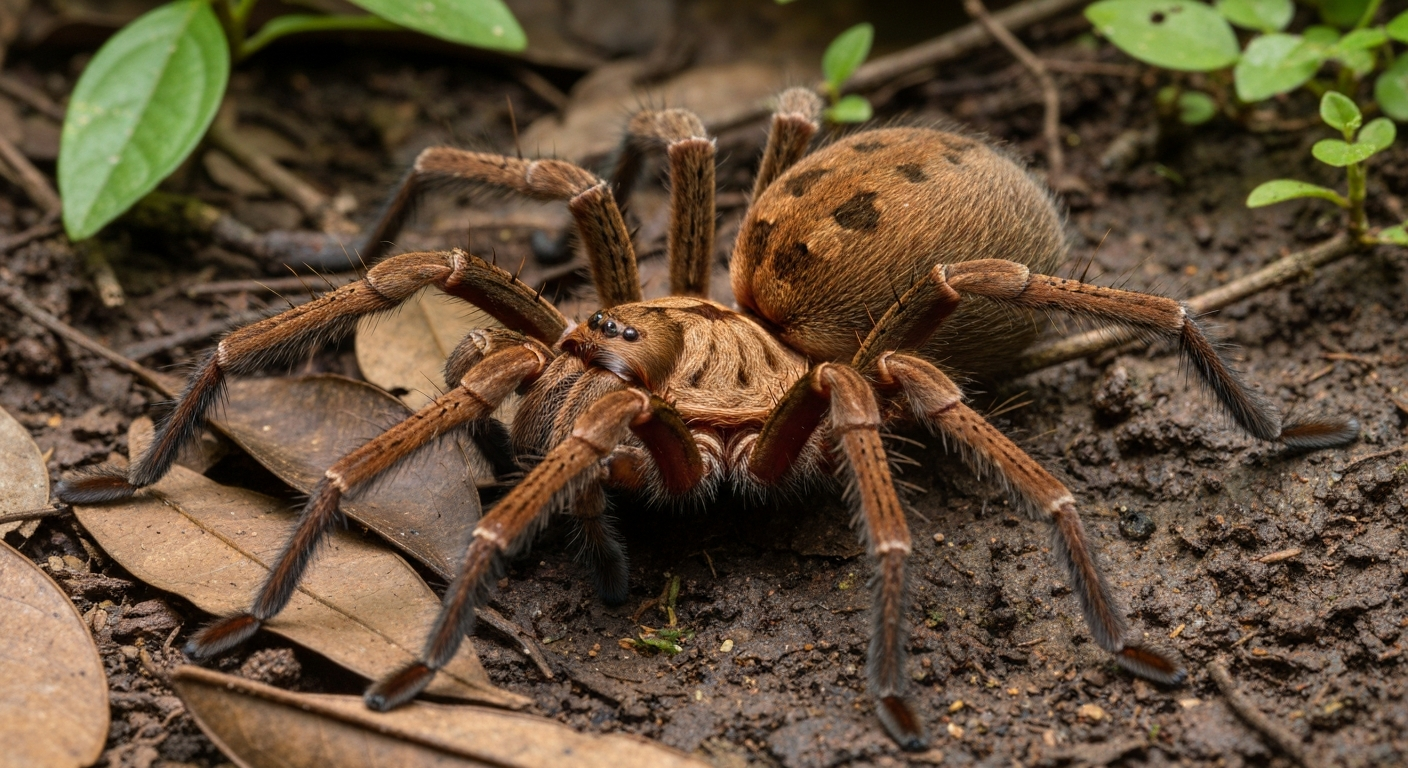
A bird-eating spider, most accurately represented by the Goliath birdeater (Theraphosa blondi), looks like a very large, densely hairy tarantula with a dark brown to reddish-brown body, a legspan that can reach 28 to 30 cm (about 11 to 12 inches), and a heavy, rounded abdomen covered in coarse bristles. It moves slowly on thick, sturdy legs, holds its body low to the ground during regular activity, and rears up dramatically when threatened. Despite the alarming name, it almost never eats healthy adult birds. The 'birdeater' label is more legend than daily reality, and understanding what these spiders actually look like and do will help you assess real risk to backyard birds and pets clearly.
What Does a Bird Eating Spider Look Like? Size, Color & Risk

Maya Bennett
25 Jul 2026
At a Glance: Visual ID for the Goliath Birdeater
If you want a fast reference before diving deeper, here are the core identification points for Theraphosa blondi and closely related large tarantulas. These are the features to look for in photos, documentaries, or if you ever encounter one in the wild or in a collection.
| Feature | Goliath Birdeater (T. blondi) | Lasiodora parahybana | Theraphosa stirmi |
|---|---|---|---|
| Body length | Up to ~13 cm (5 in) | Up to ~10 cm (4 in) | Up to ~12 cm (4.7 in) |
| Legspan | Up to 28–30 cm (11–12 in) | ~20–25 cm (8–10 in) | ~20–28 cm (8–11 in) |
| Body mass | Up to ~175 g | ~100 g (large females) | Comparable to T. blondi |
| Color | Dark brown to reddish-brown | Salmon-pink setae on legs | Dark brown, similar to T. blondi |
| Setae (hair) texture | Coarse, dense, bristle-like | Finer, salmon-pink hue on legs | Coarse, dense |
| Urticating setae | Yes (Type I and IV) | Yes | Yes |
| Native region | Venezuela, Guyana, N. Brazil | Northeastern Brazil | Guyana, Suriname, N. Brazil |
Body Part by Body Part: What You're Actually Seeing
Carapace (the top of the front body section)
The carapace (the hard upper plate of the prosoma, the spider's front body segment) on a Goliath birdeater is broad, slightly domed, and covered in dense, coarse setae. The color is typically a deep chocolate brown to rufous (reddish-brown). In adults you can see the fovea, a central pit or groove on the carapace's surface, which is where powerful leg muscles attach internally. The eight small eyes are clustered near the front of the carapace in two short rows, though they are almost impossible to spot without magnification. The overall impression is of a thick, heavy armored plate, nothing like the sleek spider body most people picture.
Abdomen (opisthosoma)
The abdomen is large, rounded, and distinctly plump on well-fed adults. It can appear almost globular in mature females. The surface is completely covered in coarse setae, giving it a bristly, almost furry appearance. On the underside of the abdomen, you can see the spinnerets at the rear tip. In living specimens the abdomen is often darker dorsally (on top) and slightly paler on the underside. When the spider is stressed, the abdomen can look slightly depressed or wrinkled, which keepers use as a sign of dehydration.
Legs and pedipalps
The eight legs are thick, heavily built, and covered in the same coarse setae as the body, with visible spines on many segments. The coloration generally matches the body: brown to reddish-brown, sometimes with slightly darker banding near the joints. The pedipalps (the smaller, leg-like appendages at the front) are prominent and leg-like in appearance, making it easy to initially miscount and think you are looking at a ten-legged animal. The tarsi (foot segments) have dense scopulae, tiny tufts of fine hairs that help the spider grip smooth surfaces.
Setae (urticating hairs) and fangs
The urticating setae are one of the most important ID features and also the main physical hazard these spiders present to people. Located on the dorsal surface of the abdomen, these barbed hairs can be kicked off with the rear legs when the spider feels threatened. They are microscopic in length but barbed at the tip, and they cause significant skin and eye irritation on contact. If you see a bald or bare patch on the abdomen of a pet tarantula, it has been flicking its urticating hairs. The chelicerae (fang-bearing mouthparts) are large, dark, and clearly visible from the front of the spider. In T. blondi the fangs themselves can be roughly 2 cm long (close to an inch), which is enough to break human skin, though bites are rare.
Threat Posture: When a Birdeater Rears Up
One of the most striking and memorable visual features of large tarantulas, and one you need to recognize for your own safety, is the threat display. When alarmed, a Goliath birdeater will rear up on its rear legs, lifting the front of its body and elevating the pedipalps and front legs to expose the fangs and the underside of the chelicerae. At the same time it may rub its rear legs against its abdomen to release urticating hairs into the air. The whole posture makes the spider look significantly larger and is meant to deter predators. If you ever see a large tarantula in this position, back away calmly. This is not a bluff charge; the spider will bite if pressed further.
Where It Lives and How It Behaves
The Goliath birdeater lives in the tropical rainforests of northern South America, specifically Venezuela, Guyana, Suriname, French Guiana, and northern Brazil. GBIF Backbone Taxonomy: Theraphosa blondi (GBIF occurrence & taxon pages) lists occurrences in Venezuela, Guyana, Suriname, French Guiana and northern Brazil. It is a ground-dwelling, burrowing species. Adults dig or adopt pre-existing burrows in moist, humid forest floor soil, and they typically stay close to or inside their burrow during daylight hours. This is an important point: it is not a spider that is going to turn up at a North American bird feeder. If you are a backyard birder in the US, Canada, or Europe, you are not going to encounter a Goliath birdeater in your garden.
Theraphosa blondi is nocturnal, emerging from its burrow primarily at night to ambush prey. It does not construct a classic orb web to catch prey. Instead, it may lay trip-lines or silk at the burrow entrance to detect approaching prey, then lunge when something moves close. Movement is relatively slow and deliberate during normal activity, but the strike itself is fast. The spider relies on ambush rather than pursuit, which is why it spends so much time stationary at or near its burrow.
How the Birdeater Actually Eats
Like all tarantulas, the Goliath birdeater does not chew its food. After subduing prey with its chelicerae and injecting venom (which immobilizes and begins breaking down tissues), it also secretes digestive enzymes into the prey. This extra-oral digestion liquefies the internal tissues, and the spider then ingests the resulting nutrient-rich fluid. What is left behind after a tarantula feeding is typically a dry, compacted bolus of exoskeleton, feathers, or other indigestible material. The venom itself is a complex mixture of peptides and enzymes. It is effective on invertebrates and small vertebrates but is not considered medically dangerous to healthy adult humans, though a bite is painful and can cause local effects.
The bulk of a Goliath birdeater's real diet is large insects and other invertebrates: beetles, crickets, millipedes, and similar arthropods that happen to wander close to the burrow. Opportunistically, they will also take small vertebrates: frogs, lizards, small rodents, and, rarely, nestling birds. Active pursuit of a healthy adult bird is essentially not a documented behavior. The predation events that do get recorded in the scientific literature almost always involve nestlings, injured birds, or birds that have stumbled into a burrow or web.
Species Profiles and What the Real Predation Records Show
Goliath Birdeater (Theraphosa blondi)
This is the species that earned the 'birdeater' name and holds the record as the world's heaviest spider, reaching body masses around 175 g with body lengths up to 13 cm. Documented unusual large-prey events include opportunistic predation on a snake and on antbirds in Amazonian field records, noted in published field reports. These are genuine, vouchered observations but they are exceptional rather than routine. The birdeater name itself traces to an early 18th-century illustration by the naturalist Maria Sibylla Merian (1705), which depicted a large tarantula with a hummingbird. That illustration proved far more memorable than the footnotes explaining how rarely such events occur, and the name stuck.
Theraphosa stirmi
Theraphosa stirmi is very similar in appearance to T. blondi: dark brown, densely hairy, and reaching comparable legspans in the 20 to 28 cm range. It shares the same northern South American distribution and the same burrowing, nocturnal lifestyle. For visual ID purposes the two species are easy to confuse. T. stirmi is slightly more common in the pet trade in some regions. Its predation ecology is assumed to mirror T. blondi but with fewer specific documented events in the peer-reviewed record.
Lasiodora parahybana (Brazilian Salmon-Pink Tarantula)
Lasiodora parahybana from northeastern Brazil is among the other genuinely large theraphosids. Adults commonly reach legspans of 20 to 25 cm with females sometimes exceeding that. The most distinctive visual feature separating it from Theraphosa species is the pinkish-salmon hue of the setae on the legs, particularly visible in good lighting. It is also a terrestrial, burrowing species with a similar nocturnal ambush lifestyle.
Documented bird-predation records: what the science actually says
The scientific literature does contain verified records of tarantulas eating birds. A 2021 paper in the Journal of Arachnology documented Iridopelma vanini, an arboreal theraphosid, feeding on two Troglodytes musculus (Southern house wren) nestlings in Brazil. Additional records from 2016 Brazilian studies document Avicularia and Theraphosa species in bird-predation events. Across all these records, a consistent pattern emerges: the birds involved are nestlings, entangled individuals, or birds that have entered a spider's immediate ambush zone. Contemporary researchers explicitly characterize most of these events as opportunistic. A global review of arthropod vertebrate predation (Valdez, 2020) compiled hundreds to low thousands of vouchered events across all spider species and classified genuine bird predation as occasional, not habitual, behavior.
How Big Is a Bird-Eating Spider? Size in Real Terms
The Goliath birdeater is reliably the heaviest spider in the world at around 175 g, roughly the weight of a small apple. Its body (not counting legs) reaches up to about 13 cm, or just over 5 inches. With legs fully extended the legspan reaches 28 to 30 cm, which is roughly the diameter of a dinner plate or a standard vinyl record. That is a genuinely impressive size, but it helps to hold those numbers against something familiar: a spread human hand from wrist to fingertip is typically around 18 to 20 cm, so a fully extended Goliath birdeater legspan extends meaningfully beyond that. For more detailed size comparisons across species, the sibling article on how big a bird-eating spider is covers this in depth. See the related article how big is the bird eating spider for detailed size comparisons across species.
Can a Spider Actually Eat a Bird? The Evidence, Plainly Stated
Yes, it can happen, but the full picture matters. For more detail and documented cases, see the article can a spider eat a bird. Verified records exist, as described above, and they consistently involve nestlings or vulnerable individuals rather than healthy, mobile adult birds. An adult songbird weighs somewhere between 10 and 80 g depending on species, and a healthy bird that can fly or run presents a difficult target for a sit-and-wait predator with no pursuit ability. A nestling in a low nest, however, is a different story: immobile, unprotected, close to ground level, it is a plausible prey item for a large ground-dwelling or arboreal tarantula moving through the forest at night.
For backyard birders in North America or Europe, the real-world risk is close to zero. Native large spiders in those regions do not reach the size or predatory capability of Theraphosa species. If you are in a region where large theraphosids are native (parts of South America), keeping nest boxes and bird feeders well clear of ground level and away from dense undergrowth is sensible. The sibling articles on whether a spider can eat a bird and on the spider that can eat a bird go further into the documented cases and the specific species involved. It is also worth knowing that praying mantises are actually the arthropod group most often recorded preying on small birds in yards, with around 147 documented mantid-to-bird predation events recorded globally, including many involving hummingbirds at feeders. A comprehensive review (Nyffeler, Maxwell & Remsen 2017) summarizes roughly 147 documented mantid-to-bird predation records worldwide, supporting that praying mantises are the arthropod group most often recorded preying on small birds blank" rel="noopener noreferrer">Nyffeler, Maxwell & Remsen (2017) — Bird predation by praying mantises: a global perspective (Wilson J. Ornithology, PDF of article). A spider at a feeder is far less likely to be the threat than a large mantis.
Birdeater vs Camel Spider: They Are Not the Same Animal
Camel spiders (order Solifugae) are frequently confused with tarantulas online, partly because both look large and alarming in close-up photos. They are completely different animals. Camel spiders are not true spiders, have ten legs apparent (eight legs plus large pedipalps that look like legs), lack venom glands, and are found primarily in arid desert environments in the Middle East, Africa, and parts of the Americas. They are fast-moving and aggressive toward prey but rely on powerful crushing chelicerae rather than venom. A Goliath birdeater and a camel spider share almost nothing in biology, behavior, or appearance beyond being large arachnids with prominent mouthparts. The dedicated comparison article on camel spider vs bird-eating spider covers the specific differences in detail. See the comparison article "camel spider vs bird eating spider" (625d69a0-2bf3-467e-9716-74f97c0a4353) for the specific differences in detail.
Real Risks to Backyard Birds, Pets, and People
Risk to backyard birds
For birders in the US, Canada, Europe, or Australia, the Goliath birdeater presents zero practical risk because it does not live there. If you are in northern South America and maintain nest boxes or feed birds in a forest-edge environment, low nests near ground level in dense vegetation carry a small, real risk from large theraphosids. Raising nest boxes to at least 1.5 m above ground and using baffles on poles will eliminate essentially all spider access.
Risk to pets
Captive Goliath birdeaters kept as pets are the scenario where pets (cats, dogs, small rodents) and the spider can intersect. A T. blondi bite can cause significant local pain and swelling in a small mammal and the urticating hairs can cause serious eye irritation (ophthalmia nodosa, a documented condition) in animals and people who get them in the eyes. Keep other pets away from tarantula enclosures. If urticating hairs contact your eyes or your pet's eyes, flush with clean water and seek veterinary or medical advice promptly.
Risk to people
T. blondi venom is not considered medically dangerous to healthy adults, but bites are painful and the fangs are large enough to cause a real puncture wound. The urticating hairs are the more common and more insidious hazard: they can cause persistent skin rashes and, if they reach the eye, keratitis or conjunctivitis, as documented in medical literature going back to Cooke, Roth and Miller (1972). If you encounter a large theraphosid in the wild, observe it from a distance of at least a meter. Do not attempt to handle it. Do not disturb the area around it. If you find one in your home in a range country, contact a local wildlife or pest management service rather than attempting to capture it yourself. For another relevant comparison, see spider that can eat a bird.
Practical Safety Checklist for Backyard Birders
- Keep bird feeders and nest boxes at least 1.5 m (5 ft) above ground and use smooth pole baffles to prevent climbing access.
- In range countries (northern South America), check nest boxes regularly and avoid placing them in dense leaf litter or close to fallen logs where burrowing spiders could be present.
- Do not leave seed spilled on the ground for extended periods; accumulated seed and associated insect activity can attract large ground-dwelling spiders looking for prey.
- If you keep a birdeater or large tarantula as a pet, use a secure enclosure with a locking lid and keep it in a room that other pets cannot access unsupervised.
- If urticating hairs contact your eyes or your pet's eyes, flush immediately with clean water and seek medical or veterinary care.
- If you find a large tarantula unexpectedly, observe from a distance, do not handle it, and contact a local reptile/arachnid specialist or wildlife service for identification and removal if needed.
- Note that if you are seeing small birds taken at your feeder, a praying mantis perched on or near the feeder structure is a much more likely suspect than any spider.
Myth-Busting: What the Birdeater Name Gets Wrong
- Myth: Goliath birdeaters regularly hunt and eat adult birds. Reality: the documented diet is predominantly large insects and invertebrates; bird predation events are rare, opportunistic, and almost always involve nestlings.
- Myth: The 'birdeater' name comes from observed wild behavior. Reality: it comes from an early 18th-century illustration by Maria Sibylla Merian (1705) that was compelling but not representative of typical feeding behavior.
- Myth: Any large spider near a bird feeder is dangerous to birds. Reality: spiders common to North American and European gardens cannot take adult birds and very rarely even threaten nestlings; mantises are the greater risk among arthropods.
- Myth: Camel spiders are a type of birdeater. Reality: camel spiders are a completely different arachnid order, are not true spiders, lack venom glands, and are desert animals with no connection to tarantulas.
- Myth: Birdeater venom is deadly to humans. Reality: it is not considered medically significant to healthy adults; the urticating hairs are the primary human hazard.
- Myth: You can find birdeaters in North America or Europe. Reality: Theraphosa blondi and its close relatives are restricted to the humid rainforests of northern South America.
FAQ
Quick answer: What does a bird‑eating spider look like (short summary)?
Concise: “Bird‑eating spiders” refers to very large tarantulas (not a single species). Visually they are robust, densely hairy spiders with a squat cephalothorax and a rounded, hairy abdomen, heavy chelicerae (fang bases) and long, thick legs. Adults of the largest species (e.g., Theraphosa blondi) can have body lengths up to ~10–13 cm and legspans commonly in the 20–30 cm range, and weigh tens to >100 g. Color ranges from brown to reddish‑brown or rufous; New‑World species often have dense, coarse setae (hairs) and may show defensive postures (rearing/up on hind legs) and flicking of urticating hairs.
How big are bird‑eating spiders (size, legspan, weight)?
Typical sizes: Theraphosa blondi (Goliath birdeater) is the largest referenced species — body length up to ≈13 cm, legspan commonly ~28–30 cm, and body mass reported in some sources ≈175 g for very large individuals. Other large theraphosids (e.g., Lasiodora parahybana, Theraphosa stirmi) commonly reach legspans ≈20–25+ cm. Most large tarantulas used in the vernacular 'birdeater' category fit within these ranges; smaller species are correspondingly smaller.
What colors and surface features should I expect?
Appearance details: large Neotropical theraphosids are covered in coarse hairs (setae) that give a matte, fuzzy look; typical colors are shades of brown, rufous, reddish‑brown or tan. Some species have contrasting markings on legs or carapace. New‑World species possess urticating setae on the abdomen that are visible as dense hairs and can be flicked when alarmed.
What posture and behaviors help identify them?
Identification by behavior: when disturbed many large tarantulas rear up on their hind legs, raise the prosoma and front legs and may show chelicerae. New‑World tarantulas often use urticating hairs as a first defence (kicking hairs from the abdomen). They are generally nocturnal, ground‑dwelling or burrowing (some arboreal theraphosids exist), ambush predators and hide in burrows, crevices or under logs during the day.
Where do true bird‑eating tarantulas live (habitat & range)?
Range and habitat: the best‑known species (Theraphosa blondi, T. stirmi) occur in northern South America (Venezuela, Guyana, Suriname, French Guiana, northern Brazil). Other large theraphosids (Lasiodora parahybana) are native to northeastern Brazil. Habitats are typically humid tropical forests, leaf litter and burrows; many species avoid open, dry urban environments.
Can a spider actually eat a bird — how common is that?
Short answer: yes, but rare and usually opportunistic. Peer‑reviewed, vouchered records exist of tarantulas consuming nestling or otherwise vulnerable small birds and a few unusual vertebrate prey items (frogs, lizards, rodents, snakes). Most documented events involve nestlings, entangled, injured or already‑dead birds rather than active predation on healthy adult birds. Reviews of spider feeding ecology classify vertebrate captures by spiders as occasional rather than routine.
Next Article
Can a Spider Eat a Bird? What Usually Happens
Can spiders eat birds? Learn when it happens, how web trapping compares to hunting, and what to do safely.