Yes, a praying mantis can eat a bird, but only under very specific conditions. For most backyard birds, the answer is no, a mantis poses zero realistic threat. The one clear exception is hummingbirds, especially at feeders, and the science backs that up with documented cases. Here is exactly what you need to know, whether you are a backyard birder, a nature educator, or just someone who stumbled on a shocking photo online.
Can a Praying Mantis Eat a Bird? What Happens in the Wild

Maya Bennett
15 Apr 2026
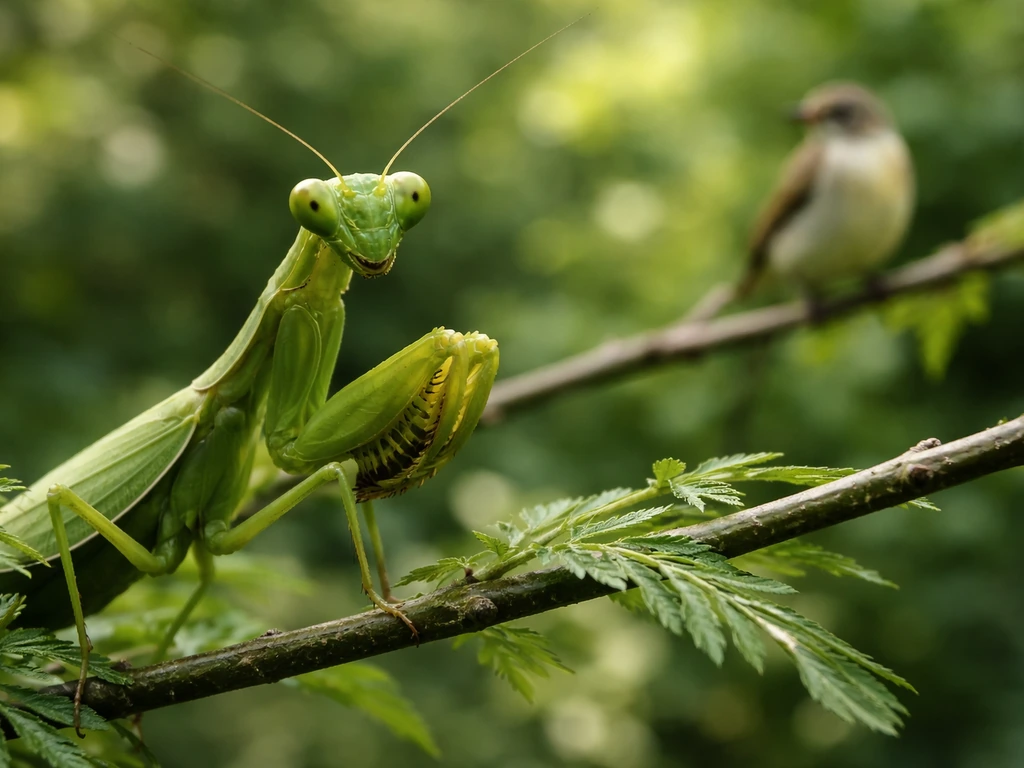
Praying mantis vs. birds: what's actually realistic
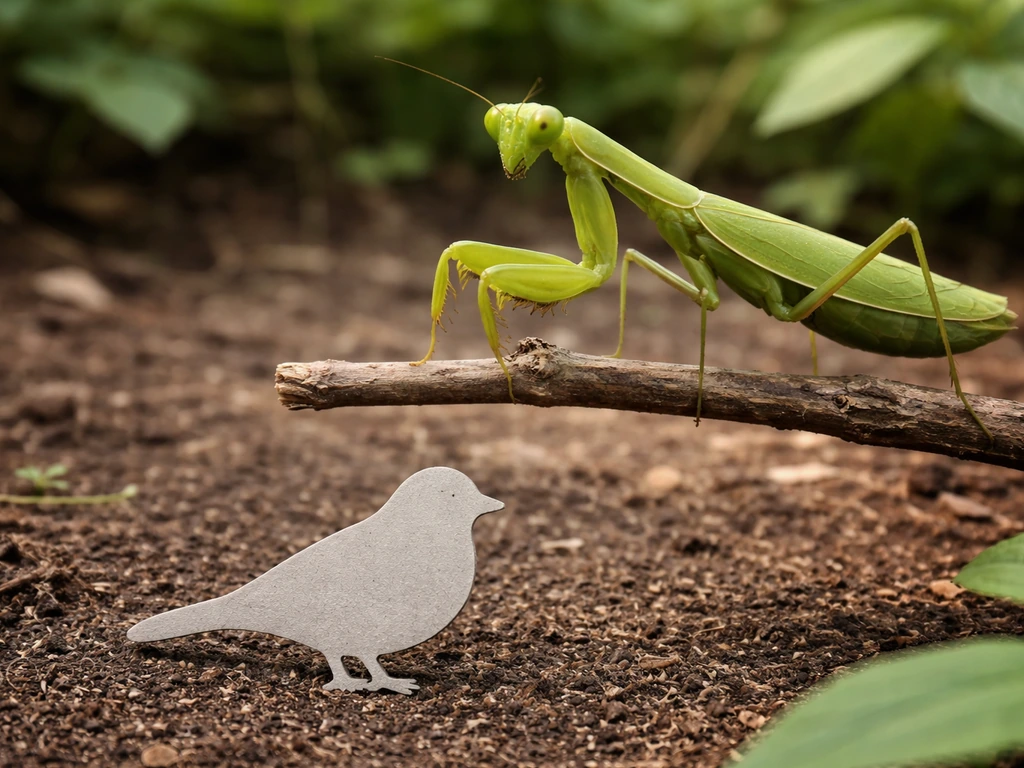
The honest framing here is that mantises are extraordinary predators for their size, but size still matters. A review published in The Wilson Journal of Ornithology compiled 147 documented incidents of mantids capturing small birds, spanning 24 bird species and 12 mantid species across multiple genera.
That sounds alarming, but put it in context: the vast majority of cases involved hummingbirds (Archilochus colubris, the ruby-throated hummingbird, was the most frequently recorded species), and most incidents came from the USA, often at hummingbird feeders or in garden settings. Scientific American coverage of that same review noted the documented captures occurred on every continent except Antarctica, and fewer than one-third of those incidents had previously appeared in the scientific literature.
So this is real, not a myth, but it is also not a common occurrence.
For a robin, a sparrow, a chickadee, or any bird of ordinary backyard size, a praying mantis is not a threat. The risk narrows down to very small birds, particularly hummingbirds, in situations where a mantis has already positioned itself near a feeder. That is the scenario worth paying attention to.
Can a mantis actually kill a bird? The evidence-based answer
The short answer is yes, but rarely. One of the earliest documented scientific cases appeared in The Auk back in 1949, when Earl M. Hildebrand recorded a hummingbird captured by a praying mantis. More recently, National Geographic reported a specific backyard incident in New Mexico where a dead hummingbird was found in the clutches of a mantis at a bird feeder, with the mantis feeding on the bird's head and eyes. These are not urban legends. They are peer-reviewed and reported cases.
The Wilson Journal of Ornithology review describes the actual mechanics: the mantid seizes the bird by striking with its raptorial front legs while holding itself to the perch, then holds the bird firmly and begins feeding. Once the mantis has a grip, a small bird like a hummingbird has very little chance of escape. So yes, a mantis can kill a bird. It just needs the right conditions to do it.
How a mantis hunts and whether it can overpower a bird
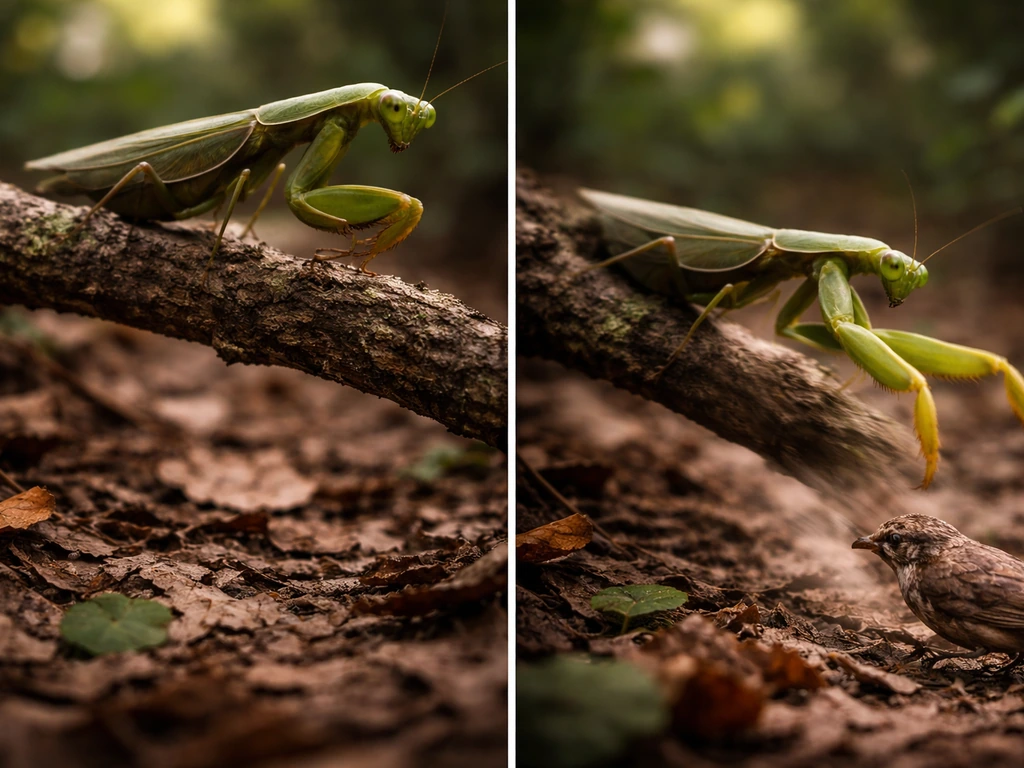
Mantises are ambush predators. They rely on camouflage, patience, and an explosive raptorial strike. A classic Nature paper on mantis feeding behavior describes the sequence clearly: the mantis visually searches for prey, makes a slow, deliberate approach, then launches an extremely rapid grasping movement with its forelegs. Research on the biomechanics of that strike shows the foreleg reflex can re-engage within roughly 100 milliseconds after a missed capture, giving the mantis multiple rapid attempts in quick succession. In Tenodera aridifolia, looming-sensitive neural activity can trigger rapid defense behavior, with firing dynamics relevant to the speed of mantis responses looming-sensitive neuron triggers defense behavior.
The raptorial forelegs are the key weapon. As the American Museum of Natural History describes them, these are spiky appendages built to strike and hold. The Amateur Entomologists' Society describes them as spined grasping appendages that close like blades. When those legs close around a small, lightweight bird, the grip is extremely difficult to break. The mantis does not need to overpower a bird through brute strength the way a hawk would. It needs to anchor itself, strike fast, and hold on. Against a hummingbird hovering near a feeder, that strategy can work.
The trigger for the strike is visual and movement-based. The same Nature paper notes that the strike response is maximal when prey exhibits rapid, jerky movements within reach. A hummingbird hovering and feeding fits that description perfectly. It is small, it moves quickly in a tight space, and it keeps returning to the same spot. That makes feeders a particularly dangerous trap.
Size and context: when it might happen and when it absolutely won't
The size of the mantis matters enormously here. Common backyard species in the US have a fairly narrow size range. The European mantid (Mantis religiosa) runs about 50 to 65 mm. The Carolina mantid (Stagmomantis carolina) reaches about 48 to 57 mm. The Chinese mantid (Tenodera sinensis) is the biggest of the common US species, with males around 3 inches and females up to about 4 and 3/8 inches long. The Chinese mantid is the species most frequently implicated in hummingbird captures, and that size overlap with a hummingbird is tight but real.
The Amateur Entomologists' Society states explicitly that mantids will eat prey of a similar size to themselves, and that larger species can take vertebrates including frogs, lizards, and mice. A ruby-throated hummingbird weighs roughly 3 grams and is about 3 inches long. A large female Chinese mantid overlaps almost exactly with that size. That is why hummingbirds are the vulnerable species here and why a Carolina mantid is unlikely to succeed against anything larger than a large insect.
| Mantis Species | Body Length | Can It Capture a Small Bird? |
|---|---|---|
| Chinese mantid (Tenodera sinensis) | Males ~3 in, females up to ~4.4 in | Yes, realistic risk to hummingbirds |
| European mantid (Mantis religiosa) | ~50–65 mm (~2–2.6 in) | Unlikely, borderline for smallest hummingbirds |
| Carolina mantid (Stagmomantis carolina) | ~48–57 mm (~1.9–2.2 in) | No, too small for any bird prey |
For birds larger than a hummingbird, including goldfinches, sparrows, wrens, or chickadees, a mantis capture is not a realistic scenario under any normal conditions. A nestling or a very newly hatched chick could theoretically be at risk from a large mantis in an exposed nest, but that would be an extremely unusual edge case. Do not lose sleep over it.
What to do around bird feeders: practical risk reduction
If you have hummingbird feeders, this is the section that matters most to you. The risk is low but it is real, and it is preventable. Audubon recommends placing a wide feeder cover above your hummingbird feeder, which makes it physically harder for a mantis to position itself at the feeder port and lie in wait. That one change alone significantly reduces the opportunity for an ambush.
Beyond the cover, regular inspection of your feeders is the most practical habit you can build. Check the feeder each morning before hummingbirds are most active, look for any mantis clinging near the feeding ports, and remove them if you find one. Relocate the mantis to a different part of the garden, away from the feeder. Mantises are genuinely beneficial in the garden for insect control, so there is no reason to kill them, just relocate them.
Feeder cleanliness is also important for reasons beyond mantis risk. Cornell Lab's Project FeederWatch recommends cleaning hummingbird feeders every time you refill the nectar, and more frequently in hot weather when mold and bacteria grow fast in sugar water. A clean, well-maintained feeder that you are checking regularly is also a feeder you will notice a mantis on before it becomes a problem. Good feeder hygiene and mantis prevention reinforce each other.
- Add a wide cover or baffle above your hummingbird feeder to block mantis access
- Inspect the feeder each morning, especially during late summer when large mantises are most active
- If you find a mantis on or near the feeder, relocate it to another part of the garden
- Clean and refill hummingbird feeders frequently; regular handling means you will catch mantis ambush setups early
- Consider moving feeders to open spots away from dense vegetation where mantises typically hide and wait
Mantises, spiders, and the 'bugs eating birds' question
The mantis question does not exist in isolation. It is part of a broader set of 'can an insect or arachnid eat a bird?' questions that circulate regularly online. The mantis one turns out to be true in limited cases. Some of the others are more complicated.
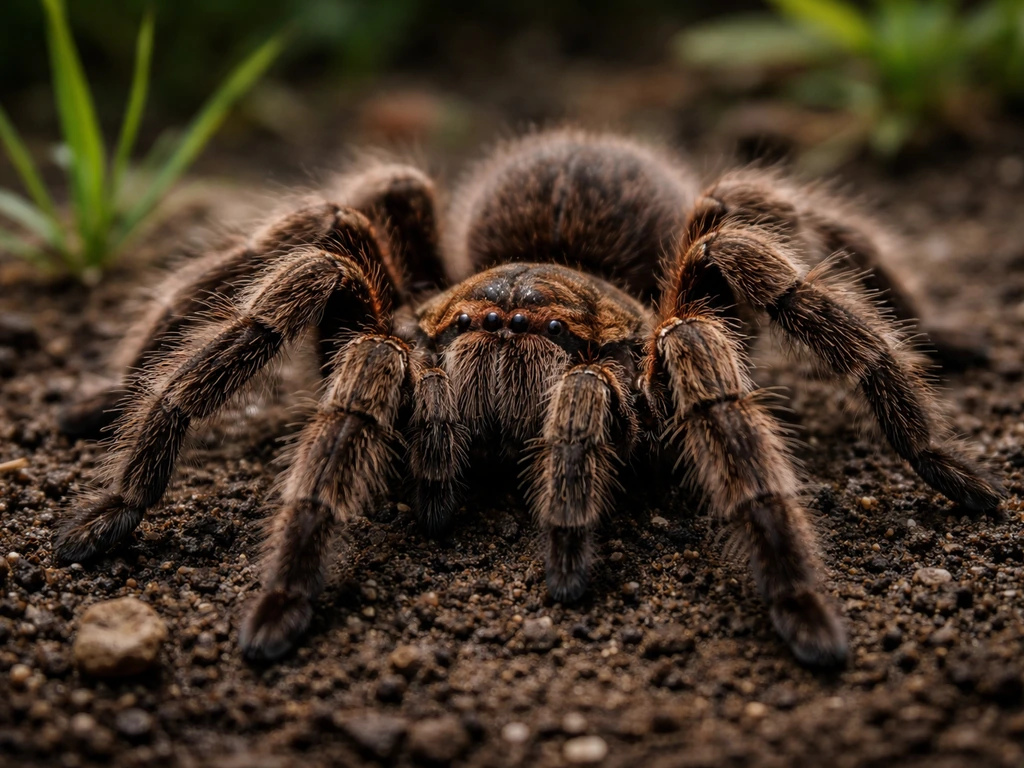
Take the spider angle. People often ask can a spider eat a bird, and the answer follows a similar pattern to the mantis: rarely, under extreme size conditions, and usually involving very small birds or nestlings. The most famous example is the Goliath bird-eating spider, whose name comes largely from an old engraving and the fact that bird predation, while documented, is rare and opportunistic. If you want to understand the spider that can eat a bird in more detail, the key point is the same as with the mantis: size overlap is the deciding factor, not raw aggression.
For anyone curious about the sheer scale of these spiders, how big is the bird eating spider gives you a real sense of why size alone makes these interactions possible but rare. And if you have ever wondered about species comparisons, the camel spider vs bird eating spider breakdown is a useful reminder that common names often exaggerate what these animals actually prey on in the wild.
If you want a visual reference for the bird-eating spider specifically, what does a bird eating spider look like is worth checking, particularly if you are a nature educator trying to separate the dramatic name from the actual biology. The pattern across all these predator questions is consistent: the internet amplifies the dramatic edge cases, but the realistic risk to typical backyard birds is extremely low.
The practical takeaway for backyard birders is straightforward. Mantises are not a general threat to garden birds. They are a specific, manageable risk to hummingbirds at feeders, primarily from large species like the Chinese mantid during late summer. Monitor your hummingbird feeders, add a protective cover, and keep the feeders clean. That covers the realistic risk. Everything else, from viral photos to 'bird-eating' spider names, is worth understanding for context, but it should not change how you manage your feeders day to day.
FAQ
Will a praying mantis attack birds that are perched away from the feeder?
It is still extremely unlikely for typical backyard birds. The documented cases concentrate near a tight feeding station, because the mantis needs to strike from close range and anchor itself where the bird repeatedly comes within reach.
Are hummingbirds safe if they are feeding on flowers instead of a feeder?
Mostly yes. The risk is highest at feeders because hummingbirds repeatedly return to the same spot, which gives a mantis more time to position itself and maintain ambush posture. If you see a mantis near dense flowering patches, the safest move is to remove it from the exact flight path, not to worry about the whole garden.
Does the time of day matter for mantis captures of hummingbirds?
Yes. Mantises are most effective when prey is active and coming within strike distance repeatedly. Practically, that means your morning and early-day feeder checks matter, since hummingbirds often use feeders heavily during peak activity.
How can I tell if a mantis is likely to be a problem at my hummingbird feeder?
Look for a mantis clinging close to the feeder ports, especially in sheltered spots where it can hide its body while keeping its head oriented toward incoming birds. A mantis positioned on or just above the feeding area is more concerning than one elsewhere in the yard.
Should I remove the mantis or can I just relocate it?
Relocating is usually the best choice. Move it away from the feeder rather than killing it, since mantises are beneficial insect predators. Use a container and gloves if needed, and release it at least several yards from the feeder to reduce immediate return attempts.
Can I use insect spray around feeders to stop mantises from eating hummingbirds?
Avoid spraying near nectar feeders. Many pesticides can harm hummingbirds and also contaminate nectar. Prevention methods that do not involve chemicals, like feeder covers, routine checks, and keeping the feeding area clear, are safer.
Do feeder types or placement affect the risk?
Yes. Open, easily reachable feeder designs and placement where a mantis can get directly above or beside the port increase the chance of an ambush. Hanging feeders with a wide protective cover and placing them where there is less natural cover nearby can reduce the opportunity for mantises to wait.
Is a mantis more likely to be around feeders in late summer?
Often, yes. Larger mantis species and the timing of juvenile-to-adult transitions can make certain late-season periods more noticeable. If you start seeing mantises near feeders more frequently in warmer months, increase inspection frequency during that window.
If I find a hummingbird killed by a mantis, what should I do next?
First, remove the remains promptly so you do not draw more insects in. Then check nearby perches, feeder supports, and any plant cover where the mantis might be hiding. In most cases, removing or relocating the mantis and adding a protective cover prevents repeat incidents.
Can a mantis eat a baby bird from a nest?
In theory, a very large mantis could capture a tiny, exposed nestling, but this is an uncommon edge case compared with feeder-related hummingbird captures. If you want to reduce even this unlikely risk, avoid placing feeder stations very close to exposed nest sites and keep an eye out for mantises around nests.
Do mantises only eat birds, or are they mostly insect predators like the article suggests?
They are primarily insect hunters. Bird captures are rare and opportunistic, driven mainly by size overlap and access. So even if you occasionally see mantises near feeders, most of their impact in the garden is still beneficial insect control.